


 Disney Channel Logo PNG
The Disney Channel logo’s animated design conveys that a lively, bright world awaits the channel’s viewers. The logo suggests the programs foster easy, fun development and learning through the studio’s special approach.
The Walt Disney Company developed Disney Channel in the early 1980s as a cable project, with Alan Wagner as its first president. It launched on April 18, 1983, as The Disney Channel, a paid service costing $10-$12 per month. Its first program was Good Morning, Mickey!, built around classic studio cartoons. By the end of 1983, the channel reached more than 611,000 homes.
The channel quickly moved into original programming. In October 1983, Tiger Town became the first cable-made film and won a CableACE Award. Broadcasting expanded to 18 hours a day in 1984, then to 24 hours on December 7, 1986. By 1990, Disney Channel reached five million homes and won its first Daytime Emmy Awards.
During the 1990s, the channel shifted from a premium subscription model toward basic cable and focused more on children and teenagers. The channel shortened its name to Disney Channel in 1997. Live-action series such as Flash Forward, The Famous Jett Jackson, and So Weird laid the groundwork for Lizzie McGuire in 2001, helping turn Hilary Duff into the channel’s first major teen star.
The 2000s brought a stronger music-driven format. The Cheetah Girls appeared in 2003, followed by High School Musical and Hannah Montana in 2006. High School Musical 2 drew 17.2 million viewers in 2007. In 2012, Disney Channel passed Nickelodeon in U.S. kids’ cable ratings, while Nickelodeon and Cartoon Network remained its main rivals. In 2019, Disney+ moved much of Disney’s youth audience to streaming.
Meaning and History
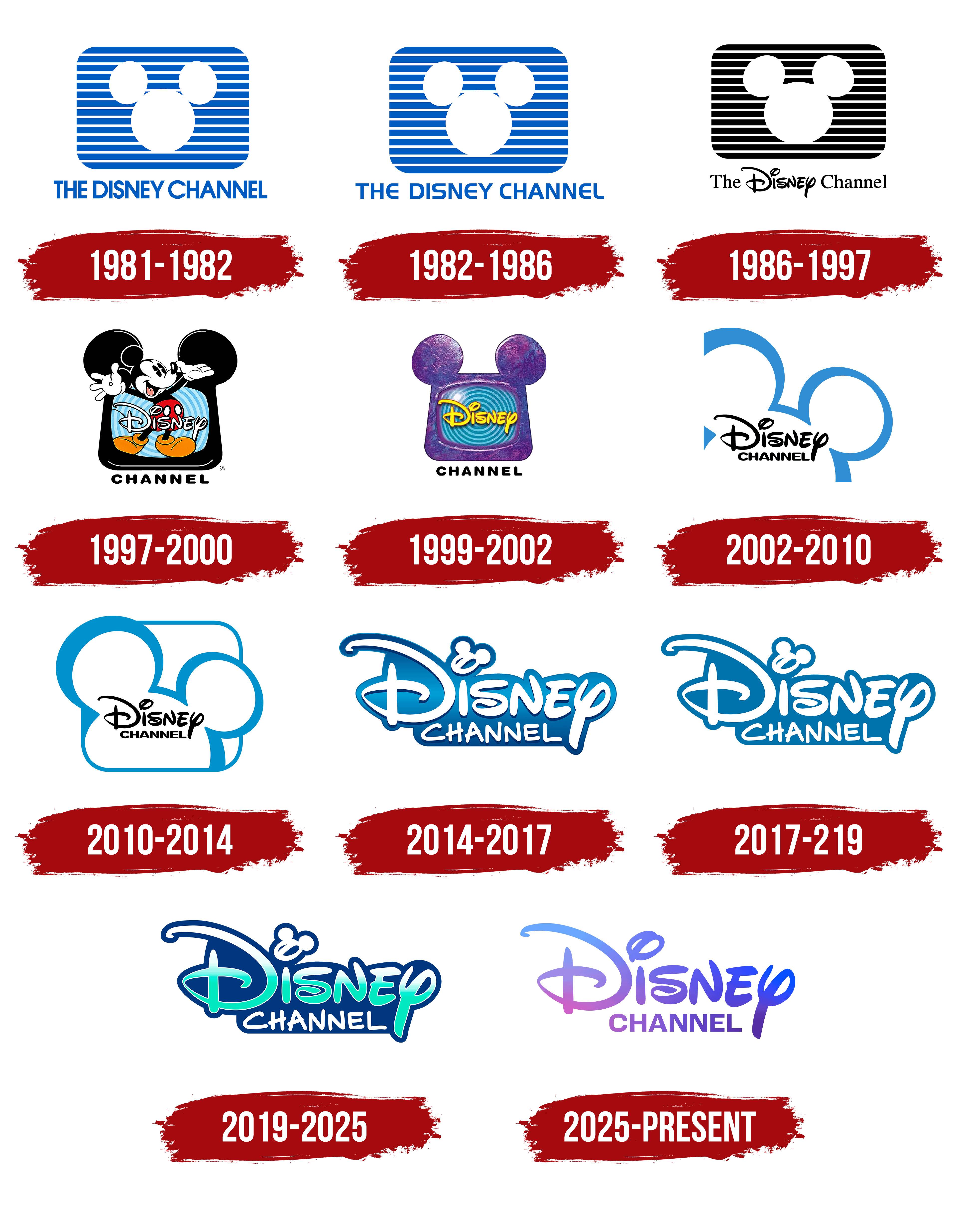
Disney Channel’s primary target audience is children and adolescents aged 9 to 16. Moreover, its audience is dynamic: as one generation grows up, another immediately takes its place. The channel must constantly adapt to new viewers in such an unstable environment. This process involves constant logo changes to keep up with current trends. Identity evolves even in small details, shifting from simple 2D graphics to 3D design. As a result, the first character is nothing like the last.
What is Disney Channel?
Disney Channel is an American television channel for teenagers and children, owned by Disney Branded Television. It broadcasts in English and is available throughout the United States. The channel airs blocks of educational and entertainment programs for preschoolers, feature films, TV series, short animated films, and other original content. The channel has existed since 1983, but has targeted younger audiences since 1997.
1981 – 1982 (prelaunch)
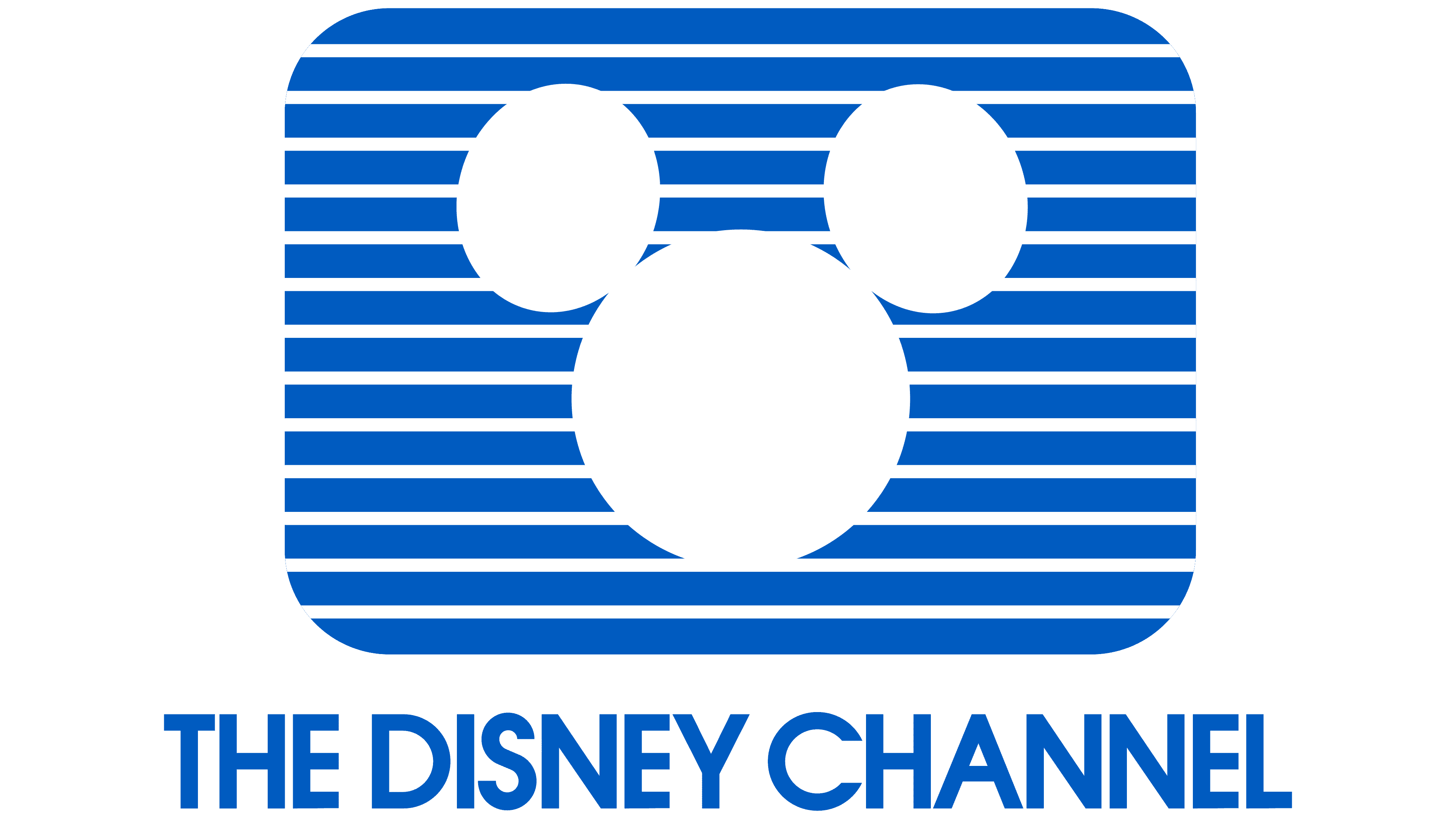
The Disney Channel name appeared before the network began broadcasting. On November 11, 1981, Walt Disney Productions announced a partnership with Group W to develop a cable network called The Disney Channel. The name combined Walt Disney’s surname with “channel,” identifying the project as part of the Disney studio. The channel went on the air on April 18, 1983. “The” remained part of its official name until 1997.
Rod Dyer of Dyer/Kahn, Inc. designed the first logo. Its introduction dates to November 11, 1981, while the earliest advertisement featuring the emblem dates to March 17, 1982. The ad was placed by Teleprompter Cable TV, a Group W cable subsidiary.
The design combined a television screen with Mickey Mouse’s silhouette. A rectangle with rounded corners represented television, while three connected circles forming the character’s head and ears linked the channel to the studio. In the blue prelaunch version, horizontal stripes separated by white gaps filled the screen. A white Mickey silhouette appeared over them.
Beneath the screen, “THE DISNEY CHANNEL” appeared in uppercase lettering based on a modified version of ITC Avant Garde Gothic. The early wordmark appeared in two styles. The first used narrow letters with geometric curves and tight spacing.
1982 – 1986
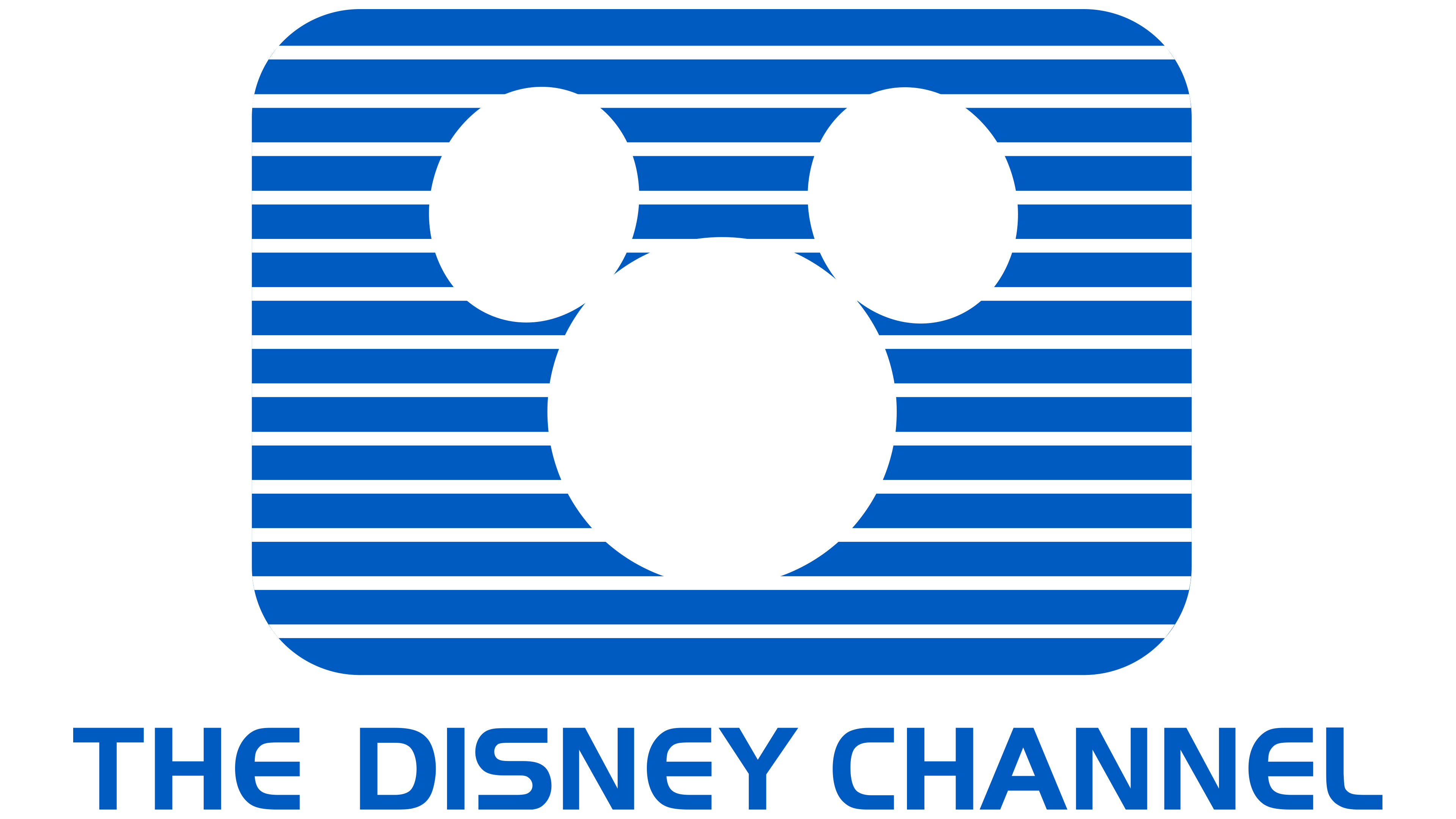
By November 1982, the lettering beneath The Disney Channel emblem had switched to Handel Gothic. The letters became wider, and greater spacing between the words gave the line more breathing room. Introduced in late 1982, this version aired on April 18, 1983, when The Disney Channel launched nationally as a premium cable channel. Its programming included the animated series “Good Morning, Mickey!”
The update changed the television screen’s proportions and the relative sizes of the three circles forming Mickey Mouse’s head. A large white circle joined two smaller ears. The silhouette emerged from the white space among horizontal turquoise stripes. The parallel lines formed a rectangle with rounded sides, resembling a television screen of the era. The striped surface and white head maintained continuity with the previous version.
The combination of a television screen and Walt Disney’s character conveyed the channel’s purpose and its studio affiliation. Its linear design earned the emblem the nickname “Line Television Cube.” The full name “THE DISNEY CHANNEL” appeared beneath it, retaining the article “THE.”
1986 – 1997

By January 1986, the Disney Channel wordmark had been brought closer to the identity of the recently renamed Walt Disney Company. Geometric uppercase letters gave way to the Disney script paired with “The” and “Channel” in a Times-family typeface. Both words began with a capital letter followed by lowercase letters. The Disney lettering featured loops, an extended upper stroke on the “D,” and an uneven baseline familiar from the studio’s corporate logo.
The striped screen retained its basic structure, with changes to individual details. The horizontal lines became thicker, and the gaps between them narrowed. Mickey Mouse’s head was raised slightly, and the ears became oval. In the black-and-white version, the black screen contained white stripes and the character’s silhouette. The black treatment was intended for light backgrounds. Alongside the full emblem, a version consisting of the wordmark and Mickey’s head was also used.
The early striped logo remained part of the channel’s historical imagery. In 2023, D23 released a glitter-finish anniversary pin featuring the original emblem to mark Disney Channel’s 40th anniversary.
1997 – 2000

Disney Channel’s transition from a premium subscription service to basic cable was accompanied by a major update in 1997. The network remained commercial-free. Its focus shifted from family programming to children, and the network dropped “The” from its name. Disney Channel and the shortened Disney entered use. The previous name remained in use for corporate purposes until 2004 and continued to appear in some international versions.
Lee Hunt Associates handled the positioning and new logo. Cuppa Coffee Studios, Cherry Bomb Studios, and English & Pockett contributed to the identity. The new emblem was announced on January 19, 1997, during the National Cable Television Association’s January press tour. It was shown at the association’s conference in March and began airing by the end of that month, ahead of the full launch on April 6. A seven-note audio signature accompanied the update.
The television became a three-dimensional black set with two round Mickey Mouse ears. Against a blue screen patterned with concentric circles, Mickey appeared in the style of his 1930s cartoons. He was shown full-length, smiling with his arms raised, wearing red shorts with two white buttons, white gloves, and large yellow shoes. His figure extended beyond the screen, connecting the television set to the illustrated scene. In animated idents, Mickey danced.
White Disney script ran across the middle of the emblem, overlapping the character’s lower body. Black “CHANNEL” lettering appeared on a separate line beneath the television. The heavy, rounded uppercase letters used Helvetica Rounded Black, while Triplex Sans Extra Bold appeared in the on-air graphics. The television, character, and prominent name suited the channel’s focus on children.
The logo appeared in a series of 27 ten-second idents created by Lee Hunt Associates for the Little Kids, Kids, and Kids & Family audience segments. The spots combined live action with animation. In one, a family riding bicycles passed through a Disney Channel logo drawn on the street and entered an animated world. In 1998, the Disney Channel Repositioning project won Gold at the New York Festivals in the television programming and promotion category for traditional animation.
A year after the rebrand, logo variations appeared for three programming blocks. The morning Playhouse Disney block served preschoolers, Vault Disney aired at night, and Zoog Disney occupied weekend slots for children and teenagers. Other characters also appeared on television. In 2000, characters were removed from the main identity. However, the original version continued appearing until 2002 in the three blocks, “Imagineer That” segments, and Disney Channel Original Movies. Toon Disney retained its character-based version until 2002.
1999 – 2002

In September 1999, Disney Channel reworked its television emblem while retaining the foundation of the 1997 version. Autonomy, Tenth Annual Industries, and Colossal Pictures contributed to the update. Mickey Mouse’s figure was removed, and the television with round ears became a three-dimensional, toy-like object. The emblem became known as the “Mickey-shaped Trinitron.”
The black casing turned blue-purple. Changes in texture, highlights, and lighting added depth to the surface. A blue-green field with concentric ovals replaced the character on the screen. Shading made the rings appear raised. The Disney script sat over the pattern, changing from white to yellow. Yellow lettering, cool screen colors, and a purple casing strengthened the emblem’s color contrast.
The separate black “CHANNEL” line remained beneath the television, connecting the update to its predecessor. It used heavy, rounded uppercase Helvetica Rounded Black, while Triplex Sans Extra Bold appeared in the on-air graphics. After Vault Disney ended in September 2002, the emblem also appeared during overnight programming until the next logo was introduced.
2002 – 2010
Disney Channel’s September 30, 2002, update was designed for 15 channels in different countries. Eleo Hensleigh, who led international branding at ABC Cable Networks Group, oversaw the work. Fifteen Disney Channel representatives and Razorfish participated in the project. Thomas Hallgren of Razorfish designed the logo. CA Square handled the brand identity, while PMcD Design created the idents. In 2003, the new identity expanded beyond its initial market.
A partial outline of Mickey Mouse’s head replaced the three-dimensional television. A light blue line of varying thickness traced the ears and part of the head, leaving the left and lower edges open. The silhouette was tilted slightly, with the right ear smaller than the left. The asymmetrical outline allowed the emblem to sit against the edge of the frame. The head and ears replaced the television casing, stripes, textures, and character illustration while preserving the connection to Disney’s heritage.
The black name appeared in the center of the white field. Disney script was paired with “CHANNEL” in a modified Helvetica Rounded Black. Some strokes in the lower line were narrowed, making the letters lighter. The emblem occupied the lower-left corner of the screen, and live-action footage and animation appeared inside its outline. Creative director Andrea Taylor wanted the identity to feel closer to children and teenagers. Green, pink, and turquoise replaced dark blue and dark red combinations, while open space within the outline replaced the older cartoon characters.
Taylor’s concept continued with the wand idents, which first aired on June 7, 2003. Actors introduced themselves and drew Mickey’s ears in the air. Director Glen Owen filmed the first spots at Raleigh Studios in Hollywood in late summer 2002. Participants held a green drumstick, with the glowing trail added in post-production. The wand referred to Tinker Bell. Celebrities, live-action characters, and animated characters appeared throughout the series.
In the idents, the spoken channel name was paired with the drawn outline and a four-note musical phrase. Alex Lasarenko composed the phrase to match the pronunciation of “Disney Channel.” After the primary logo changed in May 2010, the 2002 version continued to appear alongside the new emblem, including in Wand IDs, until 2016. It returned on channel merchandise in 2025.
2010 – 2014

Disney Channel’s May 7, 2010, update enclosed the 2002 emblem within a frame. New Wave Entertainment developed the design. A month before the full launch, the new version had already appeared in idents and promotional spots for weekend evening programming. It was used alongside the previous logo until 2014.
The light blue Mickey head outline was combined with a square frame with rounded corners. The lower portion of the silhouette joined the frame’s base, while the right ear extended beyond it. The upper part of the head, with its differently sized ears, remained visible inside. The frame resembled both a television screen and a smartphone app icon, earning it the nickname “Mouse-Shaped iPhone App.”
The white field, light blue outline, and black lettering maintained a color connection to the previous emblem. Disney script appeared above a compact uppercase “CHANNEL” line in modified Helvetica Rounded Black. Playhouse Disney received a similar version. It was used briefly before Disney Junior replaced the brand.
2014 – 2017

Work on Germany’s Disney Channel led to the 2014 logo update. BDA Creative won a competitive pitch in 2013, then developed the identity for Germany and the United States. Tim Finnamore served as creative lead, while Anika Flade provided art direction for parts of the project. UnitedSenses and Royale worked alongside Disney’s internal team. The German version debuted on January 17, 2014, and Disney introduced the updated logo in the United States and internationally on May 23.
The name filled most of the emblem, replacing the large Mickey head silhouette and square frame. Disney script appeared above “CHANNEL.” The extended upper stroke of the “D” and the lower loop of the “y” defined the wordmark’s outer boundaries. A miniature Mickey head appeared above the “i,” combining two round ears with an oval loop. The German version introduced in January had only the loop above the letter.
The blue-and-white combination remained, now with a gradient. A blue shape with light blue transitions and a light inner border surrounded the white letters. The saturated background separated the name from its surroundings. The lower “CHANNEL” line gained irregular, rounded forms resembling handwriting. Instead of a separate frame, the logo’s boundaries now followed the name’s shape.
Disney’s international team allowed idents to be adapted to local stories, families, and viewers’ everyday lives. The “D”- framed imagery remained, along with the wand idents and four-note musical phrase. Disney used the identity internationally until May 2, 2026.
2017 – 2019

The premiere of “Tangled: The Series” accompanied a Disney Channel update on March 24, 2017. Makiné Studios worked on the on-air identity. Along with new idents and other broadcast materials, the channel introduced a flat version of the existing logo.
The blue background became a solid fill, replacing the gradient and lighting effects. The boundary between it and the white letters became flat. The arrangement remained unchanged. Disney script sat above “CHANNEL,” with Mickey’s head retained above the “i.” The update was limited to color treatment and the shift from a dimensional image to a flat one. The wordmark and its surrounding shape remained intact.
The next logo became the primary version in January 2019. The 2017 design continued to be used alongside it until 2025 and remained in use on international channels until 2023.
2019 – 2025
Disney returned to a gradient in the logo in December 2018. Makiné Studios’ version appeared during “25 Days of Christmas” alongside the 2017 emblem, then entered promotional spots for “Sydney to the Max.” It became the primary logo on January 25, 2019, when the channel made a modest identity update.
The logo’s structure remained the same, with changes focused on color. The white upper portion of the Disney script transitioned to turquoise and greenish shades along the lower edges of the letters. The surrounding shape became dark blue. “CHANNEL” remained white, distinguishing it from the colored lettering above. The previous version’s on-screen logo animation continued to be used until February 29, 2020.
After later versions appeared, the emblem remained in general-purpose idents and on-screen overlays. It continued as the primary logo in many international markets. Its use alongside the 2017 version ended on February 1, 2025.
A regional Disney Channel update in 2022 changed the wordmark’s design. Developed by the channel’s Spanish team and Flopicco Studio, the identity first aired in France on August 30 before expanding to other countries in Europe, the Middle East, and Africa. Mickey’s ears, the outer outline, and the shared background shape were removed. Disney script remained above “CHANNEL,” now set in upright uppercase letters. Enlarged flourishes and strokes drawn from the Disney lettering replaced the enclosed frame throughout the identity.
Flopicco described the redesign as an effort to refresh the channel’s image and create a unified identity for viewers of any gender. The primary blue shades brought the television identity closer to Disney+. The project was described as “Funventures,” combining “fun” and “adventures.” The lettering and strokes allowed design variations while maintaining a connection to the Disney script.
2025 – today
Disney Channel’s official U.S. rebrand launched on February 1, 2025, after several advance appearances of the new emblem. It was first shown on August 29, 2024, on the first poster for “Wizards Beyond Waverly Place.” The logo began appearing on the channel’s social media pages on September 24 and entered the on-air identity for Monstober 2024 on September 30.
Makiné Studios and CLAUS developed the project. Alberto Adjar and Corina Capuano provided creative direction for Makiné, with Justin Harder serving as art director. Disney’s team included Head of Design Brian Everett, Creative Director of Motion Design Neil Weisenberg, and Senior Art Director Debra Bernard.
For the first time, the Mickey Mouse motif was removed from the logo. A plain oval loop remained above the “i” in the Disney script. The shared blue background shape was removed, opening the space around the name. The gradient moved inside the letters, blending light blue, purple, and pink. Beneath Disney, “CHANNEL” appeared in bold sans-serif lettering with vertical strokes, based on a modified Cobe Extra Bold.
Mickey’s ears remained in the broader channel identity alongside an enlarged “D” and portions of the script’s flourishes. Repeated shapes, color transitions, and open areas within the frame united the broadcast materials with other applications. The team prepared seasonal versions, including Halloween and winter holiday designs. The team removed the four-note audio signature introduced in 2002 from the main package but retained it in Wand IDs. Disney Channel Rebrand 2025 won Gold at the Collision Awards in the Corporate Communication category.
Font and Colors
The modern symbol combines the recognizable shape of the Mickey Mouse head with the stylized Walt Disney signature. These elements represent the channel and the company’s legacy. Notably, the designers chose not to follow the path of simplification: they complicated the emblem despite the trend toward minimalism.

Because the logo consists of lettering, the designers paid close attention to typography. The designers used the proprietary Walt Disney Script font for the first word, based on the Walt Disney signature, and the equally original Placard Bold Condensed for the second, which looks handwritten. The main colors are white, blue, and turquoise in various shades.