 Ram Logo PNG
Off-roading in this pickup isn’t scary. This is the direct message that the Dodge Ram logo, a horned ram, carries in this series of cars. Strong horns indicate the car’s reliability, a stubborn look suggests high cross-country ability, and a powerful forehead suggests a strong body. The symbol balances identity and technical characteristics. It is associated with powerful pickup trucks designed for heavy work and challenging conditions. Highlights the reliability, strength, and practicality of vehicles valued for their ability to handle any task.
Dodge trucks began in 1918, when brothers John and Horace Dodge produced their first truck under the slogan “Dodge Brothers’ Business Car.” In 1928, Walter Chrysler acquired the company, and the iconic ram’s head hood ornament debuted in the 1930s.
The Ram name debuted in 1981 with the Ram and Power Ram pickups, classified as 150, 250, and 350 by payload capacity. In 1994, the second generation appeared, featuring distinctive styling inspired by heavy-duty trucks. The third generation, launched in 2002, introduced modern technologies and enhanced engines, including the powerful Hemi V8.
In 2009, Ram became a standalone brand separate from Dodge within Chrysler. Recent generations have featured luxurious interiors and advanced technologies, particularly in higher trim levels. In 2021, the brand became part of Stellantis, and Ram introduced the extreme Ram 1500 TRX model, featuring a 702-hp engine. The refreshed 2025 Ram introduced the new six-cylinder Hurricane engine, continuing the brand’s tradition of power and reliability.
Meaning and History
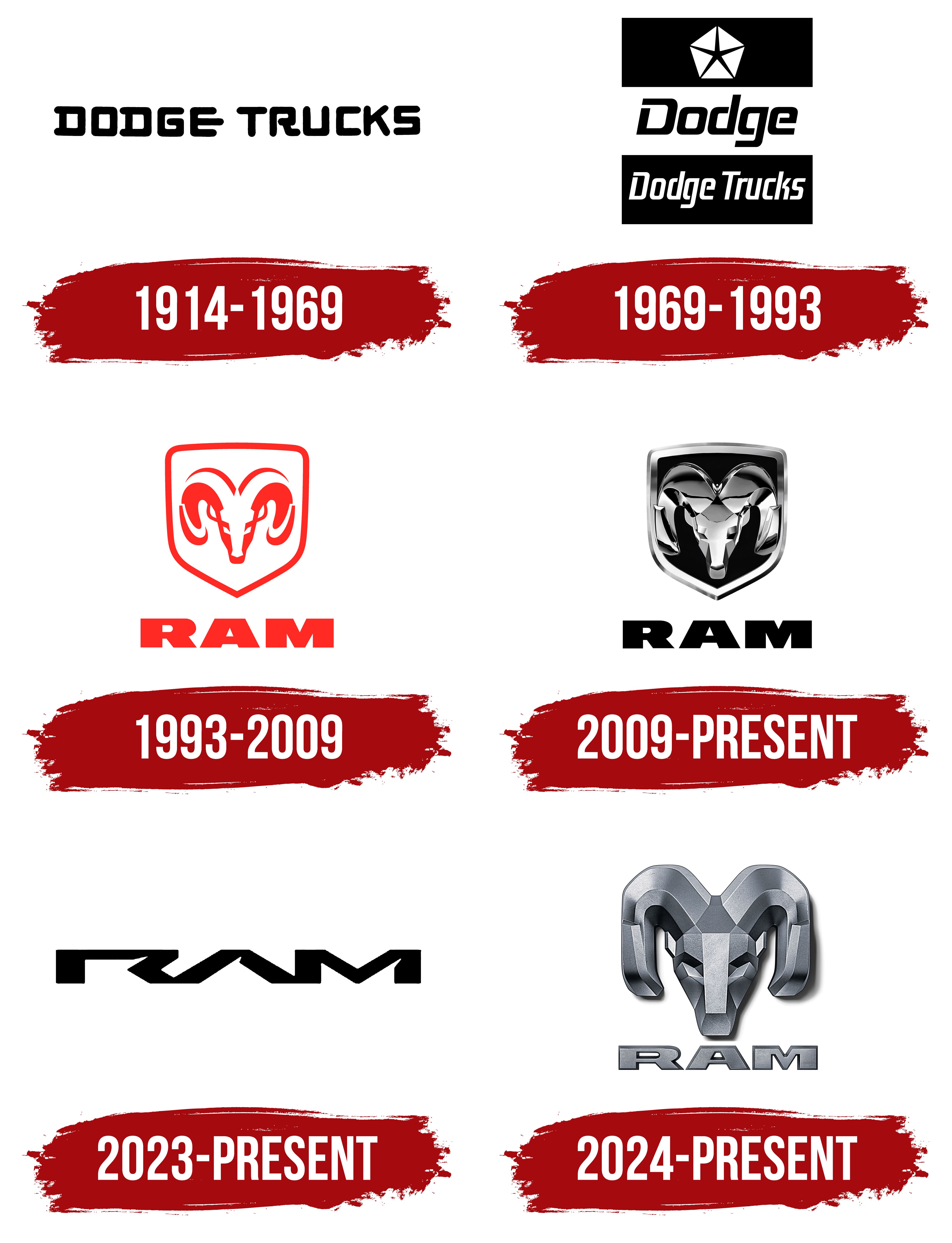
Despite the frequent changes in the style and design of light trucks, the brand’s logo has remained largely unchanged. What changed most was the company’s identity mark as it expanded and transformed. This can be traced back to the years when updated emblems appeared. The brand had many, dating back to the founding of the automobile enterprise by brothers John F. Dodge and Horace E. Dodge.
What is Ram?
It is an American automotive brand producing powerful pickup trucks and commercial vehicles. After separating from a well-known automotive corporation, the brand adopted the ram, a symbol of reliability. Farmers, construction workers, and outdoor enthusiasts favor its vehicles for their comfortable interiors, powerful diesel engines, and modern technology.
1914 – 1969
The logo is wordy. It contains only the inscription “Dodge Trucks.” It appears on a single line in a stylized square font. The inter-letter space is narrow, and the inter-word space is wide. Each character is unique. The “D” has flat serifs protruding to the left. The “O” and “G” are identical; they look like squares with no serifs. “E” has an elongated horizontal stripe in the center, so the letter resembles a right-pointing pitchfork. The “U” and “C” are the same. They appear to repeat each other but face different directions, forming wide staples. The black-and-white lettering immediately draws the eye.
1969 – 1993
After the redesign, the logo was divided into three parts. The upper rectangle displays a pentagon with a narrow star at its center. Each ray rests in a separate corner. At the bottom, the company’s full name, “Dodge Trucks,” appears on the same black background. The letters are stenciled, bold, stretched upward, and sans-serif. It contains the abbreviated brand name, simply “Dodge.” These symbols are wider and squarer than the previous ones; the inscription combines uppercase and lowercase letters.
1993 – 2009
While working on the second and third generations of Ram trucks, the company changed both the logo and the name, renaming it Dodge Ram. However, that was the name of the trucks produced in 1981. Those were the upgraded Ram and Power Ram, which replaced the Dodge D-Series. The brand took its original name from the hood’s decor. The cool-horned ram’s head print first appeared on Dodge cars in the 1930s. The animal is positioned directly and appears menacing in profile, its horns pointing forward. The image of the ram is double: one red (external), the other white (internal), projecting from the negative space. At the bottom, “Ram” is written in columnar letters.
2009 – today
While retaining the lettering style, the designers completely redesigned the graphic part. They kept the shield and the ram image but changed the design. Now, a three-dimensional chrome head with a gradient from light gray to lead is looking from the hood of the Ram truck. The professional combination of shadows and highlights creates a 3D effect. At the same time, they are not scattered chaotically but arranged in a structured (even mirror-like) way. The head and horns fill the entire inner space of the metalized shield with a volumetric frame.
2023 – today (electric models)
In 2023, RAM experimented with a new identity as it entered the electric-vehicle market, subtly updating its logo. The brand moved away from aggressive horns and heavy metal by introducing a new symbol: the word “RAM” set in an unconventional typeface. The entire inscription is black, with simple, sharp, geometric lines, and the letters “R” and “A” are missing their horizontal strokes. The result feels fresh and slightly futuristic, highlighting the company’s new electric direction.
The letters connect to form a unified shape, while small triangular cutouts in the upper-right corners add lightness and motion. With the launch of its electric vehicle lineup, the company chose to present itself in a new light, moving away from familiar ruggedness toward modern technology and minimalism.
2024 – today
The Ram Trucks logo became the brand’s official emblem in 2024, following its complete separation from Dodge. The new visual style reflects the brand’s independent, robust character, strongly associated with heavy, high-performance vehicles.
The design composition features a three-dimensional ram’s head crafted in a heavy-metal style with a rugged, faceted surface. Aggressive, sharp lines and pronounced edges suggest forged metal. The ram’s horns curve forward and downward, forming a silhouette poised for a forceful charge and symbolizing the overcoming of obstacles and the power inherent in the brand’s vehicles.
The steel-gray color palette, with a noticeable gradient from light silver to dark gray, conveys durability, technological advancement, and premium product quality. The metallic texture underscores the industrial nature and creates a visual illusion of heaviness, reinforcing the perception of the brand as a manufacturer of powerful trucks built to endure harsh operating conditions.
The brand name “RAM” is rendered in a bold, geometric sans-serif font with an intentionally rough texture and solid proportions. This typeface, similar to Optiflare, features wide glyphs with horizontal extensions that reflect the vehicles’ physical strength and stability. The letterforms emphasize solidity, toughness, and reliability.
The ram image was selected because this animal traditionally symbolizes perseverance, strength, determination, and dominance. The visual concept aligns with the brand’s philosophy, targeting customers who need vehicles that can handle challenging tasks in extreme conditions.
This emblem has been introduced across the entire Ram lineup, including the key pickup models 1500, 2500, and 3500. It appears prominently on radiator grilles, body components, and in marketing campaigns and communication materials, ensuring a cohesive brand perception and recognition in the truck market.
Font and Colors
The evolution of the Ram Trucks logo closely paralleled the company’s development and its vehicle offerings. The logo underwent another update during the most critical stages to enhance the features of the branded vehicles. It is worth noting that the symbol evolved from simple to complex, a characteristic not shared by all brands, as there has been a recent tendency to simplify.
For the pickup truck manufacturer’s modern emblem, the Optiflare font was chosen, with squat, wide, sans-serif letters. The characters’ lines are smooth, bold, and flat. The signature palette features a classic black-and-white combination. The 1993 version also features red.