


 Dolby Atmos Logo PNG
The Dolby Atmos Logo is a set of easily recognizable visual symbols that connect the company to the theme of sound. The emblem’s elements hint at new approaches to sound-range transmission, offering unforgettable listening experiences.
Emerging from the innovative labs at Dolby Laboratories, Dolby Atmos debuted in 2012, adding a new dimension to the cinematic audio experience. Its first public showcase came in Pixar’s film “Brave,” released that same year. Unlike traditional surround sound setups, Dolby Atmos introduced elevation channels to the audio landscape, allowing for a captivating three-dimensional sound environment.
By the end of its launch year, Dolby Atmos had been incorporated into around 25 installations worldwide. However, that number skyrocketed to over 300 the following year and, astonishingly, surpassed 10,000 by October 2022. This rapid adoption testified to the system’s groundbreaking impact on sound technology.
2014 was pivotal for Dolby Atmos as it transitioned from the big screen to personal home theaters. Home-compatible Blu-ray players and AV receivers that supported the technology began hitting the market later that year. Dolby Atmos has since expanded through partnerships with streaming giants like Netflix, Disney+, and Apple TV+, enabling Atmos-supported audio streaming for those with compatible home setups.
Dolby hasn’t confined the Atmos experience to large setups; the technology has been fine-tuned to suit mobile devices, headphones, personal computers, and gaming consoles. Even standard stereo content can now emulate an Atmos-like experience through specialized audio processing on these platforms.
Today, Dolby Atmos is not just another name in the surround sound lexicon; it has become a leading choice for audiophiles in cinema and personal entertainment settings. As the technology matures, Dolby Laboratories continues to explore innovative avenues to make audio experiences increasingly immersive.
Meaning and History
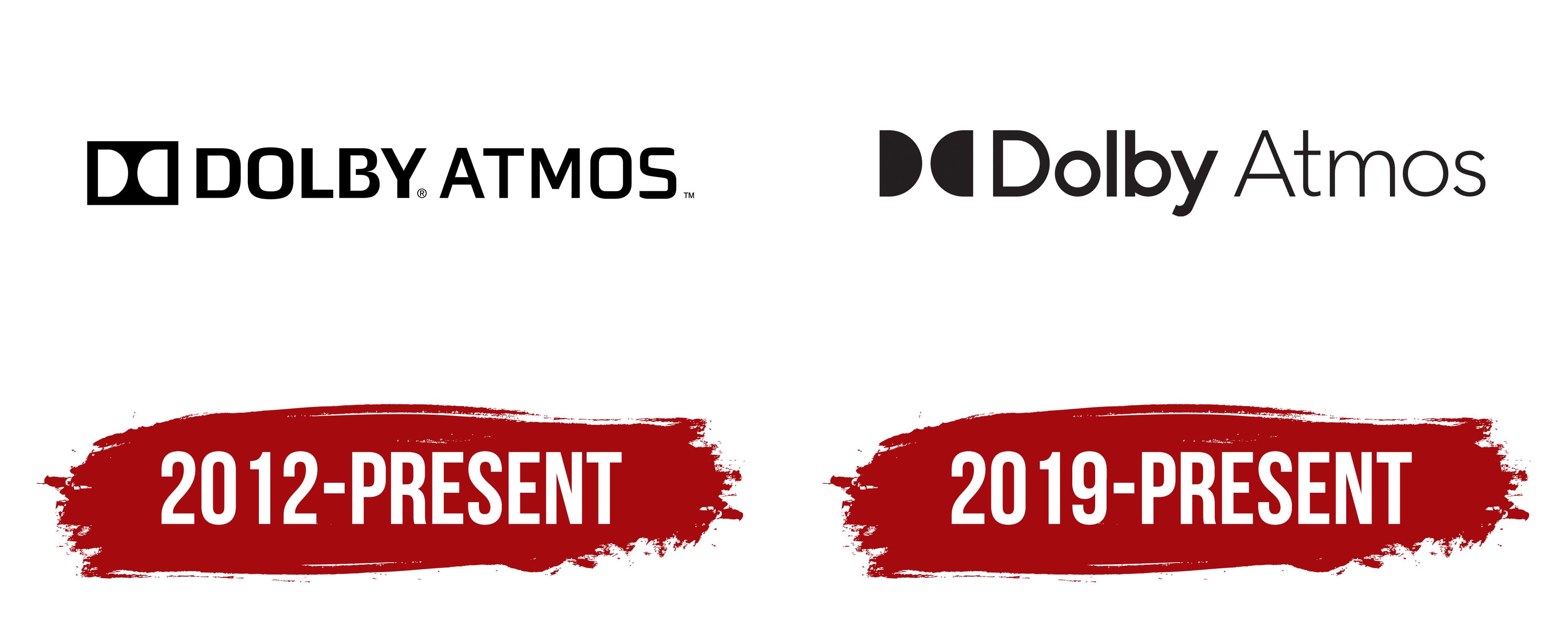
The product’s emblem closely resembles the parent company Dolby Laboratories’ logo, almost replicating it, except with the original name “Atmos”. The first installation took place at a Los Angeles movie theater before the 2012 screening of the animated film Brave, when the logo was introduced. The 2019 rebranding, which occurred concurrently with the Laboratories rebranding, aimed to strengthen ties with the latter.
What is Dolby Atmos?
A modern sound transmission technology that adds depth to music and maximum realism to movies. Introduced for video as Dolby Atmos and for audio as Dolby Atmos Music. The product’s essence lies in dividing sound into central dialogue or singing and surrounding objects. Listeners can distinguish up to 16 simultaneous elements.
2012 – today
The system’s logo consisted of an image and an inscription. A black rectangular graphic element was positioned at the beginning of the composition. Two white semi-circles pointing in different directions were drawn inside the figure. The rectangle symbolized:
- A movie theater screen. In 2012, the system debuted as a product for 3D theaters.
- A closed space, a room where sound spreads.
- A speaker with two drivers.
The halves resembled headphones to convey the idea of surround sound. The different directions indicated that the system’s speakers are placed at various points in the room, filling the space with sound waves and creating a sense of full presence.
The name was placed to the left of the graphic element. The main feature used words in varying thicknesses. Thin characters in Atmos emphasized that the word represents Dolby-branded technology. Capital letters indicated greater clarity, loudness, and sound depth.
2019 – today
By 2019, the parent company updated its mark, which affected the Atmos logo.
Two speakers on the emblem were positioned freely, without a background. The disappearance of borders indicated:
- The widespread adoption of the technology. 6,000 theaters worldwide were using the technology.
- The system’s rollout is beyond theaters in a broad range of gadgets. Atmos has been adapted for home-theater music streaming services and released as software for smartphones and other devices, enabling anyone to record in Dolby Atmos.
The technology’s unique feature is its ability to direct specific sounds to specific locations around the viewer, including the ceiling. If cavalry passes in front of the hero on screen, an enemy sneaks up from behind, and a squirrel jumps from a tree above, Dolby Atmos lets the viewer hear each sound coming from the correct direction. The logo’s lack of borders highlights these capabilities.
The switch from a dark background to a light space hints at the emergence of the Dolby Cinema system, which combines Atmos audio technology with Vision visual technology to create a new, boundary-free reality for the viewer.
Font and Colors
The logo’s color scheme is built on the contrast of black and white, emphasizing the wide range of sounds, from the lowest to barely audible squeaks, that are distinguishable with Dolby Atmos. The contrast embodies the idea of revolutionary innovation.
The inscription’s font is smooth and flowing. The stark contrast in word thickness reflects the emergence of Cinema. Atmos is now just one component of a larger system. Hence, the lines of the word are thinner. Dolby, conversely, is the primary brand. New technologies will change. Consumers should remember the owner’s name, so the word glyphs should be much more prominent and instantly eye-catching.