


 Dole Logo PNG
The Dole logo has an unusual style that evokes the company’s agricultural roots. It’s cute, gentle, and appealing. It radiates positive energy, with rays that emit soft light. As a result, the emblem glows from the inside out, underscoring plants’ importance in human life.
Dole grew from two business lines in Hawaii. In 1851, former Boston missionaries Samuel Northrup Castle and Amos Starr Cooke founded Castle & Cooke, first as a trading firm and later as a sugar investor. By 1894, it had become Castle & Cooke Co., Inc., one of Hawaii’s “Big Five” companies in sugar, shipping, and banking.
The second line began with James Drummond Dole, a Harvard graduate who arrived in Hawaii in 1899 with $1,000. In 1901, he founded the Hawaiian Pineapple Company in Wahiawa on Oahu. The first shipment of canned pineapples reached the U.S. mainland in 1903. In 1911, engineer Henry Ginaca created a machine that peeled, cored, and sliced up to 100 pineapples per minute, changing the economics of canning.
By 1918, the company produced one million cases of pineapple a year. In 1922, Dole bought Lanai for $1.1 million and turned more than 20,000 acres into a pineapple plantation. To finance the deal, he gave Castle & Cooke’s affiliate a 33% stake. By the late 1920s, Hawaiian Pineapple grew over 75% of the world’s pineapples. The Dole name first appeared on cans in 1927, and in 1933, it covered the full product line after Castle & Cooke took control during the Depression.
Castle & Cooke fully acquired Hawaiian Pineapple in 1961 and kept the Dole brand. It later added Standard Fruit, Bud Antle, and operations tied to bananas, salads, dried fruit, and nuts, competing with Chiquita Brands International. David Murdock bought Castle & Cooke in 1985 and renamed it Dole Food Company in 1991. After deals with ITOCHU and Total Produce, Dole plc was formed in 2018 and listed on the New York Stock Exchange in 2021.
Meaning and history
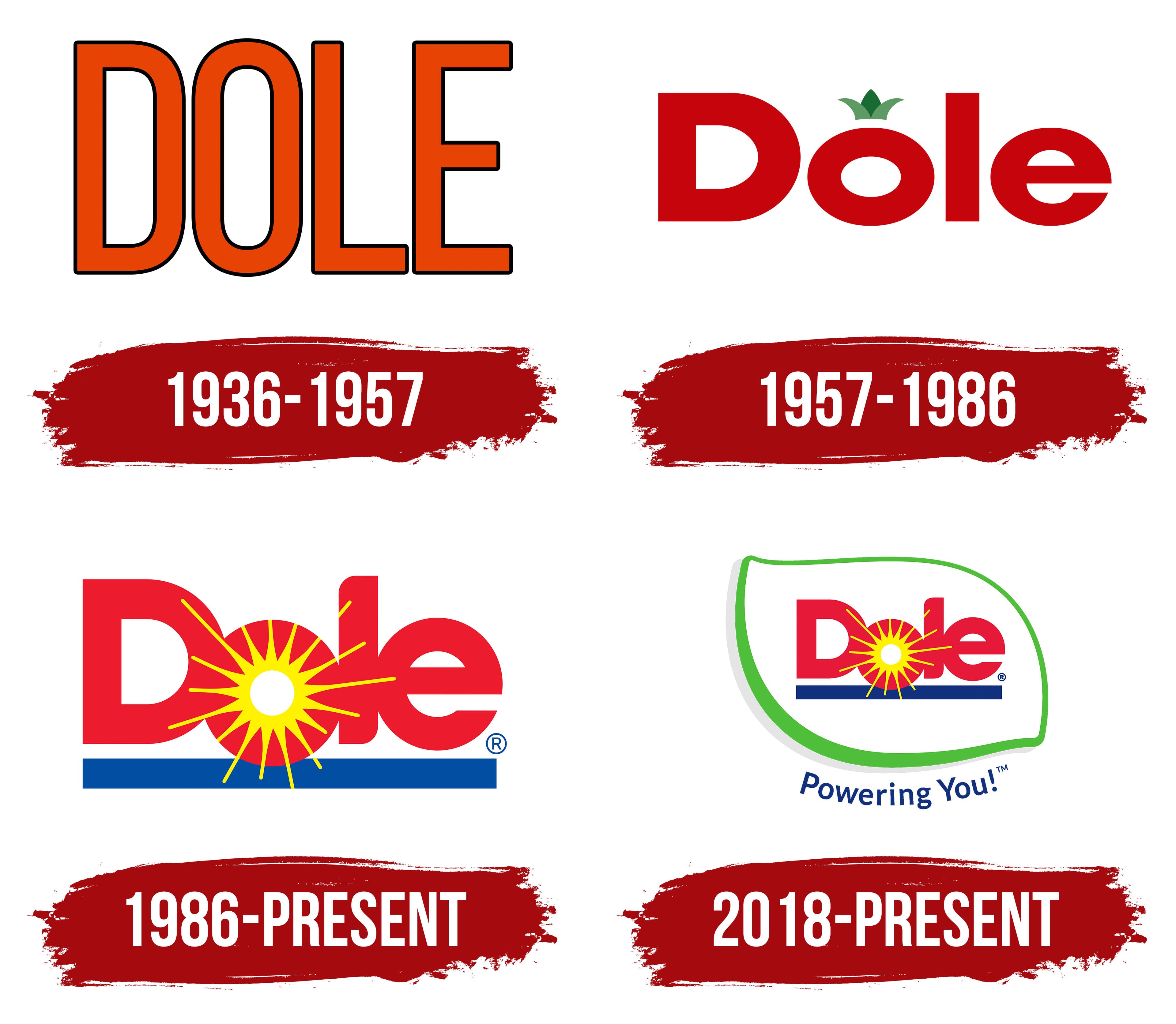
Brand recognition is high. And Dole’s vast experience is not the main factor. The logo, which has hardly changed during this time, has a greater influence. In total, the target audience was shown four versions of the logo. Overall, the redesign involved small changes that made it more modern and attractive to the target audience.
What is Dole?
This is one of the most famous brands in the agricultural industry. The company has operated for more than 150 years and has gained immense popularity with millions of buyers.
1936 – 1957

The first version of the logo was presented to the public in 1936. Typically, it featured a red inscription with the brand name on a dark blue background. The letters in the word “DOLE” were not on the same line, which created the effect of “waves.” The title used a classic bold sans-serif font with rounded corners.
1957 – 1986
The first redesign made the logo more modern and attractive. The red inscription remained unchanged, but it became more saturated and confident. All letters were on the same line. The most notable update is the crown above the “O.” Visually, it looks like a pineapple. The target audience immediately liked this logo, so it is not surprising it lasted more than 30 years.
1986 – today
The current logo appeared in 1986. A brighter shade has been used since. Also experienced updates and changes to the style of letter writing. At this stage, a smooth sans-serif font was used. Spaces between characters have been removed. A blue horizontal line appeared under the wordmark. The crown disappeared, and an abstract sun image appeared inside the letter “O.” The rays also touched the neighboring “D” and “L.” Perhaps the shade of red is associated with this element’s appearance.
2018 – today
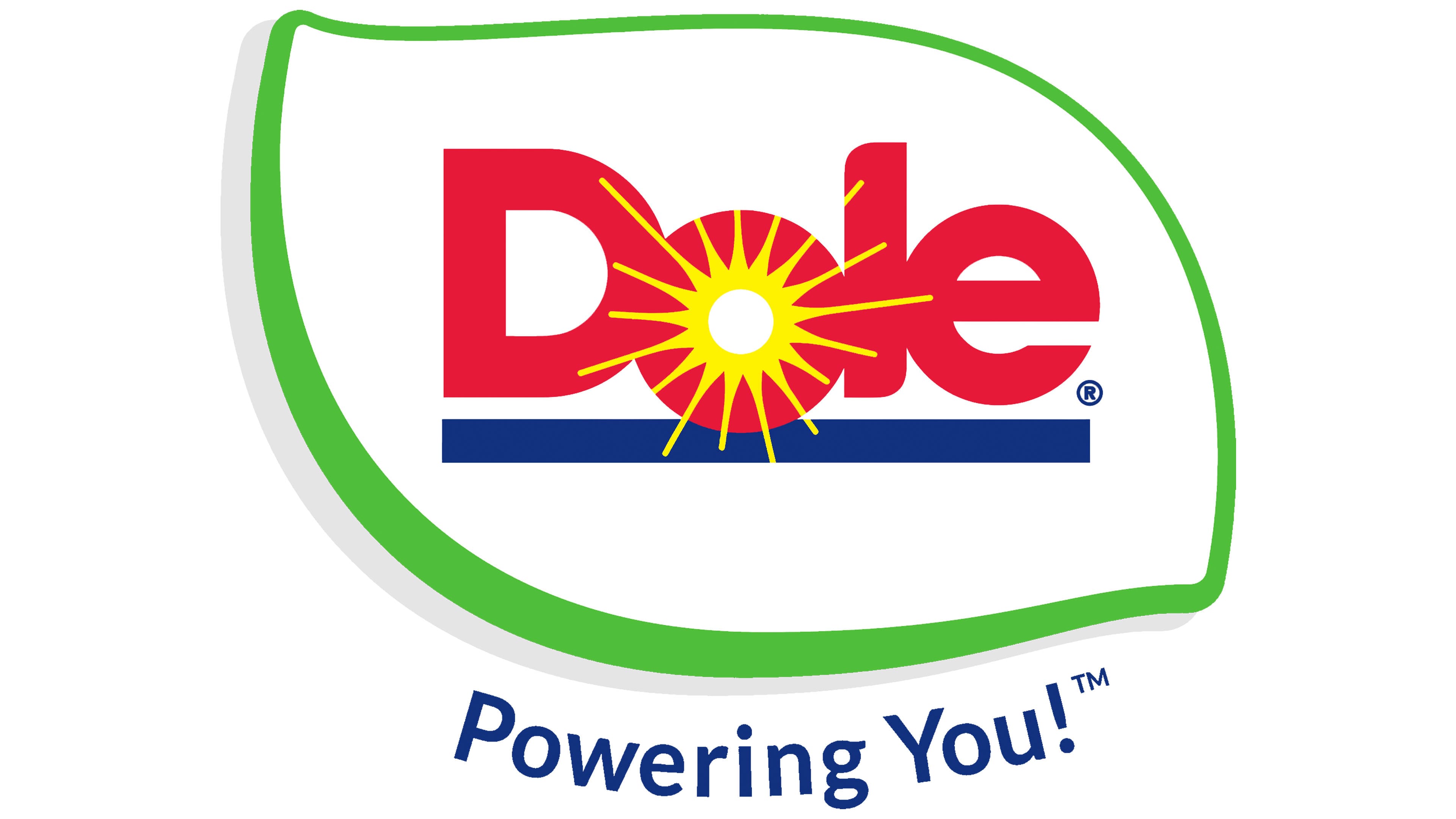
Overall, this redesign did not change the verbal inscription. However, a white frame with a thick green outline appeared around it. Visually, it resembles a tree leaf.
Font and Colors

Throughout the Dole company’s development, a generally identical bold sans-serif type with rounded letter corners was used. However, the letter arrangement varied. In some versions, “dancing” symbols replaced spaces, and in others, the brand name appeared on the same line without “unique” elements.
Traditionally, the red-and-blue color palette is considered the brand’s main one. It conveys passion and a desire to continue developing. At the same time, yellow and green are sometimes used as additional shades. They may be associated with the sun and life. These qualities are necessary for a modern agricultural company.