


 Dom Perignon Logo PNG
The drink’s emblem evokes comfort at home and universal love. This brand’s wine is drunk in sincere company and leaves an unforgettable aftertaste. The Dom Pérignon logo honors traditions and recipes passed down through generations.
Dom Pérignon traces its name to Pierre Pérignon, born in 1638 in eastern France. At 19, he joined the Benedictines and, in 1668, arrived at the Abbey of Saint-Pierre d’Hautvillers near Épernay. The monastery was struggling financially, so he took charge of its cellars and winemaking, a role he held for 47 years.
Champagne was not highly valued then, and people often treated bubbles as a defect. Pérignon did not invent sparkling wine, but he improved the process. He worked with black Pinot Noir, blended grapes from different vineyards, favored early harvesting in cool conditions, and promoted corks over wooden stoppers. His wines reached Paris and London, where Louis XIV admired them.
Moët & Chandon, founded in 1743, bought Hautvillers Abbey in 1823. The 1921 harvest later formed the basis of the first Dom Pérignon release, sold in 1936 through Simon Brothers & Co. Demand rose quickly, including a 100-bottle order from James Buchanan Duke. Until the late 1940s, Dom Pérignon was still tied to Moët & Chandon’s vintage reserves. After World War II, it became a separate cuvée, and the first rosé appeared in 1959.
In the prestige champagne segment, Dom Pérignon long competed with Louis Roederer’s Cristal, created in 1876 for Russian emperor Alexander II. Moët & Chandon merged with Hennessy in 1971, and later with Louis Vuitton in 1987, to form LVMH. The group later included brands such as Tiffany, Dior, and Givenchy. Around 2016, Dom Pérignon replaced the Œnothèque label with the P2 and P3 plénitude system for aged releases.
Meaning and History
Moët began selling even before the invention of fermentation, remuage, and the concept of “vintage champagne.” He supplied wines to the court of Louis XV. Napoleon and Jefferson were connoisseurs of his drinks. The famous house is also mentioned in Pushkin’s poems. And today, champagne from the house of Moët is served at the table of the Queen of Britain. Therefore, the words “elite” and “antique” suit this company’s products perfectly.
Manufacturers also chose a loud name for their brand. Perignon is the name of a monk who improved champagne production technology. The prefix “House” appealed to a clergyman (from the Latin dominus, meaning “lord”). The monk managed the monastery’s food and paid close attention to wine, as the abbey owned large vineyards. His inventions include blending and preserving wine by bottling it to trap carbon dioxide bubbles. Moët & Chandon bought the vineyards from the Abbey of Perignon in the early 19th century, so the owners decided to associate their drink with the monk’s name.
What is Dom Perignon?
This champagne represents the pinnacle of premium quality, produced by Moët & Chandon, which focuses exclusively on vintage champagne crafted from the finest grape varieties harvested in exceptional years. A harmonious blend of Chardonnay and Pinot Noir grapes, selected from premier and grand cru vineyards in the Champagne region, embodies the highest standards of Champagne in every bottle. The brand’s distinction lies in its commitment to capturing each vintage’s uniqueness, allowing every release to tell its story through diverse flavor profiles with notes of rich tartness, delicate minerality, fresh citrus, and white flowers.
The brand was immediately positioned as vintage, as it appeared before Prohibition in 21 and hit the foreign shelves only in 1936. This helped drive sparkling wine’s popularity. Lawrence Venn, an English advertiser for a company that imported the product, selected the visual image as the most elite. A year before the first delivery, copies of the wine were personally sent to the best customers who had advertised the champagne even before it appeared.

The logo is the brand’s name, set in softly rounded capital letters, as if Perignon had signed the bottles. Below is an image of an English heart-shaped shield. The shield reminds us:
- heart (a symbol of the love of the monk and the company for their business and product)
- tulip (as an association with the elite royal flower. In Europe in the 17th- 18th centuries, when the company appeared, bulbs could cost an entire estate, and only very rich seniors could afford to buy them)
- A glass of champagne because the drink gives a whole bouquet of tastes
- Grape brush.
The logo hints at knightly prowess, the era of tournaments, and kings. It also symbolizes the vine, a royal drink with a noble past.
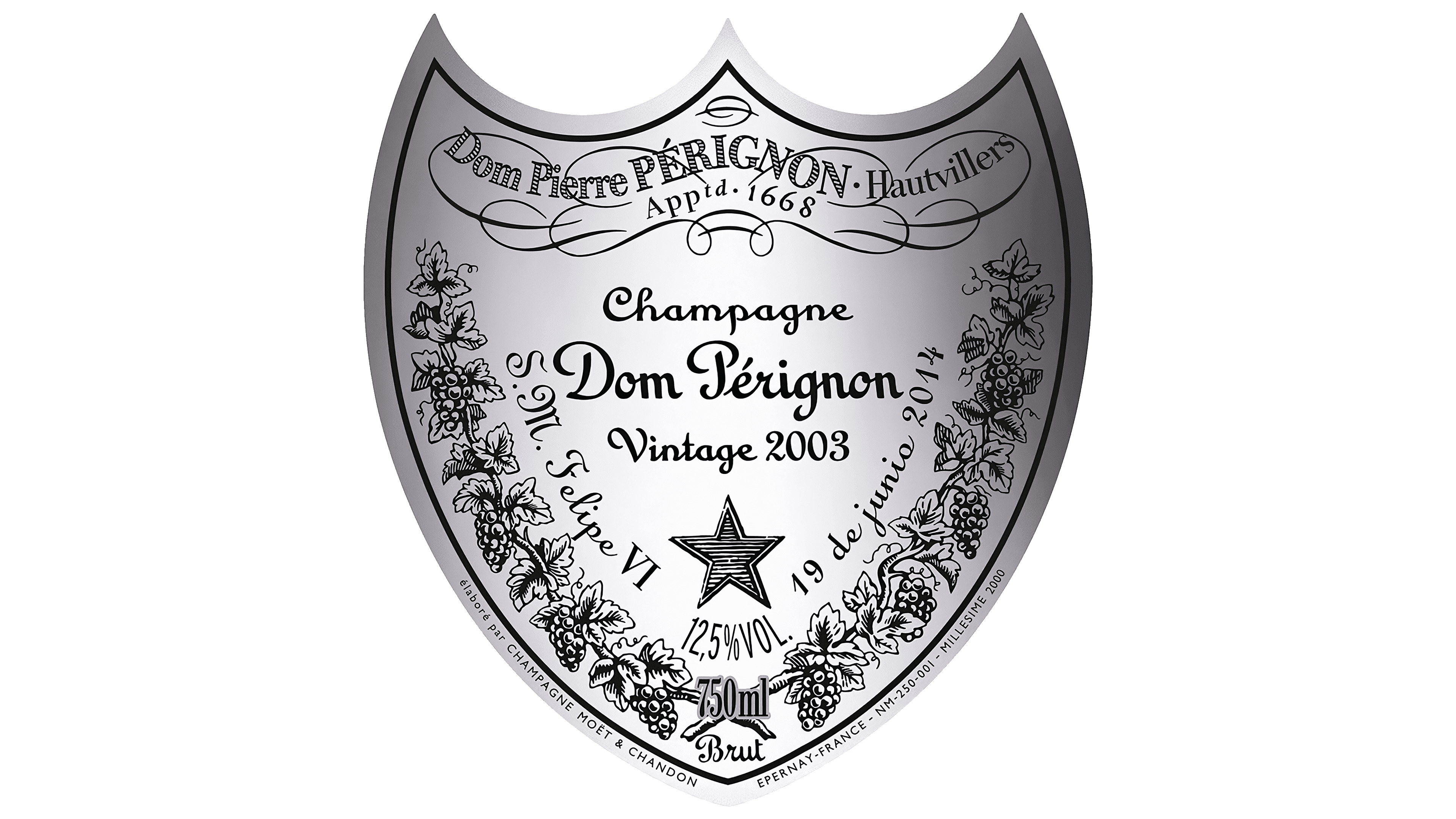
The brand’s label uses the same heart shape. The shield is decorated with vines and bunches of grapes, and has the color of old oak corks, which Perignon first used to seal his products. The brand’s name appears on the label, indicating that the champagne comes from the Abbey of Ovillers. The inscriptions are in an ornate, old-style font. Along the edges of the label, it says this is a French product made at Moët & Chandon in Champagne.
The brand constantly emphasizes its exclusivity. For example, in 2007, for Christmas, a set of six bottles and three glasses of champagne was sold in a Lagerfeld-designed bass-and-lambskin guitar case. It cost about 100,000 dollars.
Font and Colors
The handwritten font, French Script MT, is used for the emblem, which should resemble a monk’s handwriting. The emblem also uses the noblest colors: black and gold. Black represents honor and power, helping the company stand out. Black also hints at monastic attire. Gold is the color of kings, a symbol of luxury. This is how champagne, an elite brand, positions itself. A bottle of Dom Pérignon on the table signals luxury.