


 Drexel Dragons Logo PNG
Since 1985, Drexel University has been represented by athletes from the school’s teams, known as the Drexel Dragons, whose logo is “fierce” and vivid. The mascot, derived from Eastern mythology, accurately reflects the brand’s philosophy, the hidden meaning of its name, and the ambition to always reach new heights.
Drexel University’s athletic history began in 1895 with a 26:1 basketball win over Temple College. Early teams used names like Drexelites and Engineers before adopting the Dragons identity, later reinforced by the mascot Mario V. Mascioli.
In 1958, Donald Yonker’s soccer team finished 12:0 and was named national champion by the Intercollegiate Soccer Football Association of America. That title remained outside NCAA recognition but became a key part of the program’s record.
Earlier, women’s rifle teams had already won national titles in 1947, 1949, 1950, 1952, and 1954. In 1957, men’s basketball debuted in the first NCAA Division II tournament.
The move to Division I began in 1973. Under Bill Herrion in the 1990s, Drexel reached the NCAA Tournament three times. In 1996, Malik Rose led the program to a win over the Memphis Tigers before losing to Syracuse, marking the program’s only tournament victory.
Women’s basketball reached a milestone in 2009, ending Old Dominion Lady Monarchs’ 17-year run and winning the Colonial Athletic Association. In 2013, the team secured the Women’s NIT title.
Men’s lacrosse upset Virginia in 2007 and won its first conference title in 2014, reaching the NCAA Tournament. In 2018, Drexel set a Division I record comeback against Delaware, and in 2021, returned to NCAA play.
Meaning and History
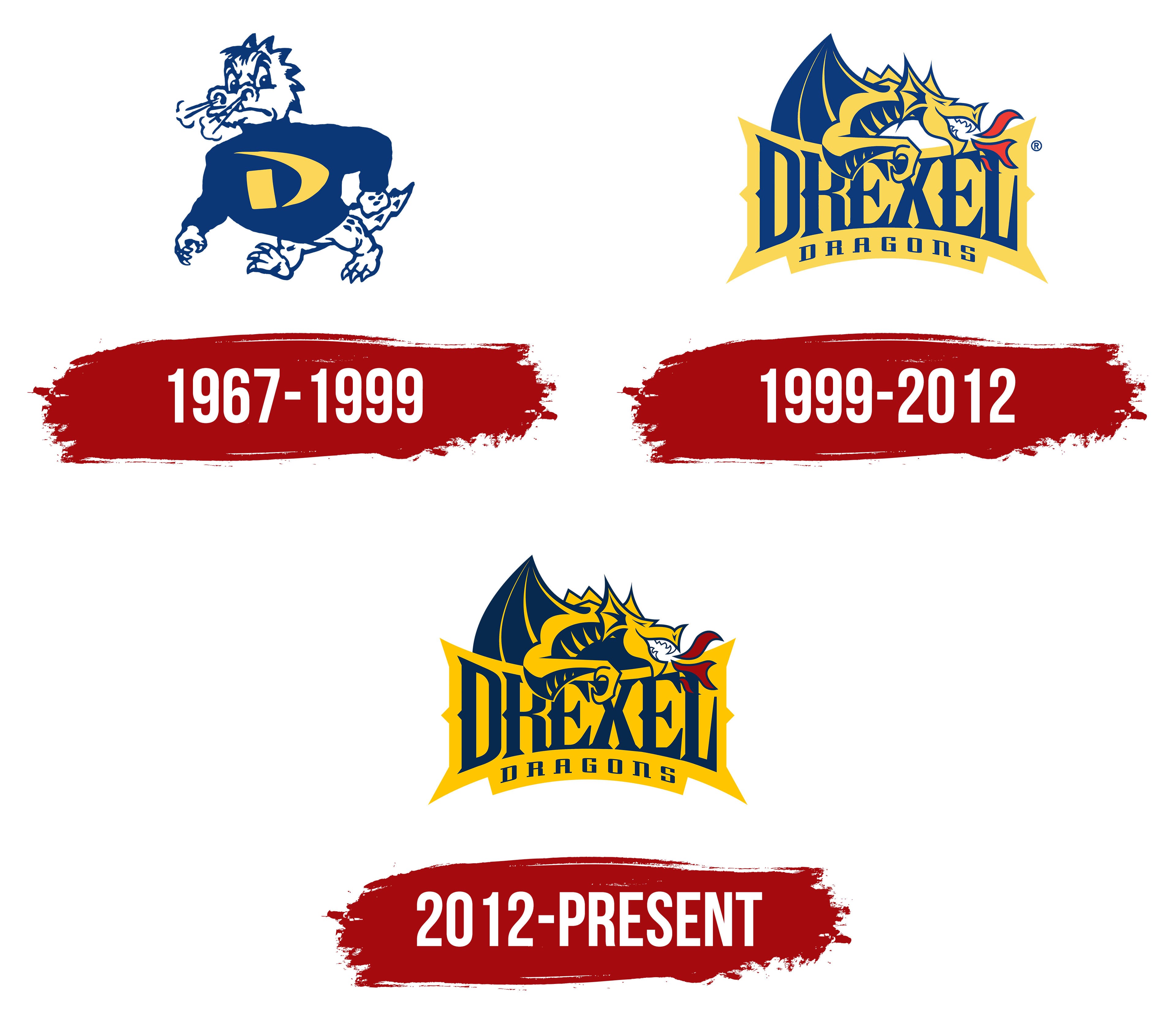
What are the Drexel Dragons?
The Drexel Dragons are Drexel University’s sports teams, located in Philadelphia, Pennsylvania. They consist of 18 student teams that compete in NCAA Division I and are members of the Colonial Athletic Association, EIWA (wrestling), and IRA (men’s rowing).
1967 – 1999

The dragon in Drexel’s identity replaced the profession-based Engineers nickname. Athletes had competed under that name until 1928, even though business administration students already played alongside future engineers. The new Dragons name brought together athletes from different fields of study. The student newspaper, The Triangle, announced the change on April 16, 1928. Earlier names included Drexelites and Blue and Gold.
The Drexel portion of Drexel Dragons comes from financier and philanthropist Anthony Joseph Drexel. In 1891, he founded Philadelphia’s Drexel Institute of Art, Science and Industry, which later became Drexel University. Blue and gold entered the athletic identity several years before the Dragons name, following approval by the athletic association. The institute’s previous official colors were orange and silver. The 1929 Lexerd yearbook already showed basketball players in uniforms featuring dragons. Women’s teams competed as the Dragonettes, a name that remained in use into the 1980s.
A three-dimensional dragon figure was created soon after the name change. It was introduced at a pregame pep rally in 1929. A year later, it was repaired with steel internal supports, a rebuilt head, and added teeth. Tubes leading to the nostrils allowed it to release smoke. Fabric structures carried by students followed, eventually giving way to a costume for a single performer. The fire-breathing character became part of student celebrations long before the later emblem with red flames.
The early athletic logo used until 1999 depicted a full-body dragon. The character walked on its hind legs, wearing a navy sweater with a gold “D.” Its head faced left, with wisps of smoke emerging from its nostrils. Furrowed brows, clenched front paws, claws, and triangular spikes gave it an angry appearance. White areas distinguished the face, paws, and tail from the blue clothing.
The letter on the chest was the only explicit university identifier. Its short vertical stroke joined a curved outer section with pointed terminals. The costumed mascot of the late 1970s and early 1980s also wore a “D” sweater, linking the illustration to the character that appeared at campus events.
In 1997, alumni presented the university with an updated dragon, Mario the Magnificent. He was named for Mario V. Mascioli, a 1945 graduate, trustee, and devoted university basketball fan. The costume combined navy and gold. The head featured large ears and narrow eyes, with a red forked tongue extending from the mouth.
A university emblem described in the supplementary account differs from the athletic character in a sweater. It features a yellow Chinese dragon curling inside a blue square, described in the source as a “moon serpent.” Drexel appears in serif lettering alongside the image. Beneath the square, University is set in sans-serif letters on a white background.
1999 – 2012
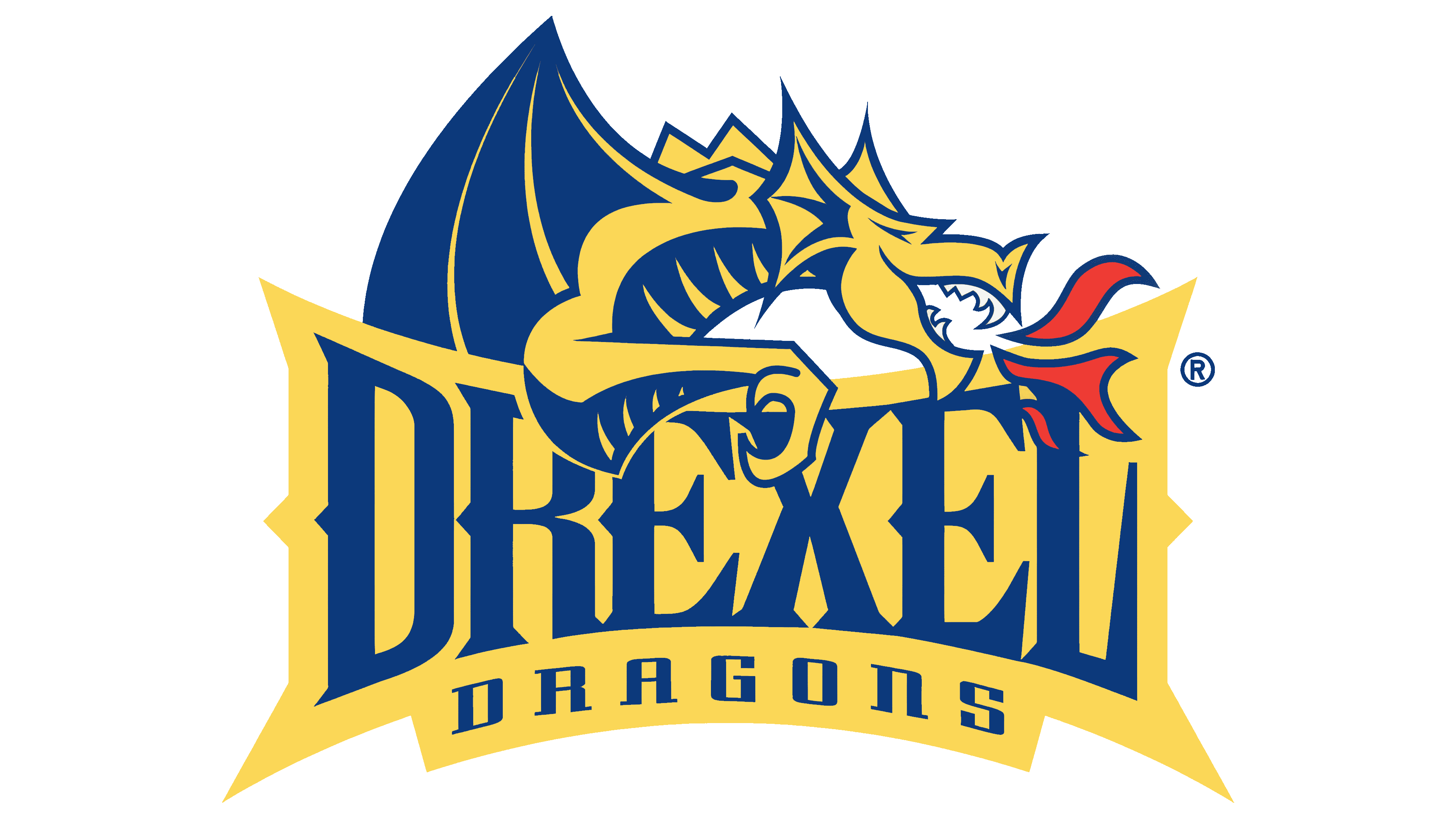
The 1999 Drexel Dragons emblem gave the dragon wings and red flames streaming from its mouth, removing the sweater. The figure was paired with two lines of text. This version remained in use until the 2012 color update.
The upper portion of a gold body with a long, curved neck rises above DREXEL. The head faces right, with bright red flames emerging from the open mouth. Dark lines outline the white teeth. A raised wing occupies the upper-left portion of the emblem, and a front paw overlaps the tops of the letters. Blue fills the wing membrane and defines shadows on the neck and the head’s interior lines.
Custom lettering was developed for the name. Tall uppercase DREXEL letters feature pointed serifs, angular transitions, and triangular projections on the left. Tight spacing brings the letters together, while the “D” and “L” frame the word. The lower edge of the line forms an arc. Smaller, widely spaced uppercase DRAGONS lettering appears beneath it. A gold background follows the curve of the wordmark and ends in projecting points.
The blue-and-gold foundation reflects the university colors. The early version used Pantone 129 for gold. Pantone 281 blue defined the outlines, eye, nostril, and dark areas of the illustration, while Pantone 200 red filled the flames. A standalone dragon figure, a fire-breathing head, and wordmarks accompanied the full emblem. The compact images retained the gold fill, blue outlines, and red flames, allowing the identity to fit spaces of different proportions.
A bronze sculpture of Mario the Magnificent by Philadelphia artist Eric Berg was unveiled on December 4, 2002. During development, Berg studied university flags and logos and consulted Dungeons & Dragons books before refining the figure’s scales, claws, and anatomy. He placed the initials of project participants near the raised front paw. At the unveiling, steam emerged from the mouth through a temporarily installed hose. The bronze Mario stands approximately 10 feet tall and measures about 14 feet long.
2012 – today
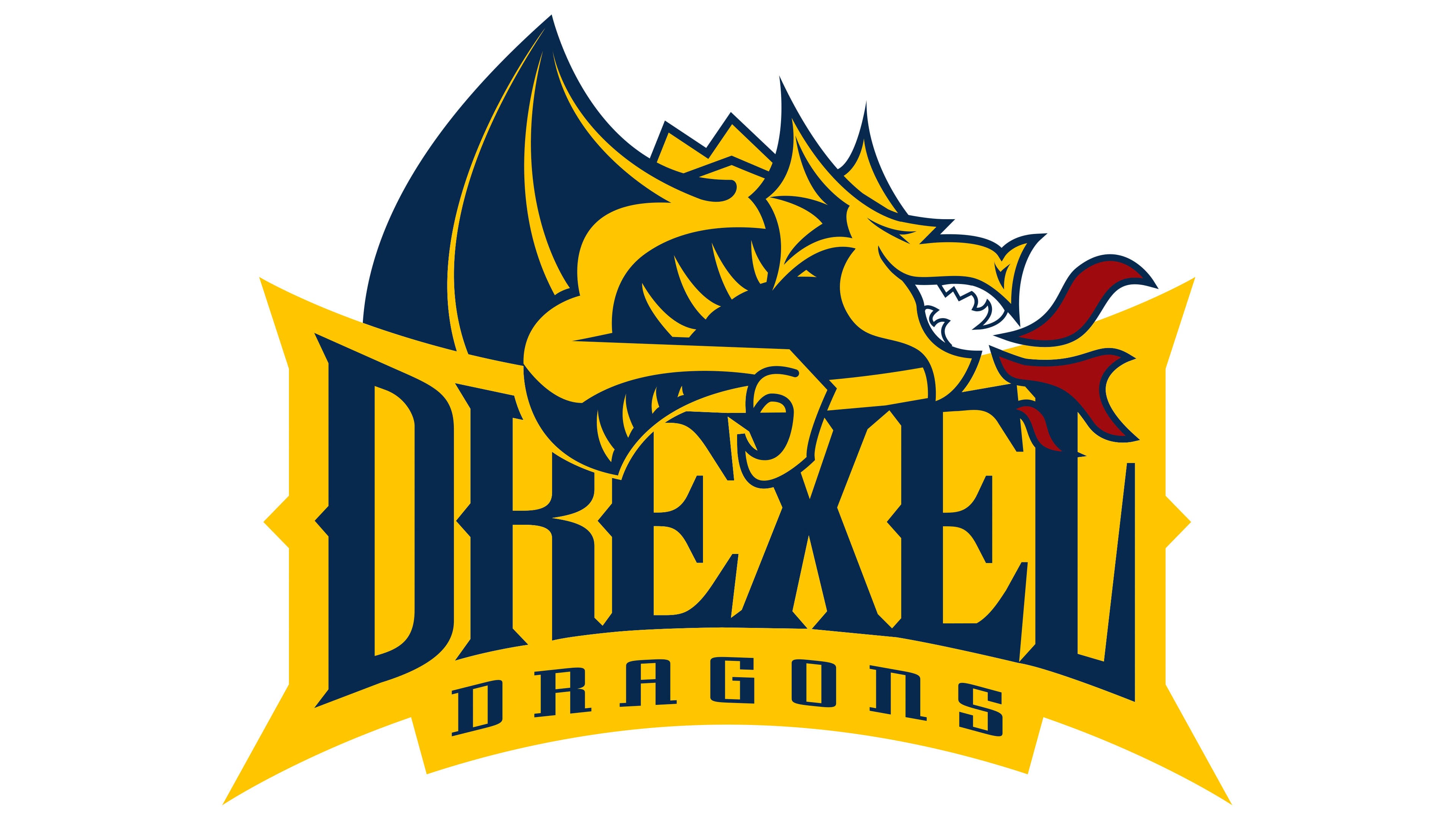
In 2012, the colors of Drexel’s athletic emblem were aligned with the university-wide identity. The shades changed slightly. Blue became darker, while a richer yellow replaced the light gold. The dragon illustration, wing position, red flames, and two-line wordmark remained unchanged.
The athletic standards specify Drexel Blue as Pantone 294 C, Drexel Gold as Pantone 7548 C, and Drexel Red as Pantone 032 C. Blue and gold now match the university’s primary colors. The custom DREXEL DRAGONS lettering remains part of an athletic collection that includes approved primary emblems, secondary marks, and wordmarks.