


 Eaton Logo PNG
The main ideas embedded in the Eaton logo are customer focus and stability. These are the basic principles that the American engineering company emphasizes. The effective use of negative space enhances the logo, conveying more to clients than they might imagine.
Eaton began in 1911 in Bloomfield, New Jersey, when Joseph Oriel Eaton joined Henning Taube and engineer Viggo Torbensen, who had patented an internal-gear rear axle in 1902. The new Torbensen Gear and Axle Co. started with $15,000 and built only seven axles by hand in its first year.
Demand from the truck industry grew fast. In 1914, production moved to Cleveland, closer to Ohio’s auto plants and Detroit. By 1916, output reached 10,000 axles a year. In 1917, the company was sold to Republic Motor Truck Co. Eaton left in 1919, founded Eaton Axle Company, bought back Torbensen Axle in 1922, and renamed the business Eaton Axle and Spring Company in 1923. In 1932, it became Eaton Manufacturing Company.
The company entered Canada in 1937 and continued to diversify after Joseph Eaton’s death in 1949. Under John C. Virden, Eaton made 23 major acquisitions in 15 years, including Fuller Manufacturing in 1958 and Yale & Towne Manufacturing in 1963. The name changed to Eaton Yale & Towne Inc. in 1965, then to Eaton Corporation in 1971.
A major shift came in 1978 with the purchase of Cutler-Hammer, moving Eaton toward electrical and electronic systems. In 1994, Eaton bought Westinghouse Electric’s power distribution and control unit for $1.1 billion. In 1998, it sold its truck axle and brake business to Dana Corporation, and in 1999, it acquired Aeroquip-Vickers. In 2012, Eaton bought Cooper Industries for about $13 billion and reincorporated in Ireland. Its main rivals include Schneider Electric and ABB.
Meaning and History
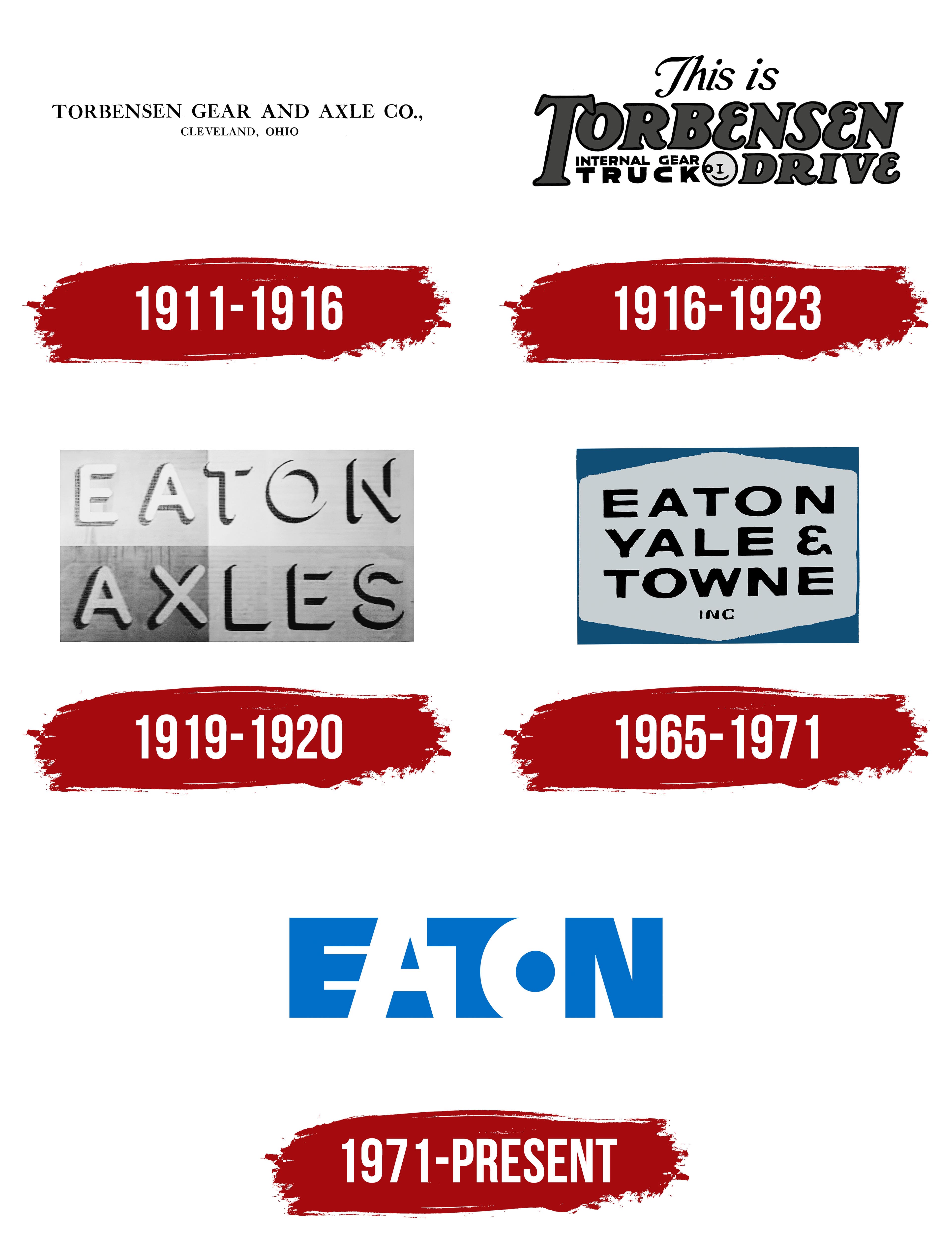
Eaton’s large-scale enterprise has one striking distinguishing feature: it has developed not only through improvements in its internal structure but also through the acquisition of small companies. As a result, the brand expanded its specialization and strengthened its status. The modern corporation operates internationally, competing with industrial giants such as Schneider Electric, Siemens, and Bosch Rexroth. Eaton’s visual identity is another confirmation of this.
The current badge demonstrates strength, confidence, scale, and professionalism. But it has been used since 1971, and before that, the brand had several different versions of the emblem. They changed depending on the company’s state and on evolving trends in brand design. These were strict pictures with a classic typeface and achromatic colors. More expressive tones and a stylish font appeared in later versions.
What is Eaton?
Eaton is a large, modern corporation with several divisions across different countries. It is of American origin and has extensive specialization. It is engaged in producing automotive components, aviation industry equipment, and various electrical engineering products.
1911 – 1916
A large corporation began as a small enterprise that produced high-strength axles for trucks. The founders were Viggo Torbensen and Henning Taube. The workshop was named after Torbensen. Its name served as the basis for the visual identity. The logo included Torbensen Gear & Axle CO and a reference to the region (Cleveland, Ohio).
It was a strict, simple icon with no expressive features. Thin straight lines with serifs distinguished the font. Newspaper articles were often printed in this format. All letters of the name were capitalized, emphasizing the importance and value of the contribution to the engineering industry.
The region was inscribed in miniature, with simple, laconic letters. The coloring included classic black, with black inscriptions and a light background. Such a combination demonstrated high quality, conscientiousness, and reliability.
1916 – 1923

Soon, it was decided to replace the original logo with a more modern one. As a result, the company 1916 received an updated emblem featuring numerous inscriptions. Among them are:
- this is;
- Torbensen Drive;
- internal gear;
- truck.
Each of them had a distinct semantic load and was set in a different font. The first used an elegant, thin font with tails, providing for the italic format. The second inscription was more massive and expressive. Her letters are created with thicker serif lines. The third and fourth inscriptions were directly located and decorated with simple letters without serifs. Black and gray were used as the color palette. This design decision symbolized increased brand profiles, expansion, and development.
1919 – 1920
During this period, the company’s management and name changed. Torbensen Gear & Axle CO was renamed Eaton Axle and Spring. All this is reflected in the visual identity. The old logo, with many inscriptions, was replaced with a more concise, uniform icon. It consisted of only two words: Eaton Axle. Both of them were made in the same style and font.
These were large, light letters, the contours of which were complemented by a shadow. This design created a three-dimensional effect, which made the overall concept more attractive and modern. The background on which the inscription was located included dark and light shades. They demonstrated prestige, responsibility, and openness.
1923 – 1932
During this period, the company developed especially actively. This was mainly due to numerous acquisitions. Eaton first bought out several small auto parts manufacturers in Cleveland and, a little later, outside of it. After that, Eaton Axle and Spring began producing springs, bumpers, poppets, and other components for the aviation industry.
1932 – 1965
The company’s entry into the international market dates to this period. The company opened a factory in Canada to produce auto parts and, a little later, created a joint venture with British corporations E.N.V. and Rubery Owen. Until 1965, the brand already had many divisions in European countries.
1965 – 1971
Another change in visual identity occurred when the company was renamed Eaton, Yale, & Towne. Since then, a new, more expressive logo has been used. It was an original figure, roughly rectangular, with the inscription “Eaton Yale & Towns Inc.” inside. In the upper and lower parts, the frame was supplemented with small graphic symbols in the form of unusual geometric flats.
The new brand name was set in a straight, slightly stretched sans-serif font. The font was black, but the graphic symbols diluted the strict palette. In the letter O, the dot was light purple, and the geometric stripes at the top and bottom were blue. The chosen palette symbolized trust, reliability, and honesty.
1971 – today
The logo that the brand currently uses was created in 1971. At that time, the discreet predecessor was replaced with a more stylish, modern emblem featuring an original design. It included only one word: Eaton, the brand’s name.
All letters in the logo are superimposed and painted in harmonious, contrasting colors. The letters A and O have an original shape; they are created without clear contours. The chosen design demonstrates development without borders, professionalism, and solid status.
Font and Colors

The Eaton brand logo features an incredibly expressive font and harmonious color scheme. It is based on thick capital letters created in bold type. The enlarged letters slightly overlap and lack serifs. Despite this format, the emblem looks balanced due to the original use of the space between word marks.
An advantageous addition to the overall concept is the color palette. Three of the letters are blue, and two are white. The first shade demonstrates authority, the value of experience, and the introduction of innovation. White color conveys openness and loyalty to customers.