


 Efes Logo PNG
The Efes logo, the only genuine Turkish beer, features a classic style. The thick white font on a rich blue background, set within a golden oval frame, symbolizes the product’s rich taste and consistent worldwide quality.
Efes Pilsen developed within a late-forming Turkish beer industry. The country’s first brewery opened in Istanbul in 1890, and in 1939 production was nationalized under Tekel, which controlled the market for nearly two decades. Private brewing became legal again in 1955.
In 1950, Kamil Yazıcı and İzzet Özilhan founded Anadolu Group, initially focused on the automotive trade and assembling Škoda trucks and Jawa motorcycles. After market liberalization, the group entered brewing in 1969, launching two plants in Kayseri and Izmir under the Efes Pilsen name, after the ancient city of Ephesus.
From the outset, the company built a vertically integrated structure, adding malt and hop processing facilities. By the 1980s, Efes Pilsen had overtaken Tekel and become Turkey’s leading beer, supported by rising per capita consumption, which grew from 4 liters in 1986 to 12 liters by 2005.
In the 1990s, Anadolu Efes expanded abroad, starting with Russia, where it built breweries amid competition from Carlsberg and Heineken. Operations later extended to Kazakhstan, Moldova, Georgia, Ukraine, and Belarus. In 1998, the company held an IPO and listed shares on the Istanbul and London stock exchanges.
A strategic partnership with SABMiller began in 2011 and later transitioned to AB InBev following the 2016 acquisition. In 2009, the brand underwent a redesign. In 2024, following regulatory decisions, Anadolu Efes retained its Russian business, while AB InBev acquired its Ukrainian assets.
Meaning and History
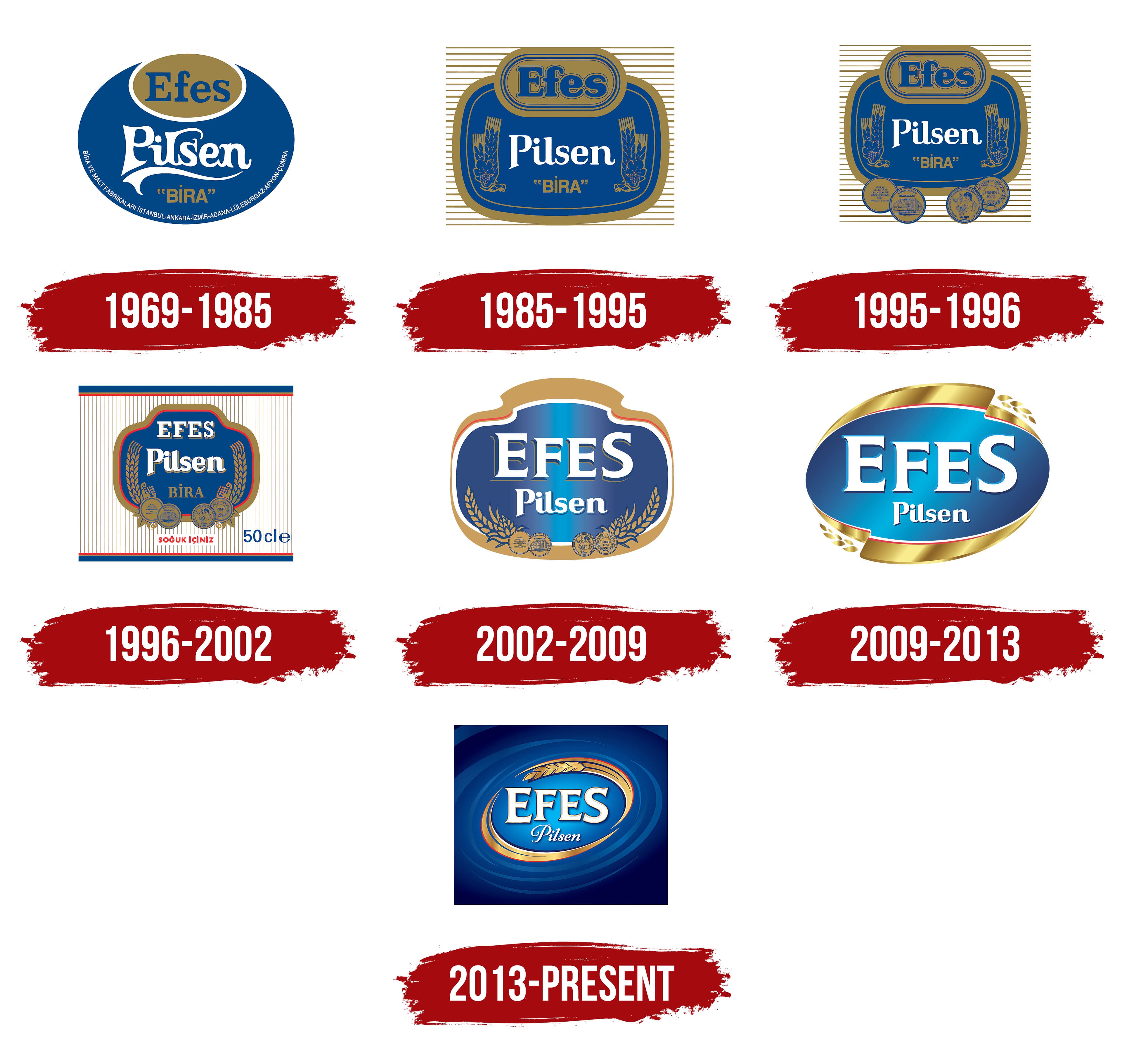
The Efes logo has a classic beer-brand design, from the color scheme (blue, gold, and white) to the barley ears on the emblem.
The emblem features thick white letters on a blue background, framed in gold. The frame has a modern oval shape with two protruding peaks.
The Efes logo aims to convey the brand’s dynamism and authenticity, as well as its commitment to quality and taste.
The design agency Interbrand created the latest version of the Efes logo. They did an excellent job creating a new, dynamic brand image that now enjoys great success in Turkey and across 80 territories worldwide.
What is Efes?
Efes is the flagship brand of the Turkish company Anadolu Efes Biracılık ve Malt Sanayii. Its range includes various beer types: the flagship Pilsener with refreshing bitterness, the coffee-chocolate lager Dark Brown, the aromatic and smooth Ice, the strong Xtra, the low-alcohol Light, and the caramel Dark. They are made from natural ingredients and are widely in demand in bars and restaurants.
1969 – 1985

One of the old Efes logos contained the phrase “BIRA VE MALT FABRIKALARI ISTANBUL-ANKARA-IZMIR-ADANA- LÜLEBURGAZ-AFYON-ÇUMRA.” It was written in small but bold white letters at the bottom of a large, dark-blue oval. Just above it was the brown word “BIRA” in quotes, and above that was the white “Pilsen,” underscored with a graceful wavy line and made of stylized letters with curled crests. A small brown oval was located at the top, serving as the base for the dark blue word “Efes.” The brand name used a bold geometric font with large serifs.
1985 – 1995
In the 1980s, the logo’s appearance changed. Designers transformed the original color palette, making shades slightly lighter. Ovals turned into rectangles with rounded edges. The long line at the bottom disappeared as the secondary information about the alcoholic drink was moved to another part of the label. Only the most important inscriptions remained: “Efes,” “Pilsen,” and “BIRA.” The brand name and its brown base now had unusually thin, dark blue outlines. Conversely, the word “Pilsen” was simplified. Designers shortened the decorative crests and swirls on some letters but used a serif font to retain a hint of the old style.
Floral ornaments were added on the right and left, signifying the drink’s natural composition. They were depicted without detail, using only contours. The large dark blue base now had a wide brown frame. The emblem’s background became a rectangle, speckled with many horizontal white and brown lines.
1995 – 1996
To show the alcohol’s high quality, designers added four awards to the Efes emblem, two on each side. They looked like brown circles with dark blue inscriptions and drawings. The medals testify that the brand participated in various competitions and won prizes, so its products deserve trust. This marketing trick was intended to increase sales.
1996 – 2002
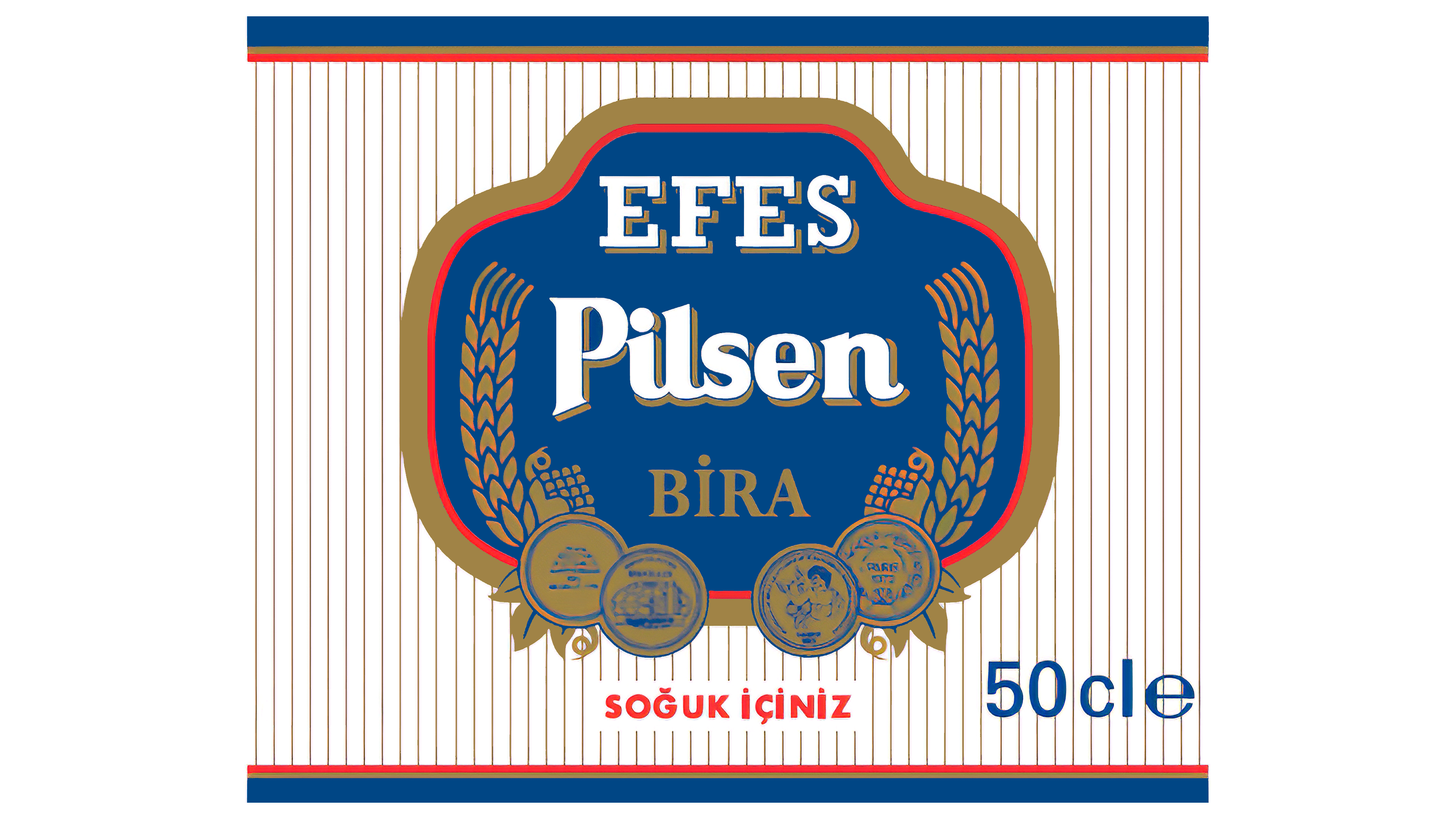
In mid-1996, the Efes label was redesigned. Two rounded rectangles were combined into one large dark blue figure with a thin red outline and a wide brown stroke. The brand name was set in uppercase and white. At the same time, it and the word “Pilsen” appeared in thin brown shadows to the right of each letter. In recent decades, the serifs disappeared from BIRA. The medals were moved slightly higher and decorated with leaves. The floral pattern also changed: artists elongated the spikes so they curved beautifully upward. Horizontal background lines became vertical lines, and bright inscriptions appeared beneath the emblem.
2002 – 2009
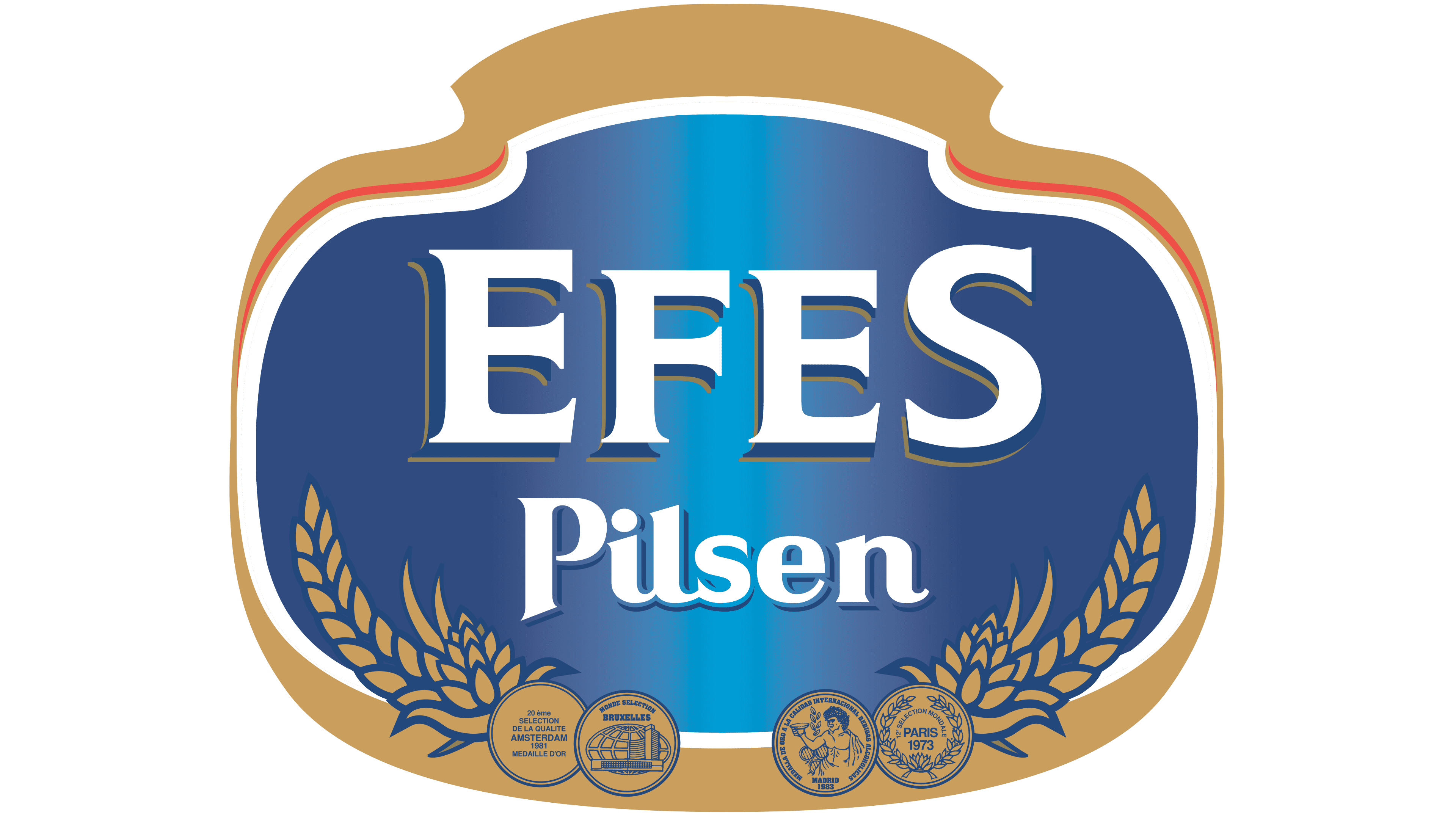
After the redesign, the word “BIRA” was removed. This allowed the “Pilsen” inscription to move down and the brand name to enlarge. Additionally, the first letter “E” and the last “S” became disproportionately large, much bigger than the “FE” located between them. The right brown outline disappeared. Each glyph now had dark blue, three-dimensional shadows. In the word “EFES,” they shifted left and appeared voluminous because of additional gold outlines.
The blue base acquired a linear gradient, starting from the center as a vertical column of light blue. A white stripe partially “eaten” the red outline. The outer brown rim became uneven: too narrow at the edges and wide at the top and bottom. The floral ornament with medals also changed. Artists reduced the four medals, shortened the spikes, and redrew the hop cones.
2009 – 2013
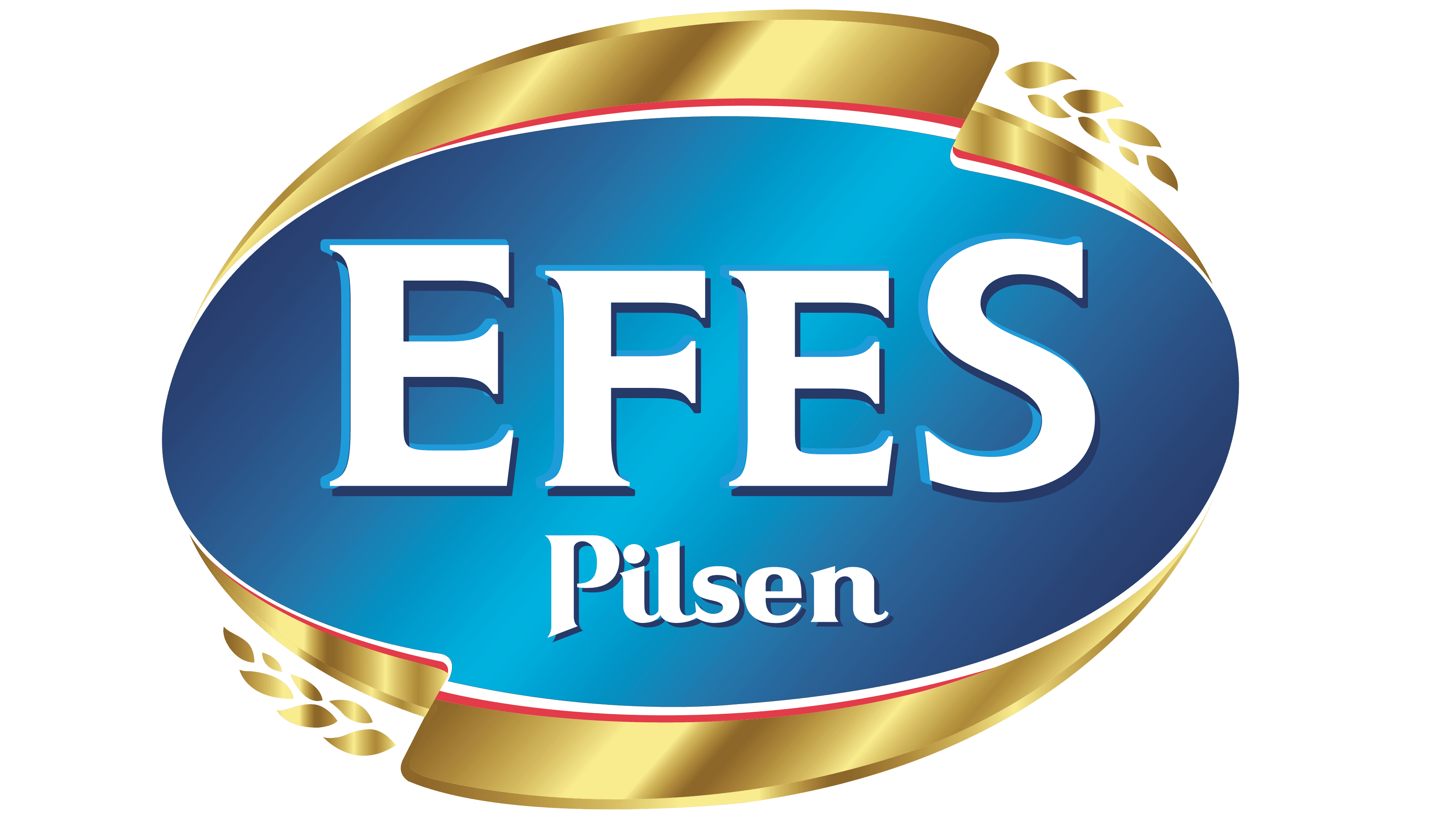
The white words “EFES” and “Pilsen” were moved into a horizontal oval with a blue gradient. In this version, the shade transition was diagonal and started near the center. The frame became two golden ribbons, mirrored on the other side. They curled at the ends and looked voluminous because of an uneven gradient. The round awards disappeared, leaving only two minimalist spikes at the top and bottom.
2013 – today
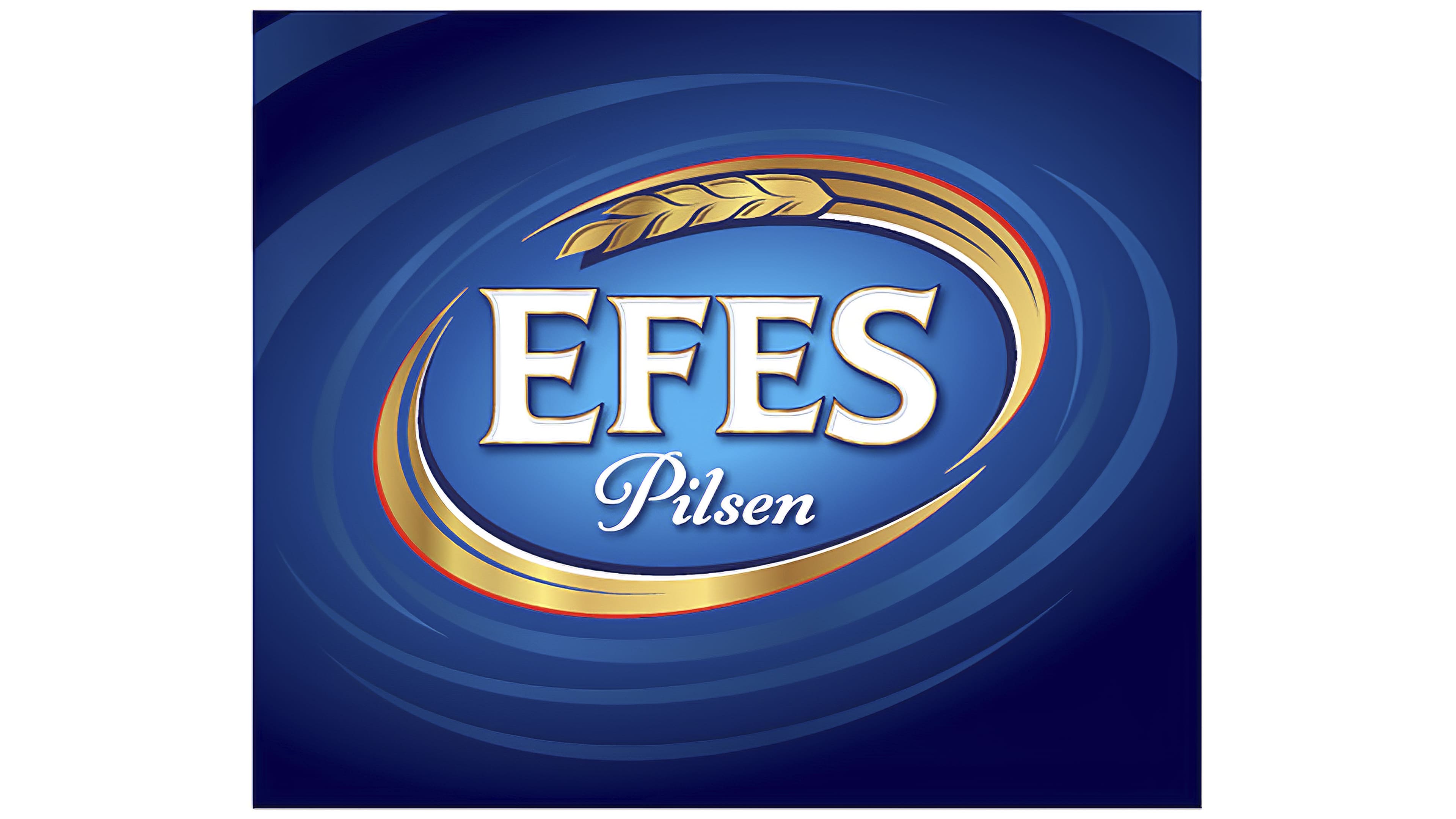
In 2013, designers changed the inscription proportions to make the brand name more noticeable. The gold frame shifted, and its parts were now positioned diagonally. The ribbons turned into graceful arches with pointed edges. The lower spike disappeared, and the upper one increased and shifted leftward. The background depicted a “whirlpool” of light-blue, gradient-filled spirals, surrounded by dark-blue space. This symbolizes purity, freshness, and progress. Such a pattern is associated with a falling drop, from which circles spread in all directions.
Font and Colors
The Efes logo uses two contrasting fonts. The trademark name is set in a bold sans-serif font with large triangular serifs and slanted ends. The word “Pilsen” is typed in cursive, stylized as calligraphic handwriting, with all letters separated despite the very narrow spacing between them. The elegant cursive is adorned with curls and swirls, especially pronounced in the capital “P.” Although these two fonts are very different, they share visual dynamics.
The emblem’s color palette also creates a sense of movement, as designers use several shades of blue to depict the “whirlpool.” The highlighted center, with a gradient, instills hope and confidence. Against this backdrop, the white inscriptions stand out, accentuated by shadows. The shimmering gold frame with a loop resembles the color of fresh Pilsner. Thin red lines complement it, diversifying the palette.