


 Emerson Electric Logo PNG
A manufacturer of electrical equipment has to maintain the image of a company that strives for progress. That’s why designers ensured the Emerson Electric logo was synonymous with innovation, cutting-edge technology, and development. It isn’t directly tied to any product; it’s an abstract design.
Emerson began in St. Louis on September 24, 1890, when Scottish brothers Charles and Alexander Meston developed an improved AC motor. Local judge and Civil War veteran John Wesley Emerson provided the capital. They named the company Emerson Electric Manufacturing Company. In 1892, under President Herbert Parker, Emerson sold what the source describes as North America’s first electric fan and reached about $60,000 in annual revenue.
The company expanded through motors and fans. In 1897, it introduced the Emerson ceiling fan, and by the 1920s, fans generated 40% of sales. In 1903, it introduced a 1.5-horsepower motor for washing machines and sewing equipment. During the Great Depression, dividends were stopped from 1930 to 1940. In 1938, William Stuart Symington became president, brought in Sears, Roebuck & Company as a major motor customer, and bought a welding business.
World War II changed Emerson’s scale. From 1941 to 1945, it produced more than 10 million brass shell casings. It became a major maker of aircraft gun turrets, including the Model 127 for the B-24 Liberator. In 1954, W. R. “Buck” Persons became president. They turned Emerson into a diversified industrial group by acquiring companies such as White-Rodgers, Therm-O-Disc, U.S. Electrical Motors, Ridge Tool, and InSinkErator.
Under Charles Knight, Emerson shifted its focus to process control and industrial automation starting in 1973. In 2000, the name was shortened to Emerson. Network Power was sold to Platinum Equity in 2016 and renamed Vertiv. In 2018, Emerson bought Textron’s tools businesses, including Greenlee, and in 2023, it acquired National Instruments for $8.2 billion. Its main automation competitors include Honeywell and ABB.
Meaning and History
Emerson Electric has achieved incredible results in engineering and technology. It is a truly transnational corporation with more than 100 enterprises in the United States of America and about the same number of sites abroad. The company has achieved several milestones in producing modern, high-tech equipment across various industries.
Several key events in Emerson Electric’s history also shaped its visual identity. The most important of them led to the change of the old logo to a modern version, which is still used today. It was created based on an original design solution that provides stylish elements that remain relevant. Among them is an unusual geometric figure with a special meaning and a massive inscription indicating the company’s name.
What is Emerson Electric?
Emerson Electric is one of the world’s largest corporations, producing electrical equipment and engineering solutions. Currently, it is located in the USA (Missouri), and individual production facilities are also located in other countries. Emerson Electric factories produce high-quality air conditioning, heating, automation, and refrigeration systems.
Old

Its future president, John Wesley Emerson, laid the basis for the future transnational corporation. In 1890, he founded the Emerson Electric Manufacturing Co., which produced fans and electric motors based on the Meston brothers’ technology. At that moment, a visual identity was also formed, reflecting the brand’s basic principles and values.
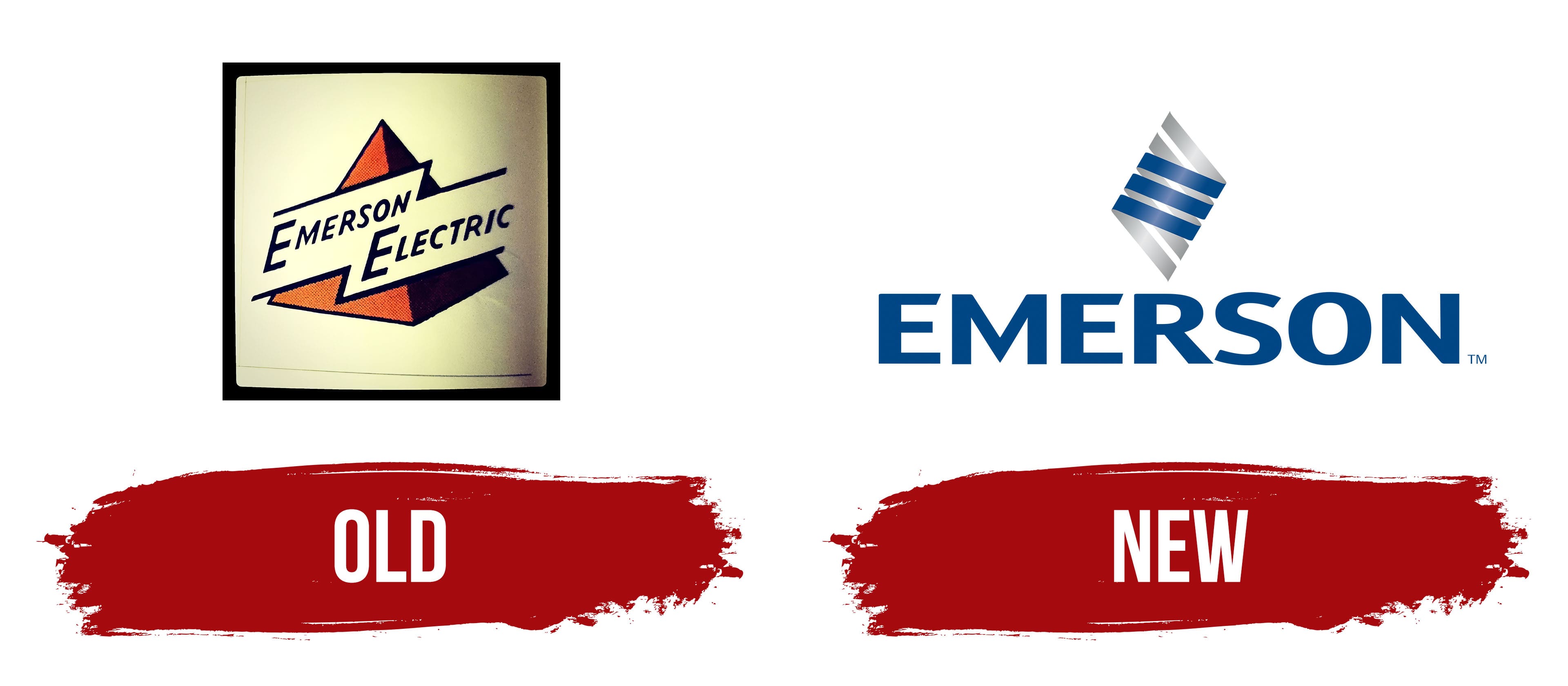
The logo featured a pyramid-like figure and a two-level inscription reading the company name. The words “Emerson Electric” were placed within a lightning-like symbol. All of this was set against a classical background. The pyramid was located so that two sides were visible. One side was brown, and the other was in shadow.
This decision created the effect of volume and expressiveness. The figure generally showed rapid growth and progress toward success; the brown color symbolized stability. Additional characteristics of the company are also reflected in the name. The inscription used a thin, italic sans-serif font.
He showed confidence and a desire for improvement, as confirmed by stylized lighting bearing an inscription. The figure symbolized energy and progressiveness and emphasized Emerson Electric’s direction. All elements were combined into a single harmonious concept that emphasized professionalism.
New
The original logo has been used for many years. But it gradually lost relevance, so the company decided to rebrand. In creating a new emblem, a completely different approach was used. It is based on neutral yet expressive shades and a bold font with thicker, smoother outlines.
The updated emblem also features an original graphic symbol reminiscent of a part from an electrical appliance. This symbol emphasizes the corporation’s products. The figure is a twisted spiral consisting of several stripes. The design uses two colors and a central glare, giving it a natural look.
Below is a large company name. The words are in Roman script, featuring thick sans-serif lines with beveled cuts on some letters. Straight contours, smooth curves, and unusual cuts make the inscription stylish and concise. Combined with the 3D spiral icon, it harmoniously reflects Emerson Electric’s essence.
Font and Colors

The Emerson Electric corporate identity successfully combines a three-dimensional image, deep coloring, and a simple font. The figure, resembling a spiral, is decorated in several shades. Its outer part is painted in deep blue, symbolizing reliability, trust, and high quality. The inner part of the spiral is painted in light gray.
These shades are also complemented by a subtle highlight, giving the figure a more natural look. The company name is set in a simple font with jagged cuts and soft outlines. Such an inscription perfectly complements the spiral, as it is made in a similar style and color. Emerson Electric’s words are deep blue, representing the company’s commitment to the business.