


 Emerson Logo PNG
The Emerson logo is a decisive element of the distributor’s home and electronics identity, highlighting the brand’s key strengths. It represents the brand as a virtuoso of its craft and emphasizes its advantages. Smooth strokes, rounded corners, and soft transitions show the company’s adaptability and the flexibility of its concept.
Emerson began as a trademark in 1912 and became a company in New York in 1915, when Victor Hugo Emerson, former chief sound engineer at Columbia Records, founded Emerson Phonograph Company. The firm sold phonographs and Universal Cut Records, featuring folk music, jazz, classical works, opera, and popular songs. By 1920, it had plants in Chicago and Framingham and called itself the third-largest record maker in the United States.
The business collapsed in December 1920 under pressure from the postwar downturn and the rise of commercial radio. In 1922, Benjamin Abrams and Rudolph Kanarek bought the company. Two years later, it became Emerson Radio & Phonograph Corp., sold the record business, and entered radio with one of America’s first radio-phonograph combinations.
Emerson’s breakthrough came in 1932 with the Peewee pocket radio, priced from $17.95 during the Great Depression. Between December 1932 and May 1933, Peewee accounted for a major share of U.S. radio sales. By 1938, Emerson had sold more than one million units. RCA supplied its radio tubes from 1937 to 1954.
During World War II, Emerson shifted to military production. It went public in 1943 and entered television in 1947 with a 10-inch set. Sales passed 375,000 units, and revenue doubled between 1948 and 1950. In 1953, Emerson acquired “Quiet Heet Corporation” and entered the air conditioner market under the Quiet Kool name. Later deals added Allen B. DuMont Laboratories in 1958 and Pilot Radio Corporation in 1965. After Benjamin Abrams died in 1967, the Emerson trademark passed to Major Electronics Corporation in 1973, while Zenith remained a strong rival in color television.
Meaning and History
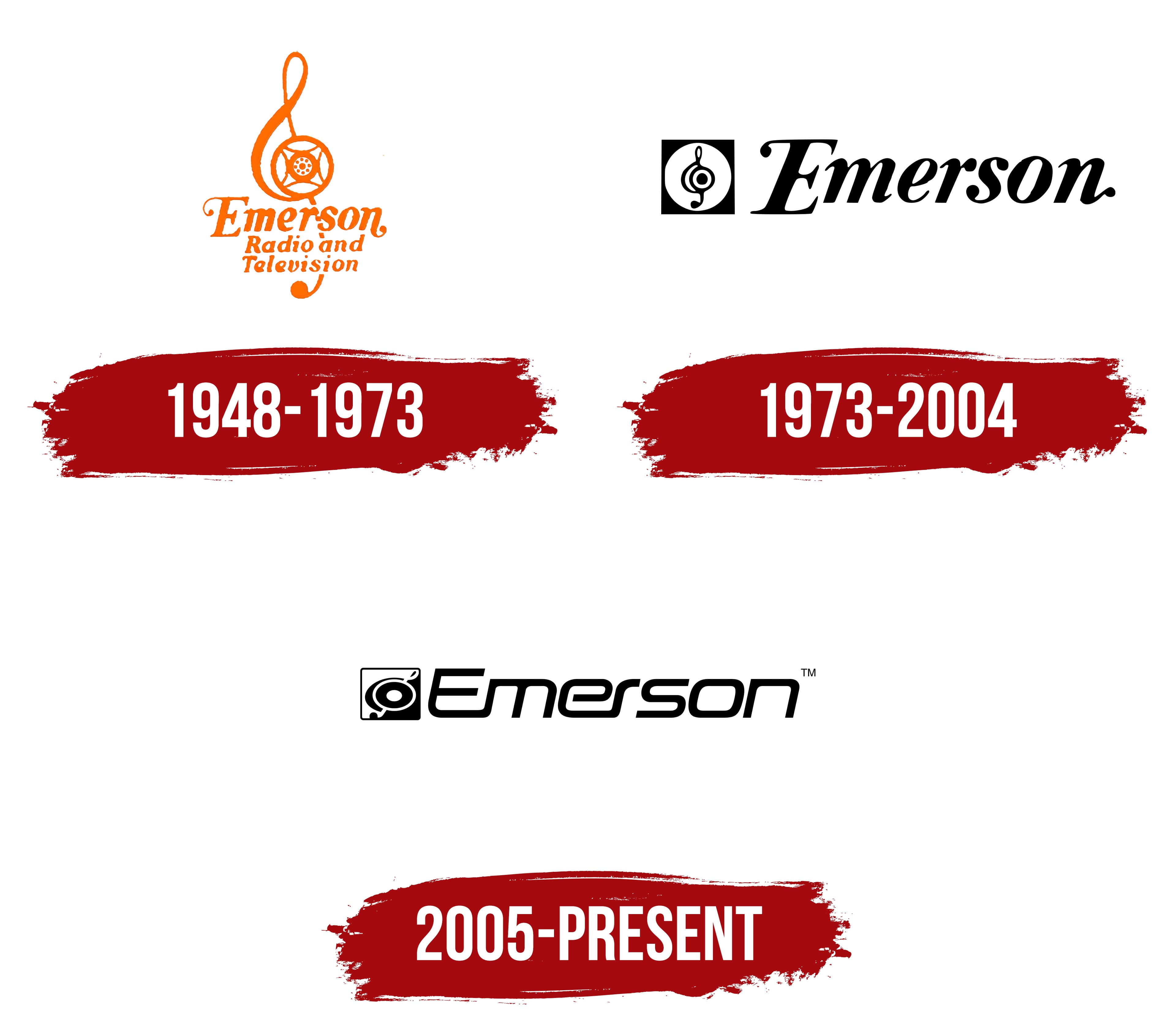
Emerson products are easily recognizable by their dynamic logo, which combines classic design with modern style. The main element is the brand name, made with clear, soft lines. It is complemented by an icon shaped like a treble clef. The central part of the key has a rather rounded shape, which makes it similar to the company’s product, Universal Cut Records. This is a symbolic mark for Emerson, as these items have become historical products.
The strict achromatic logo features a treble clef as a thematic element and a sophisticated brand name. All components are in balance and complement each other favorably. As a result, the symbol appears as a single entity and reflects the central strategy of Emerson’s development. Its essence boils down to the desire to create perfect products that have excellent technical characteristics.
What is Emerson?
Emerson is the name of one of America’s oldest consumer electronics companies. The brand has a long history and a wide range of products in different parts of the world. Among them are high-quality speaker systems, televisions, combined devices, microwave ovens, and many other products.
1948 – 1973

The large treble clef in the Emerson logo represents musicality and sound, something without which radio would not make sense. This is a simple and powerful symbol associated with the leader of the US radio market. The curl of the sign forms a circle within which a stylized player-speaker is drawn. And at the bottom, “Emerson Radio and Television” is written in elegant cursive letters. Apparently, the emblem appeared during the period when the company began producing televisions and saw increased sales. The bright orange color complements the expressive font.
1973 – 2004

The first Emerson enterprise was created in 1915, but the visual identity had not yet been established. The first official logo appeared in 1973. This version combined a graphic symbolizing an industry connection with a traditional brand name. The original badge is shaped as a black treble clef inside a white circle. The last figure was placed in a dark square.
The essence of this original performance was to make associations with the radio. It was this technique that the company used in the early periods. The inscription is dynamic and elegant. The wordmarks are reminiscent of the cursive handwriting used in classical calligraphy. Here you can see the same strokes and sizes.
Some letters have decorative dots at the ends. They refer to the time when ink was used for writing, leaving traces as tiny droplets. An additional difference between the fonts was the capital letter E, which stood out against the general background due to the size and elongated top stripe. The color scheme included only black and white. They demonstrated prestige, solid status, and reliability in such a presentation.
2005 – today
In 2005, the Emerson brand decided to change its corporate identity. The old emblem no longer reflected the company’s essence or current design trends, so they decided to refresh it. The updated logo retained the general design principles while incorporating new stylistic elements. The icon has changed its font and visual presentation. The treble clef took on a perfectly rounded shape and was placed at an angle.
The square it was placed inside was split into two parts. One of them was black and the other white. For the inscription, a more modern font was used, with the letters set at a slight slope. The chosen format demonstrated development, progressiveness, and dynamism. The colors remained the same, confirming market stability and confidence.
Font and Colors

The Emerson logo is a complete concept that symbolizes the combination of tradition and new technological solutions. The main element is the original futuristic typeface, which symbolizes innovation and complements its neat musical icon. Both components are in harmony, just as the company combines modern technologies and traditional solutions.
An original electrified font is used to design the name, similar to neon signs. The letters have a streamlined style and the same width. There are no decorative dots at the ends of the letters. The color palette includes two colors: black and white. The latter is used to decorate the background. It reflects openness and honesty. Black is used for the company name. This color is an ageless classic that is still relevant today.