 Ernst & Young Logo PNG
Concise is the best way to describe the Ernst & Young logo. The company decided to use just one bright accent in the emblem to achieve international status, as the abundance of details confuses potential clients. But it is as catchy as it is easy to remember. The simplicity of the icon helped the firm reach a high level because it represents the core concept of the consulting and auditing organization.
Ernst & Young grew from two accounting firms founded in the early 20th century. In 1903, Alwin C. Ernst and his brother Theodore opened Ernst & Ernst in Cleveland, Ohio. In 1906, Scottish accountant Arthur Young founded Arthur Young & Co. in Chicago. Ernst built a broad network of offices across the United States and Canada. At the same time, Young focused on staff training and university recruitment.
Both firms expanded through British partnerships. Arthur Young & Co. linked with Broads Paterson & Co. in 1924, while Ernst & Ernst worked with Whinney, Smith & Whinney. In 1979, that cooperation became Ernst & Whinney, ranked fourth among global accounting firms.
By the late 1980s, the audit market needed larger international networks. In May 1989, Ernst & Whinney, then ranked third worldwide, merged with Arthur Young, ranked sixth. The new firm, Ernst & Young, became the world’s largest audit company at launch.
In the 1990s, Ernst & Young expanded consulting while competing with Deloitte and PricewaterhouseCoopers. A planned merger with KPMG ended in 1998. In 2000, the firm sold its IT consulting unit to Cap Gemini for $11 billion, forming Cap Gemini Ernst & Young. In 2013, under Mark Weinberger, Ernst & Young shortened its name to EY, audited Vatican finances, and absorbed KPMG’s Danish business. In 2014, EY acquired The Parthenon Group, forming EY-Parthenon.
Meaning and History
The company originated from the merger of two US firms and became the largest representative of the UK consulting, auditing, and financial services sector. The first of these is Harding & Pullein, founded in 1849 and later renamed several times. At the time of the merger, it was called Ernst & Whinney in honor of Alwin C. Ernst. The second organization is Arthur Young & Co., founded in 1906. As a result, a large accounting company emerged, named after the founders.
Like many similar services, Ernst & Young has expanded its offerings to include a wide range of services, from strategic financial measures to advice on personnel issues. For the visual identity, the international firm first chose the text version of the logo, incorporating its name into it. Even the icon was literal: it consisted of capital characters that began each word in the name (EY). Otherwise, it was a simple informational emblem that communicated what kind of company it was and what it did. She has only two logos in her arsenal.
What is Ernst & Young?
Ernst & Young (EY) is a consulting and audit firm comprising several specialized firms across many countries. In particular, it has 728 branches in 150 states. The largest of these operates in the United States. The head office is located in London, the capital of Britain. The year of origin of this international organization is 1989. It is now included in the Big Four accounting services.
1989 – 2013

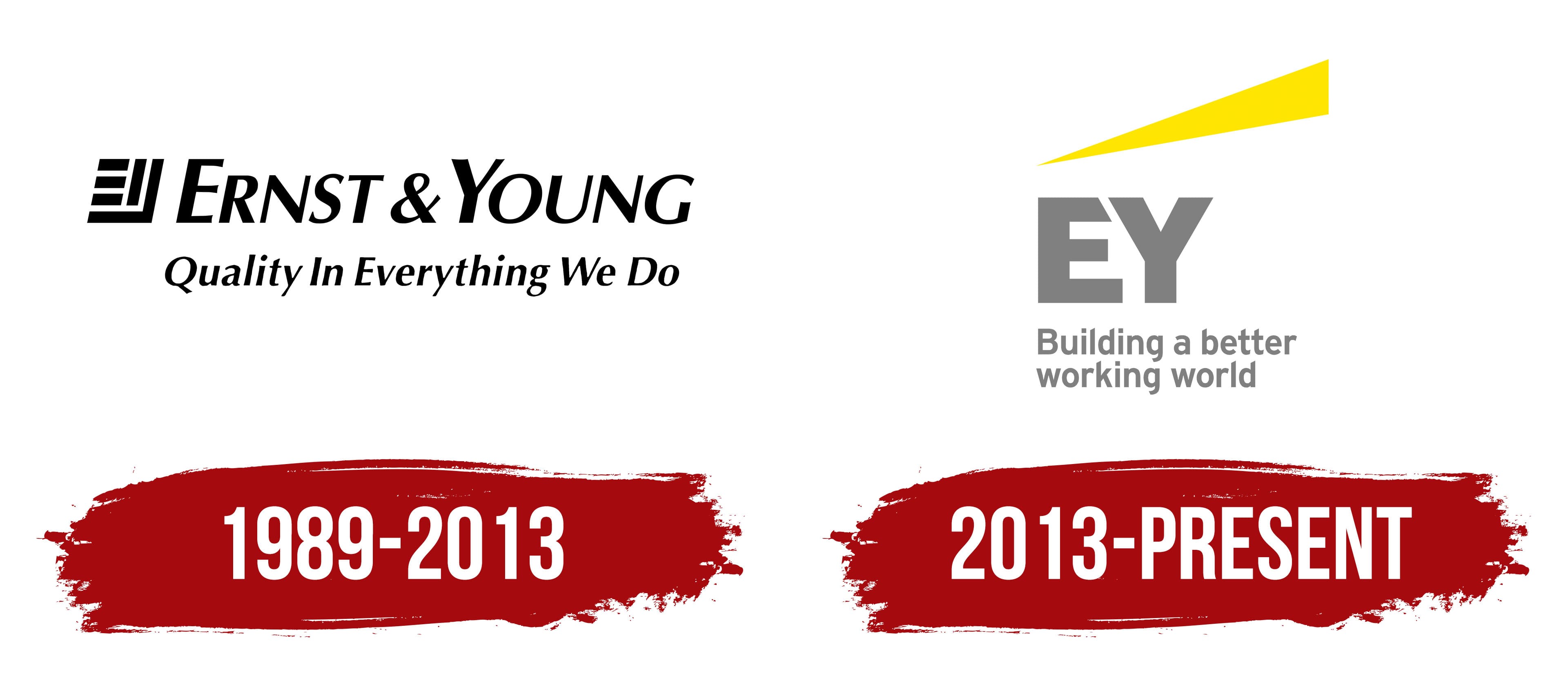
The debut version contained several inscriptions. The most important was the name, so it occupied most of the emblem and was at the top, in the first line. The phrase “Ernst & Young” was in sans-serif italics. The letters consisted of a harmonious combination of narrow and wide lines. Even though the glyphs were capital, “E” and “Y” were still larger than the rest of the characters.
They also formed the basis of the graphic sign on the left. It was a unique icon, which was an interweaving of capital letters. “E” was placed first and consisted of three short horizontal stripes. Next was “Y.” It was composed of two elements: a right angle and a wide vertical stroke. Below was the phrase “Quality in Everything We Do” in the same style as the top lettering. Everything was painted black and visible against a white background.
2013 – today
The current logo reflects Ernst & Young’s tendency to simplify, so after the rebranding, the abbreviation “EY” was added. It was she who was taken as the basis for the new identity of the audit and consulting service. This choice proved practical, making it easier for clients to navigate among competitors in the financial market. To confirm this, the management used a large font, making it the emblem’s base. “E” and “Y” are tall, wide, and massive, which conveys the British company’s main goal: to become the No. 1 brand in its field.
Although the modern Ernst & Young logo is considered very progressive, it still received criticism from graphic artists. The reason is excessive standardization. It is assumed to look like the badge of a transport and technology company rather than a consulting and auditing organization. In this regard, Business Insider named this emblem the worst in the financial sector and ranked it second-to-last in its ranking of the most failed corporate changes of 2013.
Font and Colors

The Vera Humana 95 BoldItalic typeface, designed by BX Fonts, was first chosen for the logo. After the rebranding, it was replaced by Roadgeek 2005 Series E Regular by Michael D. Adams. The corporate palette consists of black and white (in the debut logo) and gray and yellow (in the current emblem).