


 Fantastic Four Logo PNG
The Fantastic Four logo soars and makes an impression. It speaks to decades of stories, countless episodes, and the emblem’s history. The sign invites you to join your favorite quartet in blue costumes on new adventures.
Marvel Comics launched Fantastic Four in the early 1960s under business pressure. Publisher Martin Goodman noticed the success of DC Comics’ Justice League. He asked editor Stan Lee to create a superhero team. Lee, already tired of routine comic work, followed his wife’s advice and wrote the kind of story he wanted to read.
Lee prepared the synopsis and gave it to artist Jack Kirby, who shaped the characters in pencil before Lee added dialogue and captions. The first issue appeared in November 1961. Reed Richards, Sue Storm, Johnny Storm, and Ben Grimm gained powers after exposure to cosmic rays during an unauthorized space flight, a plot tied to the Cold War space race.
The series stood apart because its heroes argued, doubted themselves, and acted like a family rather than flawless icons. Doctor Doom appeared in issue #5 in July 1962, while the Galactus Trilogy began with issue #48 in March 1966, introducing Galactus and the Silver Surfer. Kirby stayed on the title until 1970, drawing the first 102 issues.
Hanna-Barbera released the first animated series in 1967, followed by later adaptations and new comic runs, including John Byrne’s work in the early 1980s. Film rights moved through Bernd Eichinger, Roger Corman’s unreleased 1994 movie, and 20th Century Fox, which released films in 2005, 2007, and 2015. After Disney acquired 21st Century Fox in 2019, Marvel Studios regained the rights, leading to Fantastic Four: First Steps in 2025.
Meaning and History

The logos relate to the original comic book series, which was regularly published until 2015. In 2018, the publication continued. The magazines came out monthly. Their covers and inscription colors alternate. The time frames below indicate the years when the Fantastic Four title adopted a new style. Meanwhile, in separate series, they occasionally reverted to previous images. The main reason for these returns is story reboots and the search for new plots.
What is the Fantastic Four?
A famous Marvel Universe comic series, compiled into six volumes. The first one included 2001 issues. Jack Kirby and Stan Lee created the characters. Later, many artists and writers contributed to the issues.
1961 – 1962

Jack Kirby and Stan Lee released the first comic book in 1961, and it received a positive response, prompting the creators to continue the series.
The emblem was the title. The series backstory and the Fantastic Four team began with a game of golf between Marvel comic publisher Martin Goodman and a DC Comics representative who boasted about the Justice League series’ success. Afterward, Stan Lee was tasked with creating a comic about a team of heroes. Lee came up with the story and the title.
The first logo featured dark blue, serif letters in varying sizes. The symbols in the inscription sit at different heights, as if jumping.
The serifs symbolize the beginning, hooks on which the plot develops further. They embody the heroes’ characteristics: ordinary people with hidden capabilities.
The letters’ “restlessness” foreshadows transformations, the constant shift between superheroes and ordinary citizens. The symbols also signified rapid movement, moving fields, flight, and other supernatural events.
Issues were published monthly, and the inscription was used in red, blue, and yellow versions.
Interestingly, the prototype and inspiration for the foursome was the 1959 film Journey to the Center of the Earth. However, none of the authors mention this, although the foundation and heroes are similar.
1962 – 1970

Black shadows appear in comic titles. The technique marks the start of active battles with villains. In 1962, the team’s most famous enemy, Doctor Doom, was introduced, and a turbulent confrontation ensued.
The shadow also suggests the foursome is strengthening its position through successful battles, asserting itself in its mission. A trace of their actions remains on Earth. The team gets the Baxter Building office known to people.
White letters and a black shadow speak to the struggle between good and evil.
1970 – 1972

In 1970, the trademark Fantastic Four was officially registered, and the first cartoon was released in 1966. The characters became popular, and the logo gained a new feature: the letters’ shadows turned red.
The color reflected the audience’s love for the famous foursome. It described bright and memorable adventures. In 1966, the first part of the Fantastic Four #48 trilogy was created, ranking 24th among the top 100 of all time (2001).
Interestingly, Marvel used the black-and-red shadow approach only for the 2nd volume (1996-1997) and, to a limited extent, for the 3rd volume (1998-2003).
1972 – 1975

The emblem appeared completely new. The capital letters of the word ‘Fantastic,’ equal in height, were placed in a semi-circle at the bottom. The word ‘Four’ was neatly positioned in the space formed within the semi-circle.
The semi-circle symbolizes Earth, as the Fantastic Four protect the entire planet from destruction, takeover, and terrifying villains. The superheroes’ mission reaches a more significant level.
The word placed under the semi-circle symbolizes protection. The team protects Earth and its inhabitants.
‘Four,’ positioned at the bottom, seems to hold the word ‘Fantastic’ on an outstretched hand and lift it into space, indicating the heroes’ extraordinary power. Capital letters reinforce this impression, suggesting the missions’ global scope and their superpowers.
The inscription alternates among white, red, and yellow, suggesting new adventures, unique characters, battles, and the joy of victory.
1975 – 1980

Jack Kirby leaves the project. The remaining artists envision the team’s logo differently. It features slanted, three-dimensional capital letters of equal size. Their colors remain white, red, and yellow. Depending on the main color, the side parts of the letters become blue, red, or black.
The tilt demonstrates the theme of development. Despite the departure of one of the main artists, the franchise continues to evolve, and many adventures lie ahead.
Letters of the same size show the equal contribution of heroes and their equal importance. The volume of characters hints at worldwide fame and cohesion. The Giant-Size Super-Stars series is introduced, as indicated by the capital letters. To fight Multiple Man, the team members need to unite and work together.
1980 – 1981

The franchise returns to the previous logo with a black background. It shows that the comics’ themes revisit earlier motifs and crossovers with famous heroes. For instance, in 1980, it featured a crossover with Spider-Man.
1981 – 1987

In 1981, the 70s logo with a red background was repeated. New authors Doug Moench and Bill Sienkiewicz worked on ten issues in 1981. The series was retitled Back to the Basics and returned to the old emblem. Their arrival helped revive the declining series.
1985 – 1992

In 1985, Fantastic Four artists returned to the original 1961 logo. To reboot the franchise, Steve Englehart joins as a scriptwriter. He removes the stretchy man and the invisible woman; the married couple retires. Instead, a new female hero, Crystal, appears. As a result, the comics seem to get a new beginning, hence the return to the first logo.
1992 – 2002

The comics used the 1962 logo again. The sign indicated the series had been rebooted again. The owners didn’t like Englehart’s changes, and he was instructed to bring back the old heroes and roll them back. Therefore, the second series logo from 1962 was used for the “revival attempt number two.”
2002 – 2004

The 2002 logo was fundamentally new: a blue oval figure inside, representing the number 4. Above, in two levels, the word “Fantastic Four” is written in red letters. A red line separates the words.
The number four in a circle first appeared in issue 51 of the third volume, when Karl Kesel arrived. Scriptwriter Mark Waid transformed it into an oval starting with issue 60. The figure resembled a buckle on a superhero’s costume. The oval embodies the team’s universe. Four represents the number of heroes. The blue color matches the shades of the team’s costumes.
The red line, like lightning, pierces the inscription, hinting at the speed and precision of blows.
2004 – 2008
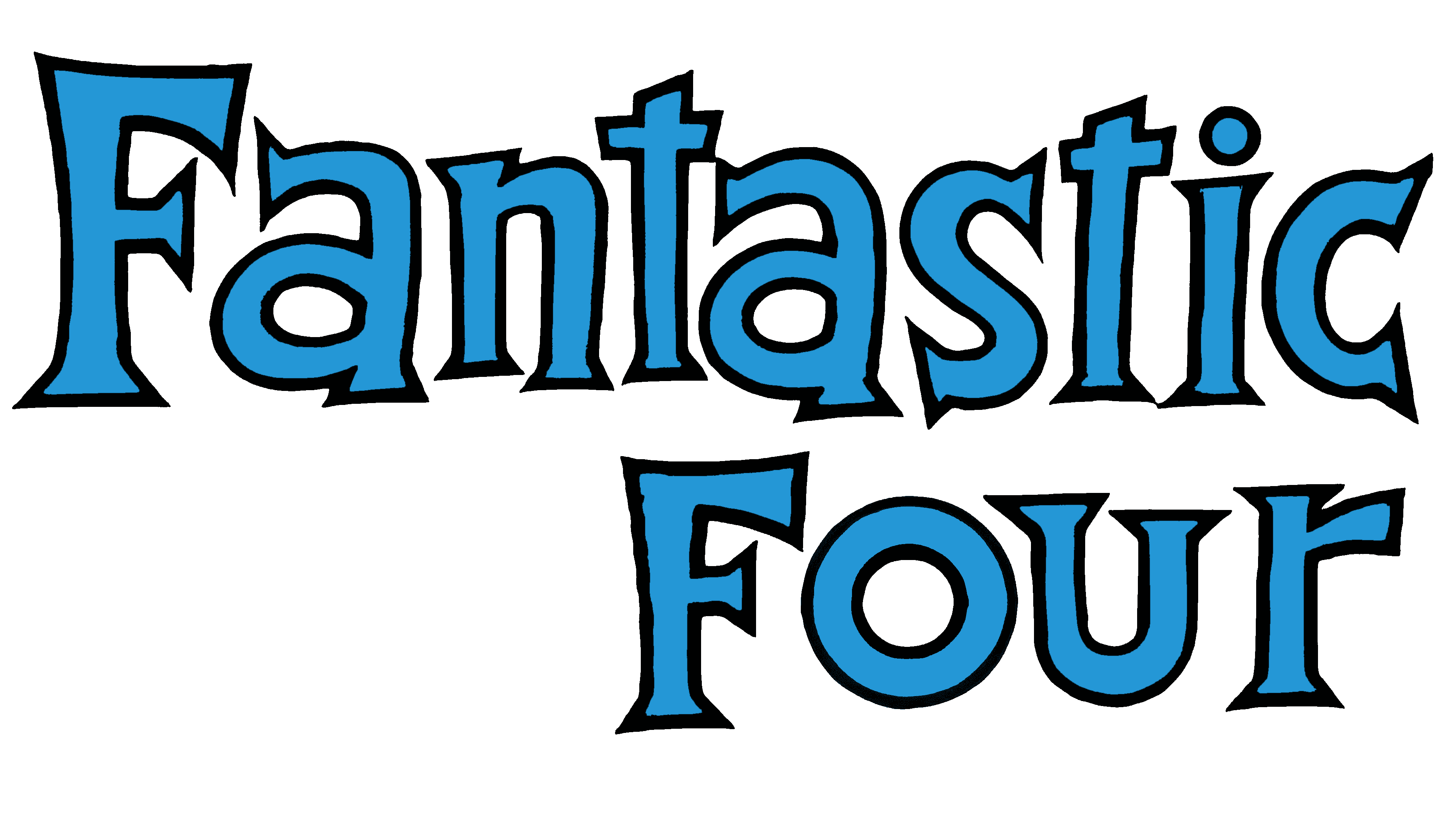
The company is searching. Writers and artists are replaced one after another, and the logo returns to its original 1961 version.
2008 – 2009

Black Panther and Storm replace the team’s family couple. Based on the plot, 16 issues appear. Secret Invasion and Dark Reign were created. The period’s logo gets a new concept. A dark blue “Fantastic” word ends in a blue circle with a white number 4. The dark shades speak of dark times. The circle symbolizes the planet. The large number 4 indicates the team’s significant contribution to maintaining order and peace on Earth. The white color enhances the impression.
2009 – 2012

Marvel returns to its 1975 logo. Despite the franchise’s approaching 50th anniversary, the comics keep appearing. The letters’ forward tilt hints at this. The inscription seems to look ahead, giving the green light to the Dark Reign: Fantastic Four series and the new writer, Jonathan Hickman.
2013 – 2014

The franchise is rebooted again. Volume 4 begins with issue one. In several issues during 2013-2014, the team goes into space to search for answers. The volume’s logo resembles the 1972 logo, but with smoother lettering. The inscription’s curve points to the celestial vault and flight, as does the blue color.
2014 – 2015

James Robinson and Leonard Kirk changed the logo. They created the final comic series, Vol. 5, to bring the story to a dignified conclusion as fan interest waned. The completely white, disappearing Fantastic inscription with the number 4 in the middle of the word seemed to signal the gradual fading of the entire history. The color resembles sugar or cotton candy, and the taste Robinson wanted to leave with readers. The barely visible logo and the fact that the four had fallen apart, leaving only its trace, show this.
2018 – today

As part of Fresh Start, Marvel continued publishing comics. The heroes were brought together again. The new series’ logo featured a pointed Fantastic Four inscription and the number 4 in a circle. The white symbols speak of renewal. The dark blue and light blue shadows are about the franchise’s significant past. Blue also indicates the color of superhero costumes.
The emblem is tilted away from the viewer and seems to fly upward into infinity, foreshadowing the story’s eternal continuation.
Animated series

1967 – 1968

1978

1994 – 1996

2006 – 2007

Font and Colors
Several recurring colors are used in the comic book logos: yellow, red, blue, and white. These colors are associated with both the heroes’ outfits and the missions they undertook.
- Blue symbolizes stretching and flexibility and is the Fantastic Four’s overall color. Initially, the members were scientists, and blue represents science and knowledge.
- Red represents the Human Torch’s fire. It symbolizes danger, speed, and intense battles.
- White symbolizes the Invisible Woman’s transparent fields and invisibility. It foreshadows regular updates and new beginnings in the story.
- Yellow is a shade close to the Thing. It represents joy and success in the team’s collective work.
The uniquely tilted inscription has interesting serrations, as if left by monster fangs. This technique points to the plot’s sharp storylines.