


 Flipkart Logo PNG
“If you’re going to a service, open your bag wide,” the Flipkart logo advises. Finding what you need on the platform is easy, and you can buy instantly. The logo demonstrates significant time savings through online ordering.
In October 2007, former Amazon engineers Sachin Bansal and Binny Bansal launched Flipkart in a rented apartment in Bangalore, investing 4 lakh rupees. The site began as a bookseller, following Amazon’s early model.
Operations were basic. A bedroom served as storage; orders came from Delhi wholesalers and were delivered via local couriers. The first order brought about 50 rupees in profit. In the first year, the company completed around 3,400 shipments. A key step was introducing cash-on-delivery to address low credit card usage and limited trust in online payments.
In 2009, Flipkart hired its first employee and received $1 million from Accel Partners. By year’s end, staff reached 150, with offices in Delhi and Mumbai. In 2010, the company entered the electronics market and launched its logistics arm, Ekart, expanding delivery coverage nationwide. In 2011, Tiger Global Management invested $10 million, and Flipkart introduced services such as FlipkartFirst and a 30-day return policy.
In 2014, Flipkart acquired Myntra for $300 million. That same year, a major sales event generated revenue comparable to a month’s average in just 10 hours. Investors, including SoftBank, Naspers and Tencent, backed further growth, pushing the valuation to $15 billion by 2015.
Competition with Amazon intensified, with heavy spending on pricing and seller acquisition. In 2016, Sachin Bansal stepped down as CEO and was replaced by Binny Bansal. In 2017, losses reached 8,771 crore rupees despite revenue growth, while SoftBank led a $1 billion funding round at a lower valuation.
On May 9, 2018, Walmart acquired a 77% stake in Flipkart for $16 billion, valuing the company at $20.8 billion. Sachin Bansal exited after selling his 5.5% stake. In November 2018, Binny Bansal resigned following an internal investigation, marking the departure of both founders.
Meaning and History
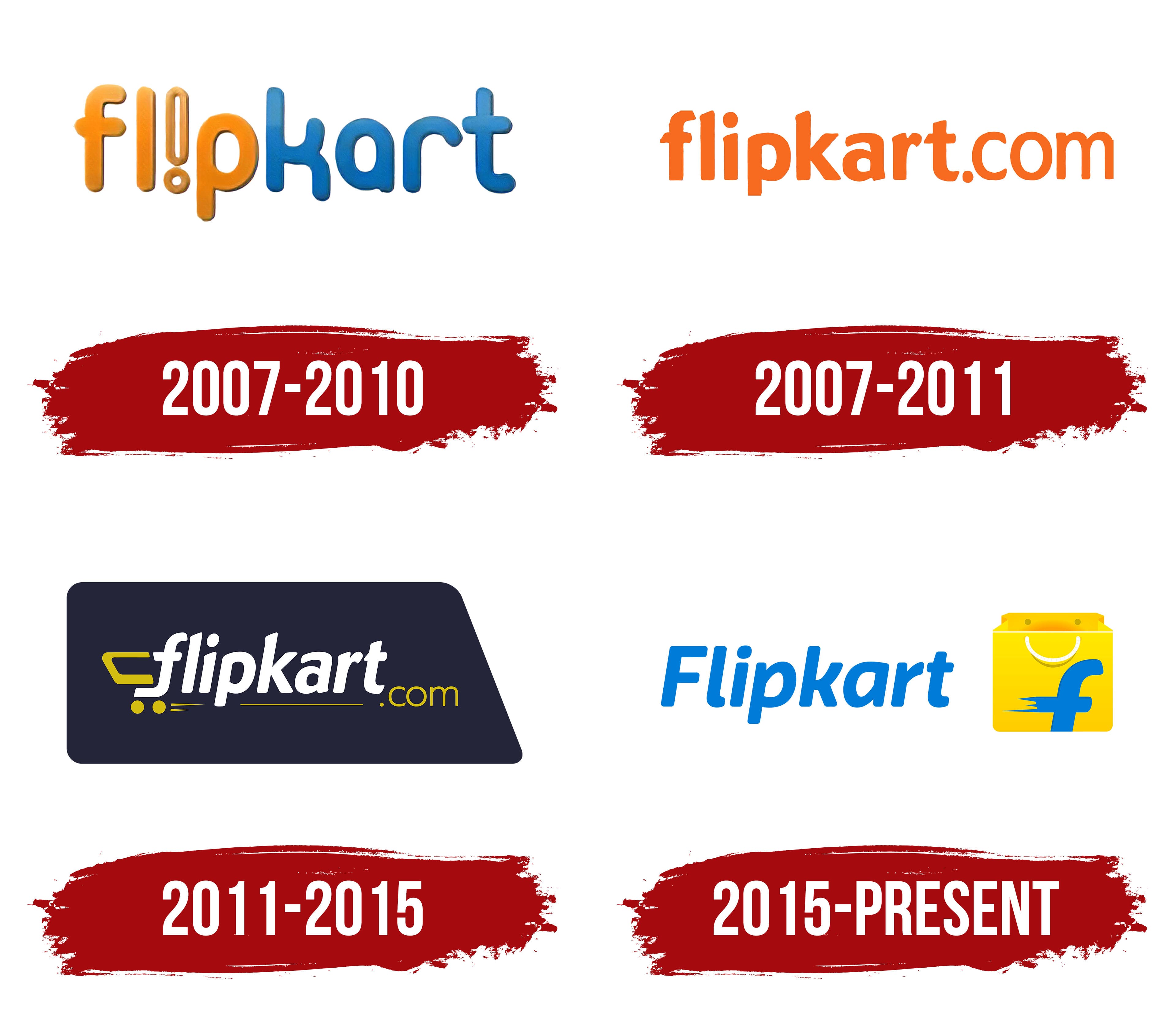
Started as a small, limited online store, Flipkart has expanded year after year, becoming a serious competitor to Amazon. It now also includes a mobile payment service that operates under the parent company’s logo. It has two of them, and both are related to sales.
What is Flipkart?
It is an Indian commercial company and its virtual marketplace. The online service was launched in 2007 and initially focused on books, but it has since expanded its offerings. Its founders are Sachin and Binny Bansal. Walmart now owns the brand and holds more than half the shares. Its headquarters are in Bangalore (Karnataka).
2007 – 2010

The very first Flipkart logo featured the company name. It used a custom bubble font with rounded corners. The word used lowercase glyphs, with the “i” replaced by a white exclamation mark outlined in orange. The first half of the inscription (“f”, “l”, “p”) was bright orange, and the second (“k”, “a”, “r”, “t”) was blue with a slight gradient.
2007 – 2011

In 2007, another logo appeared, this time with the company’s name, followed by a dot, and the domain name “com”. The lettering up to the dot was bolder to stand out. The letters had rounded corners and slanted edges. The main color is bright orange.
2011 – 2015

Initially, the logo depicted a stylized supermarket grocery cart. A handle is drawn on the left, along with two wheels. On the right is the online store’s email address (domain “.com”), making the logo both advertising- and information-driven. In the middle is the full name of the commercial site in lowercase: “Flipkart.”
To form the shape of the grocery basket, the designers used the letter “f.” They bent the leg to the left, creating the bottom element where the wheels attach. Long and short strokes under the label convey forward movement. All elements sit within a horizontal rectangle with a cut-off right corner, adding even more dynamics to the logo.
2015 – today
The current version consists of two details: the name of the retail chain and images of the grocery package, which is usually issued at checkout. The designers placed the word “Flipkart” on the left side and radically changed the font.
On the right side of the logo is the top half of the bag with a hanging handle. On a yellow background, a lowercase “f” appears with the bottom cut off. It has a blurred horizontal stroke, which adds originality and reflects the dynamics of movement. Visually, this symbol is very similar to the Facebook icon: the same rounded, smooth lines, except for a slight tilt.
Font and Colors
Both logos are based on the name and trade theme, expressed in different elements. If it was previously associated with a grocery cart, the emphasis has now shifted to a shopping bag. In both versions, the designers kept the same palette by simply rearranging the colors.
The 2015 emblem uses the Riona Sans Bold Italic typeface by Mika Melvas. The “r” has a third of the cap removed, the “l” has a lower element added, as if it were a lowercase letter, and the “p” and “a” have oval gaps. Simultaneously, the original logo was set in Dundee RR Condensed Extra Bold, designed by Pat Hickson.
The logo’s color is stable because the range is nearly the same in both the debut and current versions. The current emblem uses a selection of colors from Vivid Orange Peel, Banana Yellow, and True Blue, combined by Keshav Naidu.
FAQ
What font is used in the Flipkart logo?
The logo uses Riona Sans Bold Italic, modified to fit the logo’s design. The modifications include rounding the sharp corners and curving the upper cross stroke of the “k.” These changes give the logo a distinctive look while keeping Riona Sans’s clean, modern style.
Using Riona Sans Bold Italic creates strong visual uniqueness for the brand. The bold, italicized letters convey dynamism and energy, reflecting the brand’s vibrant, forward-thinking nature. The rounded corners and curved elements add friendliness and approachability, making the logo appealing to a wide audience.
What are Flipkart’s brand colors?
Flipkart’s primary brand colors are blue and yellow. Blue is consistently used in the top header across all platforms, providing a recognizable, cohesive look. This shade of blue conveys trust, reliability, and professionalism, key aspects of the brand’s identity.
Yellow draws attention to notifications and hover actions. This bright and vibrant color grabs attention and highlights important information.
What does the Flipkart logo mean?
The logo reflects trade and commerce. It features a package that symbolizes the available products and the site name, set in the modern Riona font. The large “F” with a bar-shaped crossbar highlights the dynamic buying process, suggesting speed and efficiency.
The logo uses yellow, blue, and white. Yellow grabs attention and suggests positivity, blue conveys trust and reliability, and white adds clarity and simplicity. These colors create an inviting and professional image.
Who is designing the Flipkart logo?
The brand’s design team, which included Umbrella Design professionals, created the modern logo. They aimed to create a distinctive, versatile logo that works well across media platforms, from desktops to billboards.
Keshav Naidu was crucial in choosing the color palette and making the logo vibrant and appealing. The design team and Umbrella Design ensured that every logo element, from its shape to its colors, would stand out and be easily recognizable.