


 Foster Logo PNG
The Foster logo reflects the Australian spirit: sun, sea, and ease. It hints at the sky and the water, creating a feeling of warmth and relaxation. The image evokes associations with friendly gatherings and calm evenings when everything feels simple and genuine.
Foster’s traces back to 1886, when American brothers William and Ralph Foster arrived in Melbourne from New York with refrigeration equipment that enabled lager brewing in a hot climate dominated by ale.
In 1887, they founded Foster’s Brewing Company. They brewed the first beer in February 1888 and released it in March, promoting it as a cold, modern drink delivered on ice, which drew public attention.
By 1889, the founders sold the brewery to local investors and returned to the United States. The brand remained, and in 1907, it joined Carlton & United Breweries.
Through the early twentieth century, Foster’s operated mainly in Australia, competing with Tooheys and XXXX. Growth in the 1950s and 1960s came from standardization and advertising.
In 1981, the brand entered the UK under license, aligning with rising demand for lager. Campaigns like “Australian for beer” shaped its image abroad.
During the 1980s and 1990s, Foster’s Group expanded, acquiring Molson in 1990 and Beringer Blass Wine Estates in 199, to build a parallel wine business.
In 2011, the company split. The beer division went to SABMiller, while Treasury Wine Estates handled wine. In 2016, SABMiller was acquired by SAB InBev, adding Foster’s to its portfolio, which already included Budweiser, Stella Artois, and Corona.
The brand has a modest share in Australia, trailing Victoria Bitter and Carlton Draught, but remains widely recognized in the UK under Heineken International.
Meaning and History
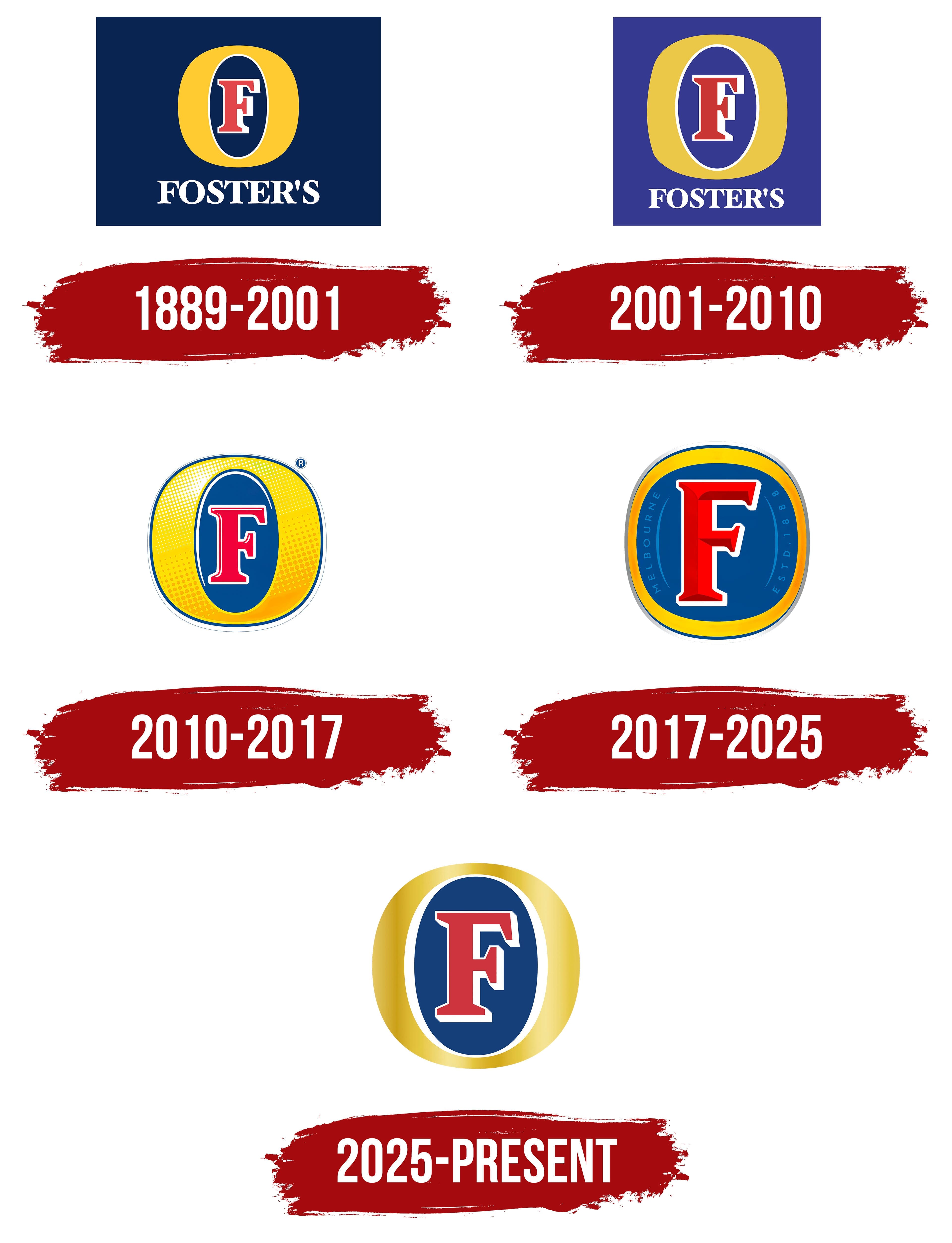
The brand aims to stand out on store shelves, and Foster effectively uses the large letter “F,” underscored on the main label and the neck, to make it easily recognizable from a distance. The Foster logo is modern and bright, with an informal and informative character.
What is Foster?
It is the informal name of the Foster’s Lager brand, under which it produces light beer. Worldwide, it is the best-selling beer brand, but at home, it is not in high demand. Carlton & United Breweries owns the brand, and the Japanese company Asahi Group Holdings, Ltd. has owned it since 2020.
1889 – 2001
The first Foster’s logo centers on a large, golden-yellow letter O shaped like an elongated oval. Inside, the letter F is rendered in a rich red-orange, serving as the main semantic and visual accent of the entire structure.
The letter O’s proportions differ from a classic oval. The sides are wider than the top and bottom, giving the outline a heavy, solid appearance. A thin white line runs between the outer golden outline and the dark blue ellipse, separating the color areas. The inner dark blue field serves as the background for the letter F. The symbol is executed in a strict serif style with massive serifs. A light outline around the red-orange symbol further emphasizes its dominance within the overall structure.
Below the main symbol is the name “FOSTER’S”. The wordmark is set in white, uppercase serif letters.
The entire image is set on a rectangular dark blue field that matches the shade of the letter O’s inner ellipse. The combination of golden yellow, red-orange, white, and blue creates a bright, easy-to-read image. As an Australian beer brand, Foster’s entered the international market with an emphasis on consistent product quality, and the early version of the mark helped shape the company’s visual image. In later revisions, details changed, but the key techniques of the first version remained present in subsequent designs.
2001 – 2010
Foster’s updated the mark, maintaining continuity and limiting changes to targeted adjustments. First, they altered the shape of the letter O. A square-like shape replaced the smooth oval of the previous version, which had rounded corners. This added visual weight to the mark and expanded the inner field that contains the letter F.
After the reworking of the inner contour, the red letter F occupied more space and became more dominant in the overall composition. Its color took on a darker, denser tone than the earlier version. The white outline around the symbol was retained and still separates it from the blue background.
The FOSTER’S wordmark beneath the main symbol was reduced. Its width now matches the letter O. The typographic base remained unchanged.
The background also changed. The rectangular shape shifted to a square, and the blue became lighter and softer than the previously used dark tone. The yellow outline of the letter O took on a calmer hue, and the overall intensity of the color combination decreased.
The updated image appears cleaner and calmer, while the key features of the previous period remain visible in the overall form and structure.
2010 – 2017
The Foster’s logo update in 2010 demonstrated that the brand could radically change its visual identity while preserving its internal identity. The new version appeared a year before SABMiller acquired the brand and was developed by the BrandMe team led by John Winn. The image took on a more premium tone, strengthened associations with Australian origins, and conveyed a sense of lightness and positivity.
A complex three-dimensional model replaced the flat execution, adding gloss effects and an internal glow. The letter O became a golden medallion. Its surface is rendered in a warm yellow range, with a soft transition from light, dotted highlights at the top to a rich orange-yellow at the bottom. The dotted gradient and polished effect create a sense of volume and inner illumination.
The letter’s inner space is filled with dark blue. The shade shifts toward royal blue with a cool sheen and a slight reflective effect. Along the upper edge, a white, curved line mimics a light highlight, enhancing the form’s depth.
The letter F inside the blue ellipse takes on a rich cherry red shade. A clean white outline separates the symbol from the background. Thin, light strokes complement the letter, creating the illusion of reflections and volume. The typeface is heavy, with large serifs that convey solidity and status.
The edge of the golden shape is finished with a three-layer outline. The multi-level frame visually separates the mark from the surrounding space, thereby strengthening its cohesion.
The updated Foster’s logo became the basis for the entire brand packaging, including glassware, bottles, and cans. The visual image took on a lighter, fresher tone while maintaining its connection to Australian origins and the brand’s sunny mood.
2017 – 2025

In the spring of 2017, Foster’s was surprised again when it presented an updated mark, abandoning the previous system of shapes and color combinations. The Amsterdam agency VBAT carried out the work. Instead of the familiar letter O, a thin yellow ring appeared with soft expansions at the top and bottom. Its shade resembles orange with a honey undertone, creating warmth and lightness.
The image’s core is a dark blue, asymmetrical circle. The color is dense and saturated, and the surface is smooth. At the center is a large letter F, scaled up from previous versions. The symbol is rendered in a rich red, with smooth tonal transitions that emphasize its relief. The left side appears darker, while the right is filled with light highlights. A thin white line neatly defines the letter’s edges.
Additional inscriptions sit inside the blue circle and are arranged vertically. MELBOURNE appears on the left, and ESTD. 1888 appears on the right. A thin sans-serif typeface is set in a light blue color and blends softly into the overall composition. Curved lines separate the text from the central letter and follow the circle’s inner contour.
Overall, the emblem is perceived as a metal badge or commemorative medallion. A subtle shadow along the edge enhances the sense of volume. The image evokes souvenir aesthetics, giving the brand a more premium, collectible appearance.
2025 – today
After several years, Foster revised the logo design again, turning to an earlier style from the brand’s visual history. The oval and the letter F inside returned as the foundation. The updated symbol consists of two shapes: an outer golden oval and an inner blue ellipse.
The yellow oval uses a gradient that smoothly transitions from darker gold on the left to lighter, shinier gold on the right. The surface appears smooth, with a gloss effect and light reflections. The inner part is an ellipse filled with a uniform dark blue. A white ring of uneven width runs between it and the outer contour, wider on the sides and narrower at the top and bottom.
The letter F is centered in the blue field, which is a warm raspberry red. A thin white outline around the symbol is slightly shifted down and to the right, creating a sense of added depth.
The new design is again perceived as a concise, bright mark that connects to Australian beer heritage and the brand’s history.
Font and Colors
The new logo features a recognizable letter “F” with serifs, but in this version, it has been redrawn. Its right-side ends are tilted at the same angle, creating a visual effect of movement. Other inscriptions are less noticeable because they use a completely different font: a thin, small sans-serif typeface.
Foster’s classic color palette consists of red, blue, and gold. It has been preserved for several decades, but the shades are now more saturated and shiny. The yellow color evokes the beer’s amber hue and is associated with freshness and sunlight. The light gradient makes the emblem look voluminous. Thin white outlines around the letter “F” and the medallion’s silver frame dilute the overall brightness.