Gartner Logo PNG
The Gartner logo is light and minimalist, focused on the brand and its concept. The logo’s main strength is its readability. It looks confident and serious, conveying reliability in providing services. The emblem’s strict style indicates that the company takes its work seriously.
Gartner began in 1979, when Gideon Gartner founded Gartner Group in Stamford, Connecticut. The company entered the still young IT consulting market by selling paid research reports and advisory services to corporate clients. Its early work focused on computer hardware, software, and technology vendors at a time when large companies needed outside analysis before making IT purchases.
In 1986, Gartner Group went public on NASDAQ, using the listing to expand its analyst staff and market reach. In 1988, Saatchi & Saatchi, the British advertising group then trying to diversify into research and consulting, bought a controlling stake. In 1990, investors, including Gideon Gartner, bought the company back through a leveraged buyout. In 1993, Gartner returned to the public markets on the New York Stock Exchange.
Gideon Gartner left in 1991 and later founded Giga Information Group, which became a direct competitor in IT research. In 2003, Giga was acquired by Forrester Research, founded in 1983 and long positioned as a competitor to Gartner in technology consulting. In 2001, Gartner Group changed its name to Gartner, Inc. In 2005, it acquired Meta Group for about $162 million, adding analysts, clients, and market coverage.
Gartner became known for the Magic Quadrant, introduced in the early 1990s to compare technology vendors by completeness of vision and ability to execute. Its Hype Cycle also became a common model for describing the rise, disappointment, and practical use of new technologies. In 2017, Gartner bought CEB Inc. for about $2.6 billion, expanding into management, HR, finance, and legal research. Its main competitors included Forrester Research and IDC, founded in 1964.
Meaning and History

Gideon Isaiah Gartner began his career at System Development Corporation and IBM, later founding a company focused on researching the security of high-tech operations. His first company, Computer Decisions, suffered losses during the latter half of the 20th century due to the recession. In 1979, he and David L. Stein created the Gartner Group to track processes in the computer industry.
Later, the company’s name was shortened to a single word that represented its founder. The Gartner logo has always had a strict style, emphasizing the seriousness of the company’s work and its business approach. The uniform color palette also represents this: dark blue symbolizes confidence, strength, loyalty, intellect, and success.
What is Gartner?
Gartner is an American company that operates in the analytics and consulting sector. Its core services include information technology analysis and consulting on a range of issues. It was founded by Gideon Gartner in 1979 and has grown into a professional center that collaborates with major companies and government agencies in the United States. The head office is located in Stamford, Connecticut.
1979 – today

The emblem is text-based, so particular attention is paid to fonts and the inscription’s style. The simple, concise design positions the company as highly responsible and business-oriented, without distraction. Its key priority is executing entrusted work professionally and as efficiently as possible. The visual identity reflects the principles the company upholds, its core concept, and its commitment to security.
The inscription is made with a smooth, sans-serif font. The letters are even, printed, and bold. All letters are lowercase except the first. This design again confirms the seriousness of Gartner’s business direction and its strong focus on work processes. In addition, the chosen style displays clearly on screens of any size without glyph distortion.
Font and Colors
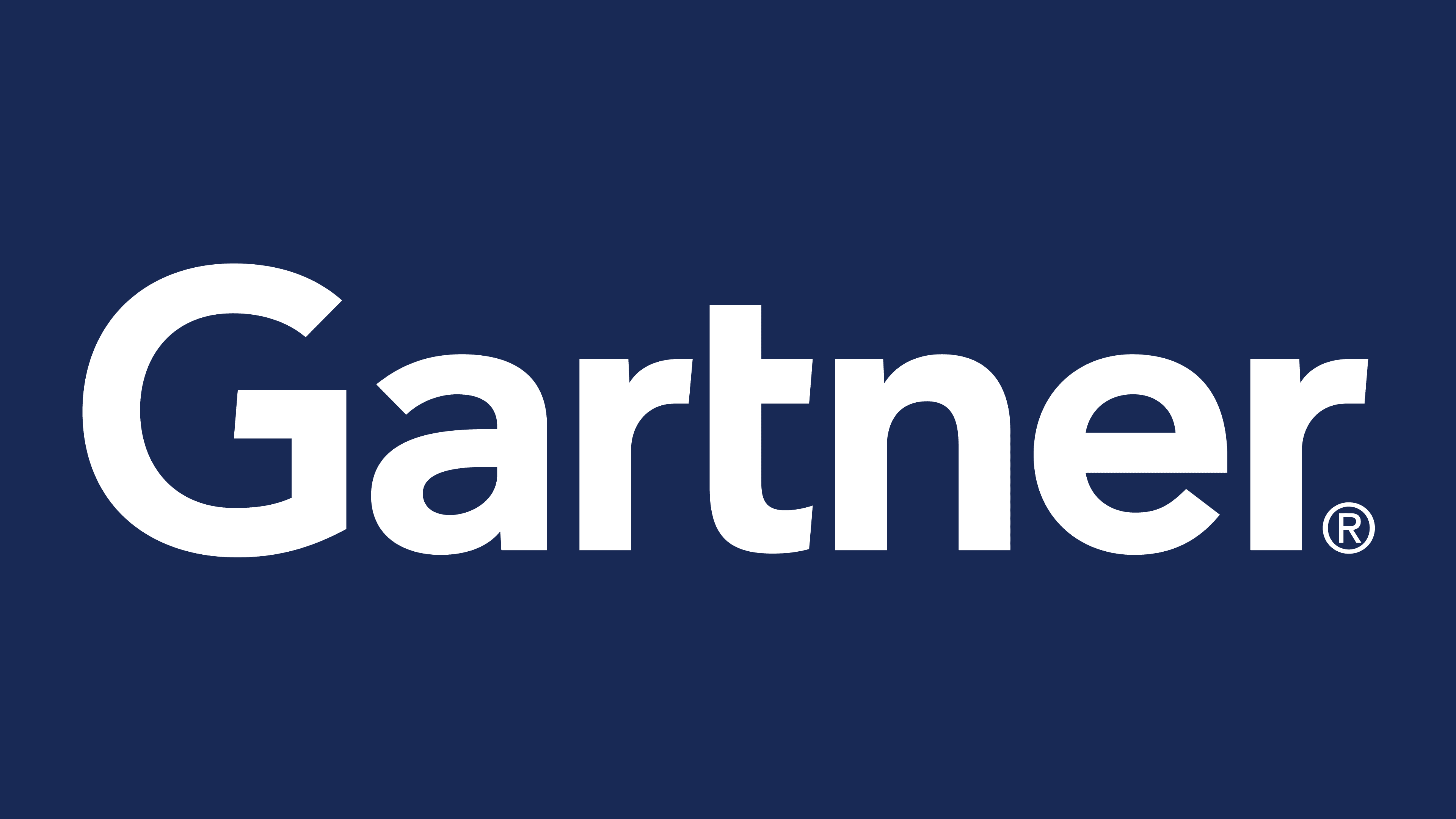
For the Gartner logo, a simple, clear font with minimal non-standard elements (e.g., a “t” with a half-bar) was chosen. It resembles the Egon Sans Bold typeface from TipografiaRamis with slight glyph modifications. Smooth, evenly spaced letters on a blank background indicate the company’s openness. The color palette also conveys this: blue represents success, intellect, and confidence.