


 Gillette Logo PNG
The Gillette logo is a classic example of a masculine and reliable brand. It demonstrates a thorough approach to developing comfortable, effective shaving products. The emblem represents a company recognized worldwide for product quality.
In 1855, King Camp Gillette was born in Wisconsin and spent years as a traveling salesman. While working at Crown Cork & Seal, inventor William Painter advised him to develop a disposable product to drive repeat purchases. In 1895, Gillette conceived the idea of a thin, double-edged steel blade cheap enough to discard after use.
After six years of development, he partnered with William Emery Nickerson and, in 1901, founded the American Safety Razor Company, which soon became the Gillette Safety Razor Company. In its first year, the company sold 51 razors and 168 blades. By 1903, sales reached 90,884 razors and 123,648 blades. In 1904, Gillette secured a patent, and Nickerson introduced a blade-grinding machine that scaled production. By 1905, the company had expanded to London and Paris, then Canada, and began European distribution in 1906.
World War I drove rapid growth. The US military required soldiers to carry shaving kits, and Gillette supplied compact sets with disposable blades. In 1917, sales reached 1.1 million razors; by 1918, Gillette distributed 3.5 million razors and 32 million blades to troops.
After the patent expired in 1921, competition increased. Gillette introduced the New Improved model and adopted a pricing model based on low-cost handles and recurring blade sales. Later diversification included acquisitions of Braun AG in 1967, Oral-B in 1984, and Duracell in 1996.
Product development continued with Trac II in 1971, Atra in 1977, and Sensor in 1989. Competitors like Schick and Wilkinson Sword challenged its position. In 1998, Gillette launched Mach3. In 2005, Procter & Gamble acquired Gillette for $57 billion, and in 2006, it released Fusion.
Meaning and History
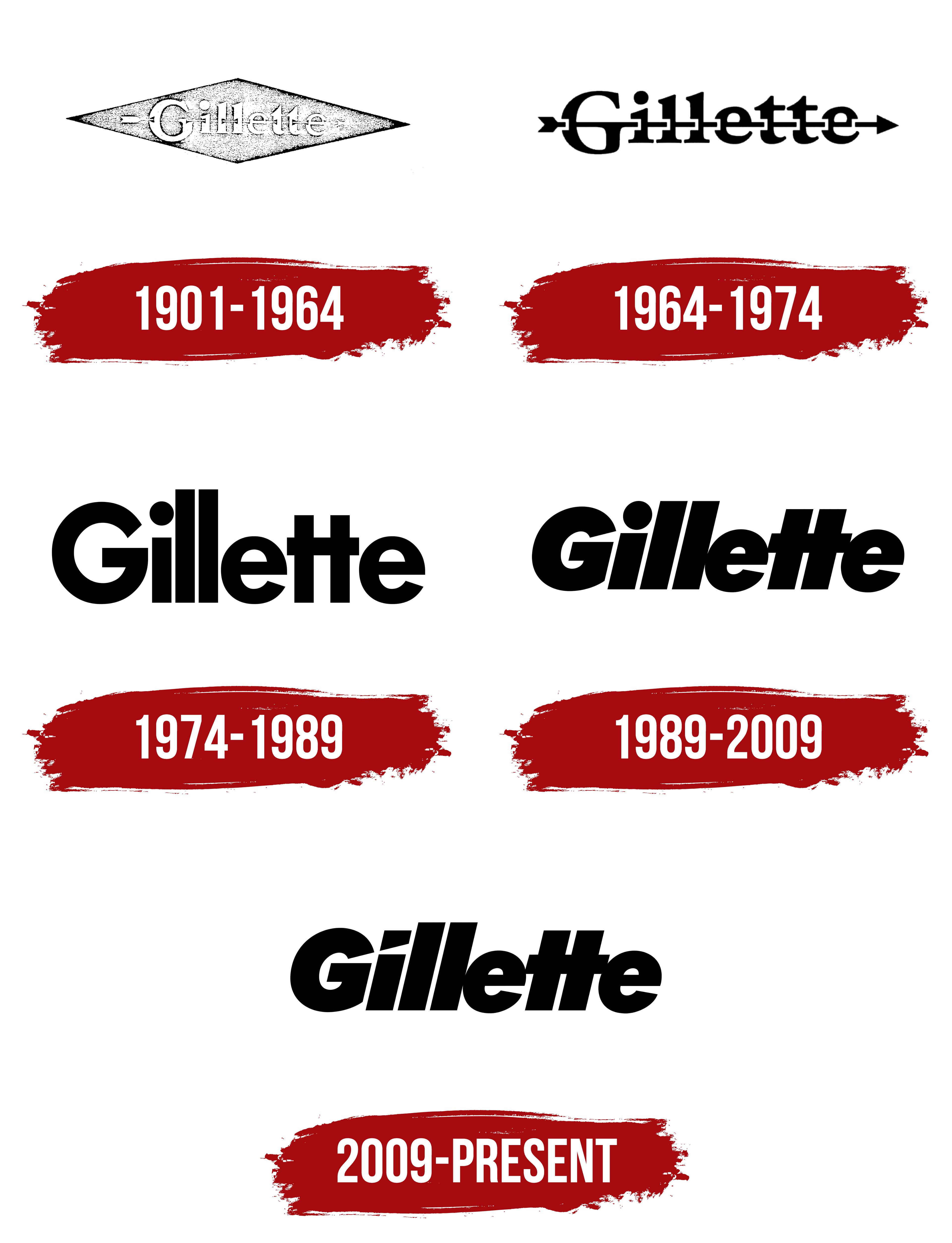
The company adopted its emblem almost 120 years ago, making it a classic. It features the company name, in honor of its creator. The logo has been revised several times to stay relevant and attract modern buyers.
What is Gillette?
Gillette is a trademark of Procter & Gamble, a multinational American corporation. It is a brand of cosmetic products for men and women, including shaving accessories. Before becoming a P&G division, Gillette was independent. It remained independent from 1901 to 2005.
1901 – 1964
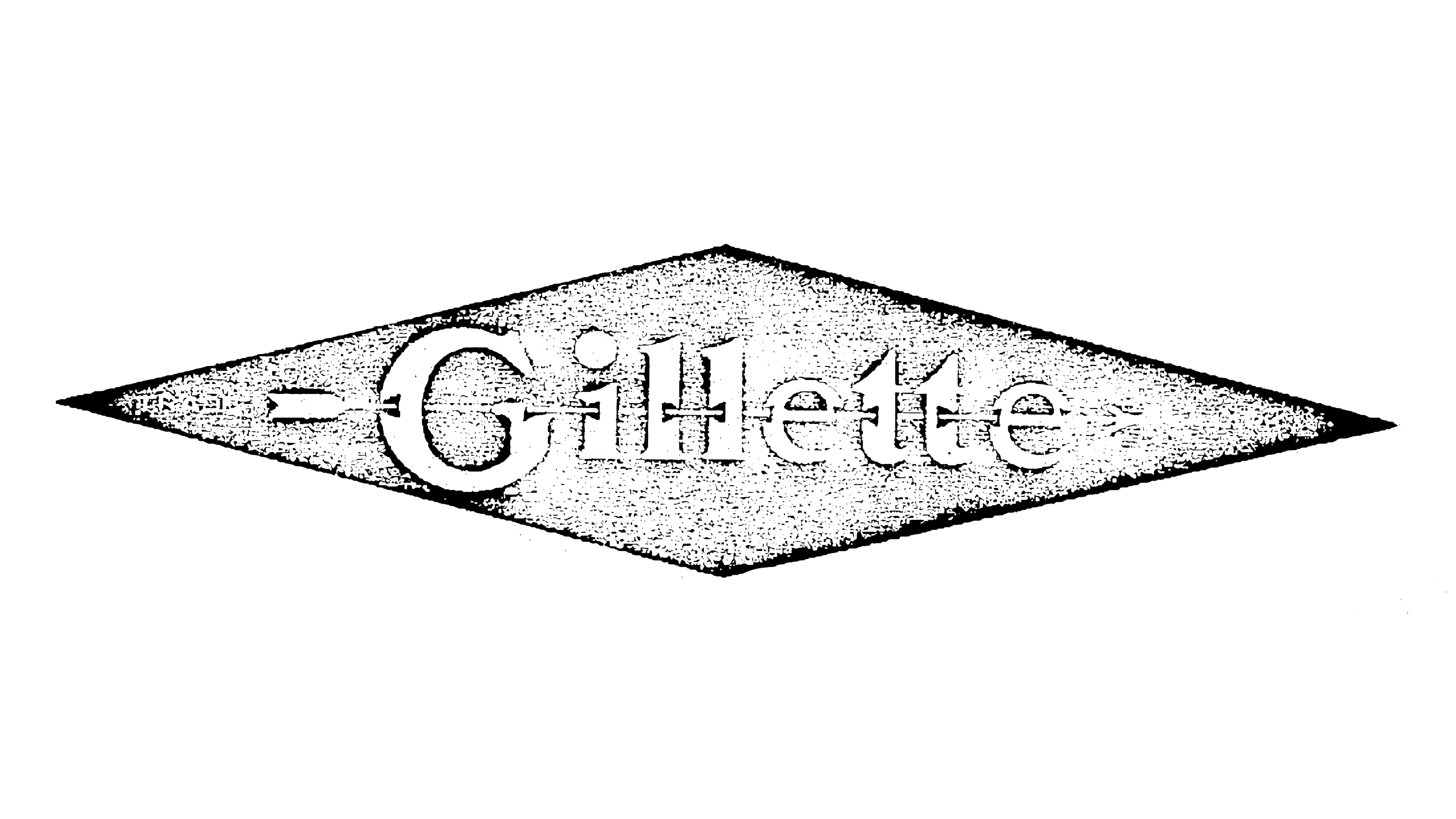
In the debut version, Gillette is written in lowercase, except for the uppercase “G”. “L” and “g” have design features; “t” is distinguished by an extraordinary presentation. Still, the logo was not the first thing that struck me, despite the arrow piercing the letters (it denotes the sharpness of the branded blades). The emblem sits inside the rhombus and is painted gray.
1964 – 1974
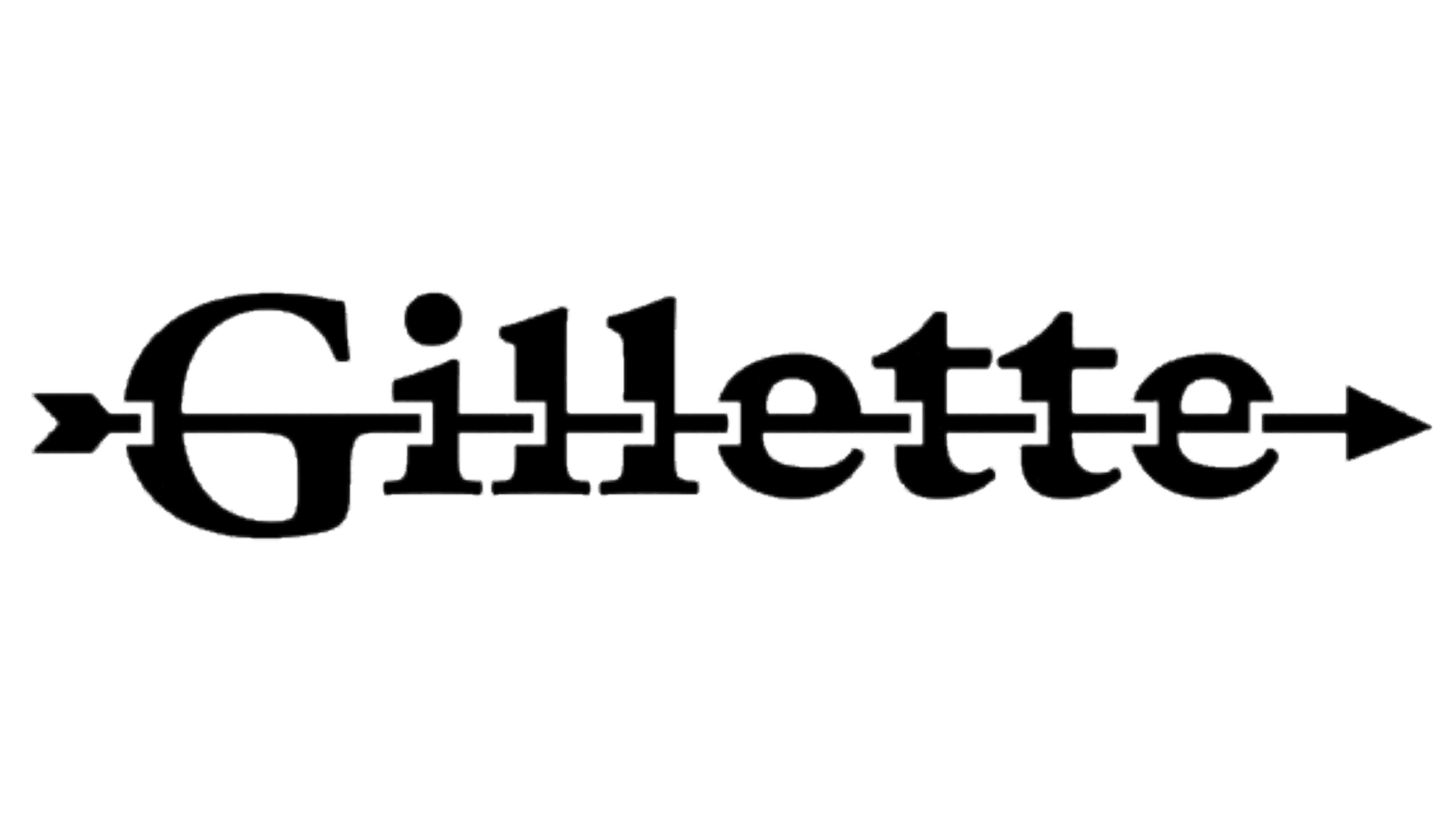
All elements have changed radically, except the arrow, which symbolizes the ease of sliding razors. The letters grew larger; the lower part of the capital “G” was lowered, and the upper part aligned with the other characters. The gray color is gone, replaced by coal black. Only the background and the holes from the arrow that goes through the letters remained white.
1974 – 1989
This is a legendary period in the emblem’s history because the designers removed the arrow and expanded the name. It is now visible and immediately apparent. The developers also added speakers, emphasizing the double “ll” and “tt”: the former are elongated and resemble solid pillars, while the latter are fused and rise above the adjacent “e.” This technique has never changed and remains relevant today. Despite the 1989 logo update, some countries used this version until 1992.
Although the brand’s verbal designation became much more readable, it still didn’t clearly convey the company’s products. Therefore, edits were needed to correct the oversight.
1989 – 2009
At that time, the modern label prototype emerged. Compared with the 1974 version, it became much more visible and confident. The letters in the word Gillette remain in lowercase, except for the first. The space between them disappeared, so the oblique signs are closer together, and the “e” links to the previous symbols. In parallel, another version was introduced with wider letter spacing.
2009 – today

In this year’s logo, the developers redesigned the “i”: they removed the round dot and added an asymmetrically cut square. With a smooth cut, they emphasized the razor’s impeccable sharpness. An “accidental” notch also appeared on the letter “G”: the lower-right part seemed struck by the blade. This happens when you accidentally cut your fingertip with a well-sharpened razor. The oblique spelling and fonts remain the same.
Font and Colors
The logo’s key element combines text and graphic design. It shows the brand name transforming from complex shapes into a concise form. The inscription is a single word, “Gillette,” linking the emblem to advertising and information. The letters are thick and bold. The twin “ll” is taller than the “tt.” They are also unique because a common crossbar unites them. Instead of a dot above the “I,” they use an obliquely cut rectangle. The “G” has a similar inward cut at the bottom of the right leg.
The authors chose a strict, chopped, grotesque typeface, Futura Extra Black Italic, for the corporate symbol. Linotype first introduced this font, designed by Paul Renner. The color scheme harmoniously complements the sharpened letters. It is in monochrome, with black characters on a white background. On product labels, the word may be colored dark blue.