


 Grameenphone Logo PNG
Despite its abstract elements, the Grameenphone logo is easy to understand. It represents communication, which is the basis of telecommunications services. The symbol also highlights the brand’s uniqueness and versatility, helping attract potential customers.
Grameenphone grew from an unusual partnership between Telenor and the Grameen network. Iqbal Quadir, a Bangladeshi investment banker who left Wall Street in 1994, came up with the idea, believing mobile phones could connect poor rural communities to markets, information, and money services. By November 1995, the investor group included Telenor (51%), Grameen Telecom (35%), Marubeni Corporation (9.5%), and Quadir’s Gonofone Development Corporation (4.5%).
The company was registered on October 10, 1996. In November, Bangladesh granted it a GSM license as the telecom market opened beyond the state-run Bangladesh Telegraph and Telephone Board. Aktel (now Robi) and Banglalink also received licenses. Grameenphone launched its service on March 26, 1997, on Bangladesh Independence Day. Prime Minister Sheik Hasina made the first call to Laily Begum, one of the first participants in the Village Phone program.
Village Phone became the company’s defining early program. A rural woman linked to Grameen Bank received a microloan to buy a mobile phone, then sold call access to neighbors. For villages without landlines, it meant contact with cities, market prices, and relatives abroad. The program later won awards from the GSM Association, the Petersburg Prize, and the International Telecommunication Union.
Growth was fast. Grameenphone had 3.8 million subscribers by the end of 2004 and 10.8 million by January 2006. Telenor raised its stake to 62% after Quadir and Marubeni sold their shares. The company launched rural internet information centers in 2006, listed in Dhaka and Chittagong in 2009, and received a 4G/LTE license in February 2018. Its main competitors remain Robi Axiata and Banglalink.
Meaning and History
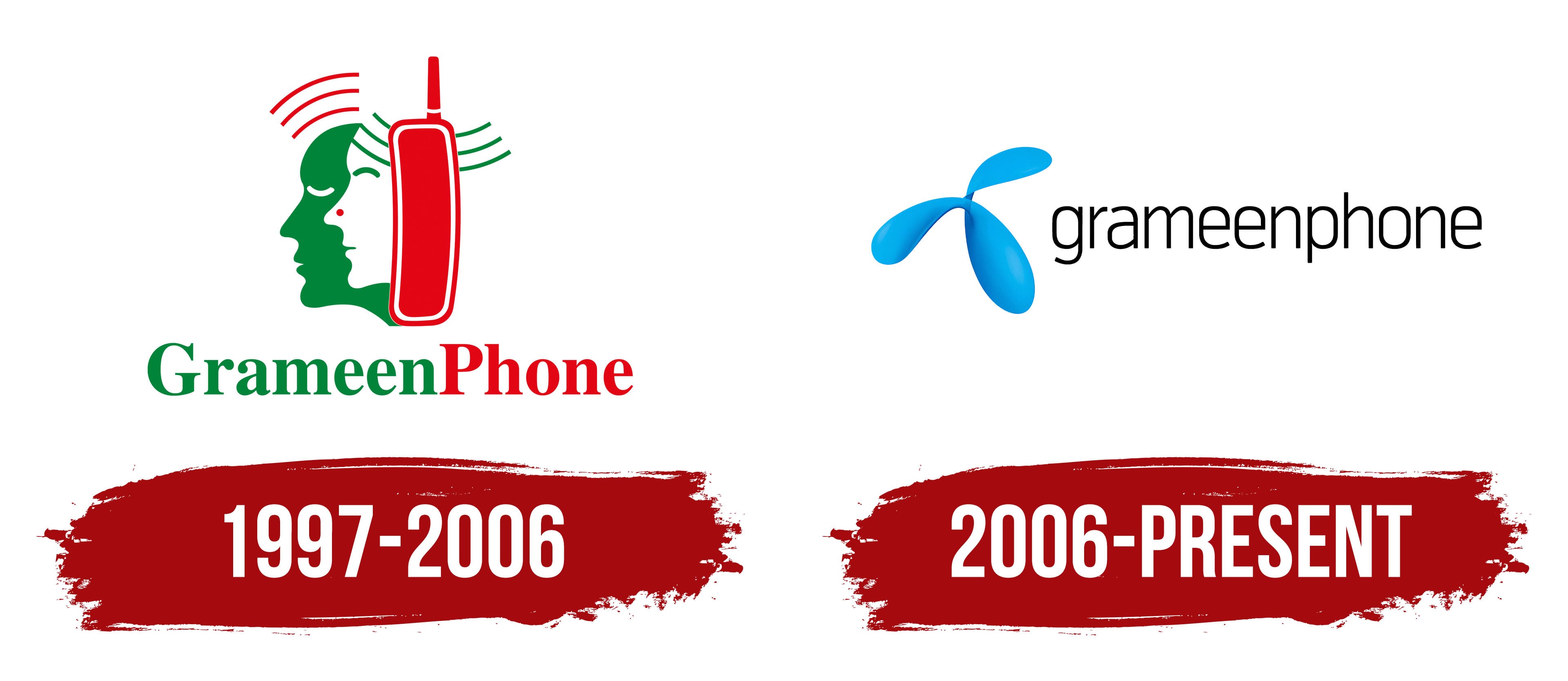
Among Bangladeshis, visual brand awareness is at its highest. Throughout the company’s existence, only two versions of the logo were used. They were decorated in different styles, yet they convey Grameenphone’s work and its focus on local customers.
What is Grameenphone?
It is the largest mobile operator in Bangladesh by the number of connected users. The company offers services related to the Internet, mobile communications, etc. The number of subscribers is growing every year.
1997 – 2006

The first version of the logo was introduced in 1997. It consisted of a wordmark with an emblem on top. The brand name was available in two colors: green and red. Hence, there are associations with Bangladesh’s flag. All letters except “G” and “P” were lowercase.
Above is the emblem. Two faces, a woman and a man, overlap. At the top, near the ear, is a red telephone receiver. Wavy lines also emanate from each figure, representing conversation. Thus, the company transmits people’s conversations in schematic form.
2006 – today
The only redesign was introduced on November 14, 2006. Interestingly, a Bengali translation is also used alongside the classic logo.
The image itself has been completely redesigned. Now the name Grameenphone appears in black, with thin lines. All characters are written in lowercase. The verbal inscription looks concise.
The emblem on the left is an abstract blue figure. It looks friendly and attracts potential customers. As a result, the new logo does not reference the classic color palette. This is a completely new option that deserves to live on. Moreover, the two elements contrast well and look harmonious.
Font and Colors

At different stages of Grameenphone’s development, different fonts were used for word inscriptions. It originally used a bold sans-serif typeface with two distinct elements, conventionally separated by capital letters. However, the current version is more concise. Thin lines in lowercase letters convey the company’s friendly attitude toward customers, fostering greater loyalty.
As for the color palette, the original logo used the colors of Bangladesh’s national flag: green and red. The company later abandoned this option. Now, black and blue are used, which look modern and stylish. It can be placed on absolutely any surface. The mysterious blue emblem increases interest among the target audience