


 Grundfos Logo PNG
The pump manufacturer uses an abstract logo that alludes to its core business. The Grundfos logo attracts attention for its unusual appearance, combining visual lightness and massiveness, softened lines, and sharp angles.
Grundfos began in Bjerringbro, Denmark, where Poul Due Jensen opened a small workshop in the basement of his home in 1944. The company first worked on water supply and heating systems for nearby farms under the name Bjerringbro Pressestøberi og Maskinfabrik. In 1945, after failing to find a reliable electric pump for a local farm order, Jensen built his own. The result was Foss 1, the company’s first pump, later nicknamed “The Pig.” Only 26 units were sold.
The product line developed quickly. In 1947, the company introduced Dybfoss for deeper wells, and in 1949, it began exporting to Norway. In 1952, its engineers developed the CP centrifugal pump, a cheaper, more compact alternative to earlier piston pumps. In 1955, the Archimedean screw became the company symbol after an employee noticed its similarity to a section of the CP pump. That same year, Grundfos released the VP 32 circulation pump for heating and hot-water systems.
International growth started in 1960 with a production and sales unit in Wahlstedt, Germany. The company adopted the name Grundfoss in 1967 and changed it to Grundfos in 1968. In 1972 and 1973, subsidiaries opened in France and the United States. In 1975, Poul Due Jensen founded the Poul Due Jensen Foundation, which later became the company’s controlling owner.
In 1992, Grundfos introduced JetSub, a submersible pump with electronics built into the motor housing. In 1999, it launched the Magna circulation pump, and in 2000, it acquired Finland’s Sarlin Pump Co. In the global pump market, Grundfos competed for decades with Wilo and Xylem.
Meaning and History

Few logos were presented throughout the company’s time in the target audience’s market. Moreover, the first was immediately associated with pumping systems, thanks to the bright emblem. The logo redesign made it more minimalistic. This is the version currently in use. In general, the brand’s visual identity is highly regarded by the organization’s customers.
What is Grundfos?
This is one of the largest companies in terms of pumping equipment production. Every year, millions of people purchase pumping units made under this brand.
Old
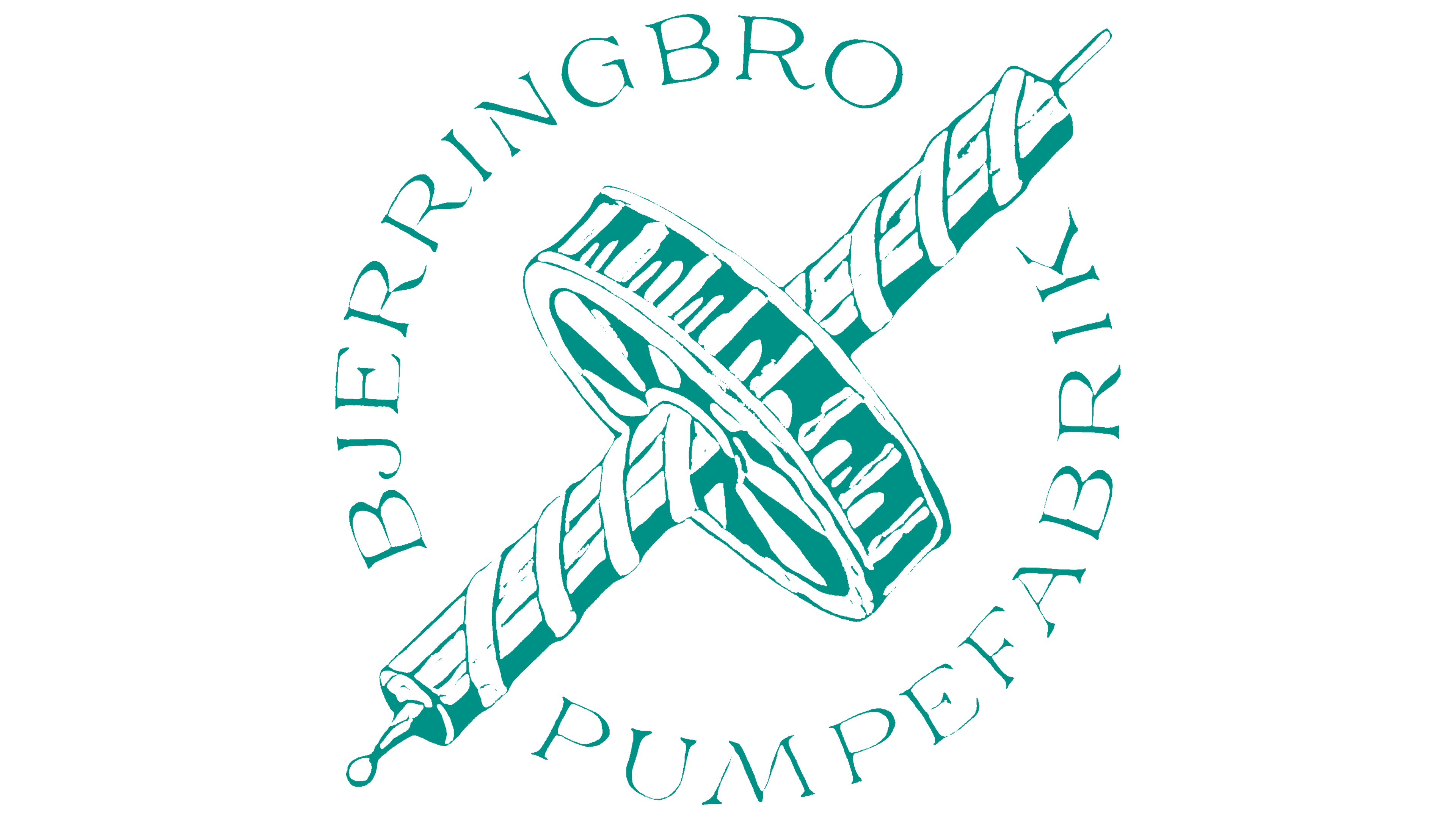
The original version of the logo was introduced in 1953. Interestingly, its basis was the abbreviation “B.P.” It was used for the first two years, but in 1955, one of the employees presented his version to Paul Due Jensen. This logo consisted of a word inscription and an image of Archimedes’ water screw at the center. Interestingly, this screw was very similar to the inside of the CP centrifugal pump. Diagonally (top-left and bottom-right) were the words “Bjerringbro” and “Pumpefabrik”.
As a rule, all the main elements were made in green on a white background.
before 2005
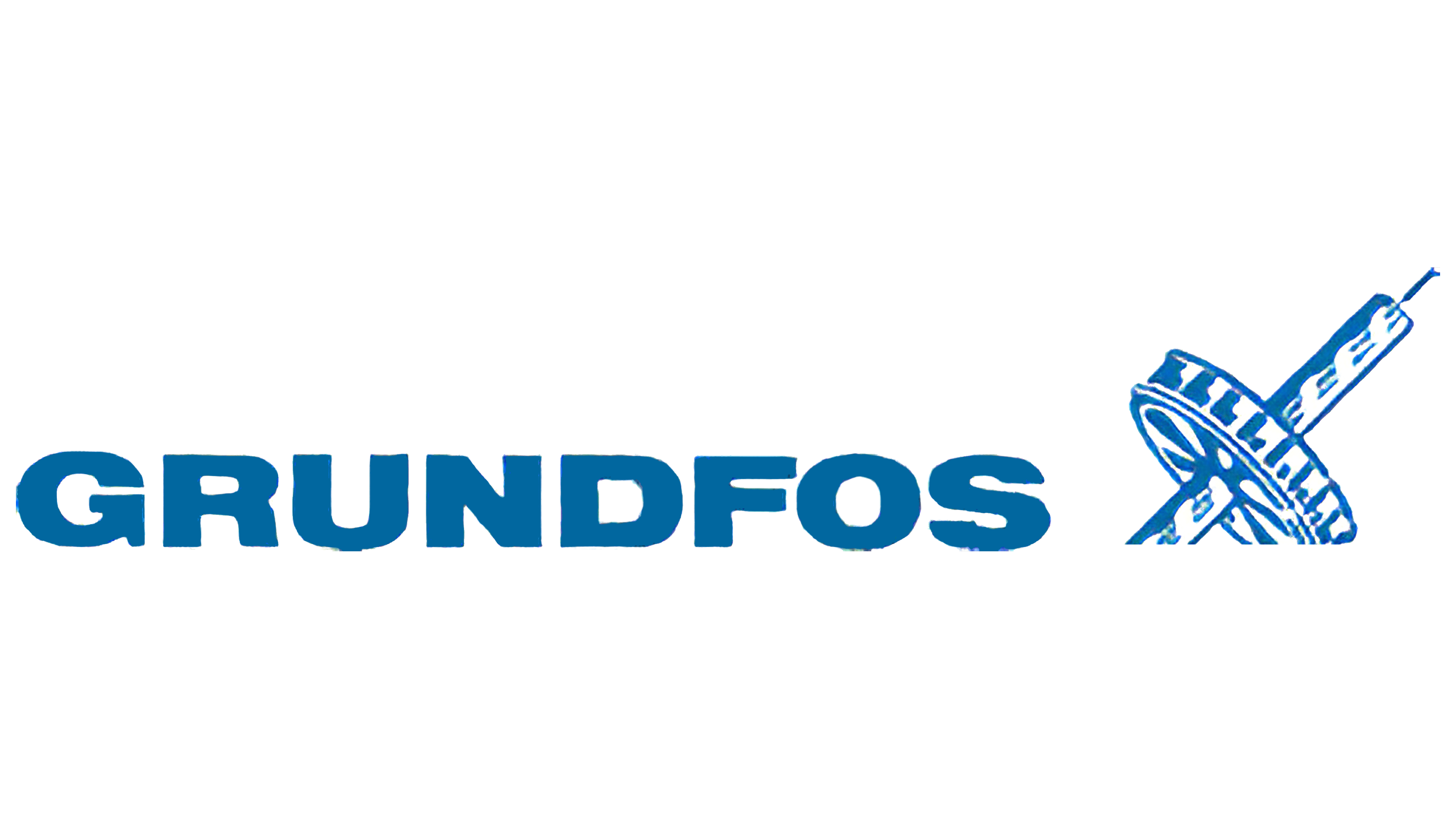
The old Grundfos logo, used until 2005, consisted of two elements: the company name and the graphic symbol of an Archimedes water screw. The word was typed in straight, uppercase letters. The bold sans-serif resembled Foundation Sans Black Extended by FontSite Inc., Annonce Regular by Canada Type, or their free counterpart ReservoirGrunge Regular by Zetafonts. The typeface was modern and simple, making the lettering legible.
The presence of the Archimedes water screw on the emblem reflects Grundfos ‘ specialization in pumping systems for moving liquids. The artists depicted this engineering device in a simplified way, using only two colors: white and dark blue.
2005 – today
The only redesign of the logo resulted in a significant simplification. Archimedes’ water screw has been removed. The basis included a verbal inscription and an emblem located on the right.
The brand name used a classic bold sans-serif font with rounded corners. There is free space between all letters, which makes the inscription look stricter and more confident.
The company logo visually depicts two intersecting orbits. In sum, this logo element looks like a stylized letter “X.” It looks interesting. Still, it does not associate the logo with Grundfos activities as in the original version.
Font and Colors
The original version of the logo used an elegant serif font with thin letter lines. However, the verbal inscription was somewhat lost against the emblem’s background, which was the logo’s main element. After the redesign, the font was replaced with a more businesslike one. Bold sans-serif letters convey confidence, reflecting the company’s strength and ambition. Also, they harmonize with the emblem.

Regarding the color palette, both versions preferred conciseness. Initially, it was green on a white background, but after a redesign, it was changed to blue. Thus, the laconic color scheme does not distract potential buyers of Grundfos products, allowing them to concentrate on the product.