


 Habbo Logo PNG
The Habbo logo features many users and themes of communication. The emblem is permeated with interpersonal connections and pleasant communication that brings joy. The sign also hints at the cartoon characters living in the villages.
Habbo began in 1999, when Finnish designer Sampo Karjalainen and programmer Aapo Kyrölä built “Mobiles Disco” for the rap group Mobiles. The small virtual club used pixel avatars, a bar, and a dance floor. Although the rooms were in Finnish, foreign users arrived quickly, prompting the creators to develop an international version.
In 2000, after joining the agency Taivas, the team launched Lumisota, a multiplayer snowball game made with Finnish provider Elisa. It tested early SMS-based paid upgrades. In August 2000, Elisa opened Hotelli Kultakala, or “Hotel Goldfish.” British user Dee Edwards created the hotel format. The company Sulake was registered the same year, and in 2001, the global Habbo brand began to spread. By late 2004, it had 16 hotels on four continents.
Sulake also built technology for Coca-Cola’s MyCoke (later Coke Music) and worked on Disney’s Virtual Magic Kingdom. Both projects used ideas close to Habbo and closed in 2007-2008. Habbo grew into a teen-focused rival to Second Life and IMVU. In June 2008, it passed 100 million registered avatars, with about 75,000 new accounts created daily.
In June 2012, a Channel 4 investigation exposed sexual messages on the service, forcing Sulake to shut down all chats and review safety policy. Investors Balderton Capital and 3i exited, and UK retailers pulled Habbo gift cards. Elisa Oyj bought Sulake in 2013. Azerion acquired a 51 percent stake in 2018 and took full ownership by 2021. Habbo moved from Adobe Flash to Unity in 2020, launched Habbo X in 2022, and introduced Habbo Hotel: Origins for adult users in June 2024.
Meaning and History
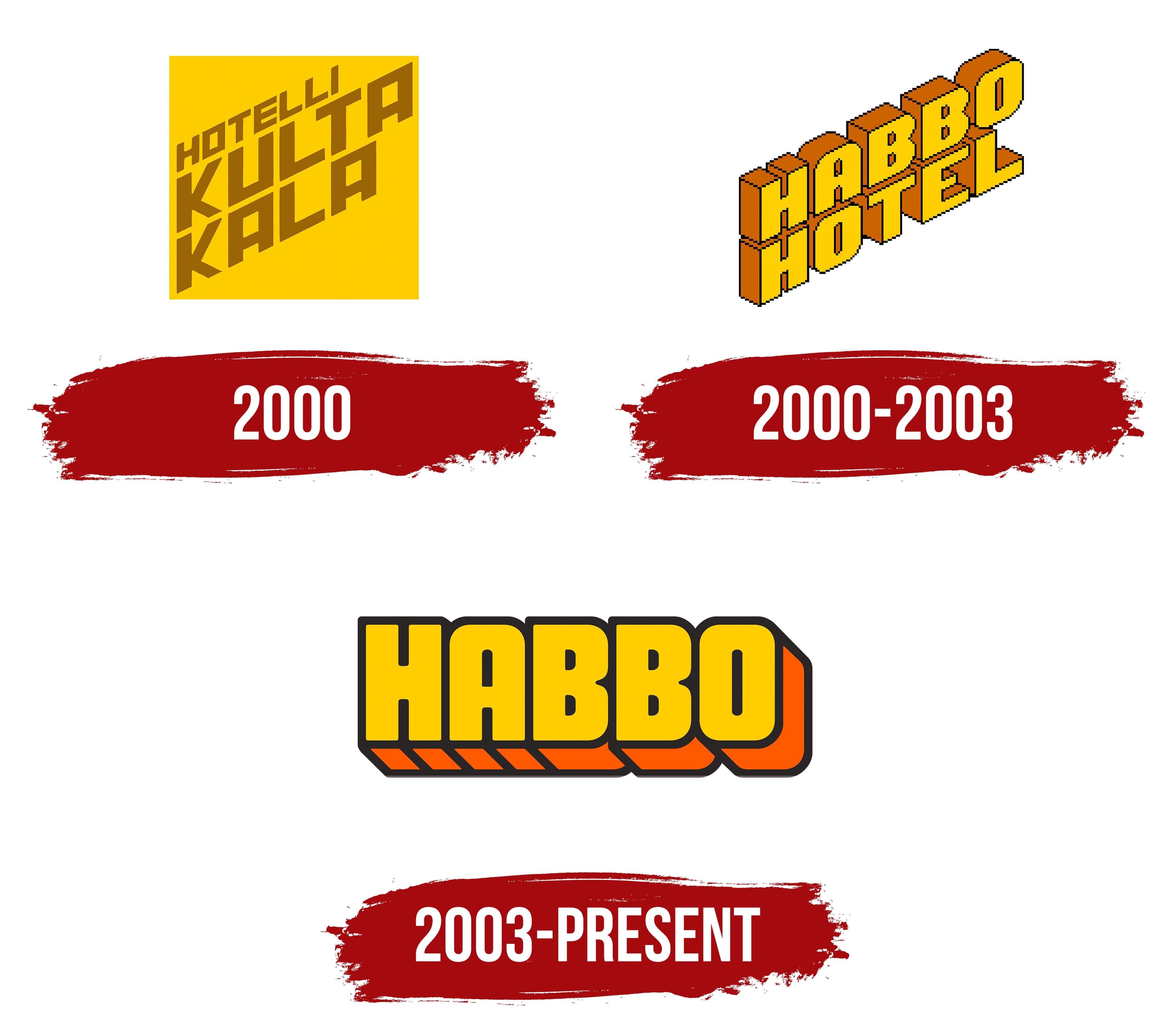
The social network’s logo has changed only twice since its launch. Unlike most competitors, it used 3D letters to create a visual identity. This made it possible to distinguish the company, attract the attention of the target audience, which largely consisted of young people, and communicate with them in the same language.
What is Habbo?
First, it is a communication resource. No matter where someone is, social networks let users always write what matters.
2000
2000 – 2003

The first version of the logo consisted of three-dimensional letters turned left. The inscription consisted of capital letters in bold sans-serif type. Yellow was chosen as the main color. However, the orange shadow in 3D space occupied more than half of the total volume. A black outline created a sense of volume. At the same time, it was not based on straight lines but consisted of many curves. Visually, the logo resembled icons of games actively released on game consoles. Interestingly, for the first three years, the verbal inscription included not only the word “HABBO” but also “HOTEL” at the bottom. The logo had no additional elements.
2003 – today

In 2003, it was decided to redesign the logo. The changes made it simpler and more modern, better aligned with the realities of that time. The word “Hotel” was removed from the name. However, the letters in “Habbo” were no longer angled towards the audience. Consequently, although the three-dimensional effect was preserved, it became less noticeable than in the previous version.
The color palette used is identical. Basic yellow color and black outlines were used to create volume. At the same time, it was decided to use gradient tones, which made the logo easier to read.
The font used for writing the characters became more stylish; all letters were single elements, with no spaces between them. Visually, the logo suggests that the main message for the target audience is the positive emotions they will experience through communication within Habbo.
Since 2003, an icon has also been used for social networks. It features a bold “H” with rounded corners on a black background.
Font and Colors

The logo was created with a three-dimensional effect, using a bold, rounded sans-serif typeface.
Yellow is the main color. However, the gradient created an orange dominance. The logo was intended to be non-standard, like a social network logo, to attract potential users.