


 Hayabusa Logo PNG
The Hayabusa logo is sharp and swift, like a gust of wind or a flame. The emblem depicts the brand’s motorcycles flying along the road, their virtuoso riding, and lightning-fast response, signifying maneuverability and speed.
The Suzuki Hayabusa emerged from Japan’s top-speed racing of the 1990s. Kawasaki had led with the ZZR1100, but in 1996, Honda launched the CBR1100XX Super Blackbird, a sport tourer capable of 285 km/h. Suzuki had to answer with a motorcycle built around maximum speed, strong aerodynamics, and enough comfort for long-distance riding, rather than a narrow racing-only concept.
The name Hayabusa means “peregrine falcon” in Japanese. The reference was aimed directly at the Honda Blackbird, since the falcon hunts blackbirds and can dive at more than 320 km/h. Lead designer Koji Yoshiura put aerodynamics at the center of the project. The motorcycle featured a drag coefficient of 0.27, triangular front air intakes, smooth side panels, and an unusual shape that met the speed target.
In 1999, Suzuki presented the model at Circuit de Catalunya in Spain. On specially developed Bridgestone tires, the Hayabusa reached between 303 and 312 km/h, beating the Honda record by at least 16 km/h. It used a 1,299 cc inline-four engine with 173 horsepower, a ram-air intake system that forced cool air into the cylinders at speed, and an aluminum twin-spar frame that kept wet weight at 215 kg.
The record pushed the whole industry toward a limit. Kawasaki was preparing the Ninja ZX-12R, while European regulators began discussing restrictions on ultra-fast motorcycles. In 2000-2001, Japanese and European manufacturers adopted a voluntary electronic speed cap of 299 km/h. The 1999 Hayabusa became the last production motorcycle of that era without a factory limiter. In 2008, Suzuki released the second generation with a 1,340 cc engine and revised bodywork. In 2021, the third generation arrived with updated electronics, rider aids, a new instrument layout, and production in Toyokawa and Gurgaon.
Meaning and History
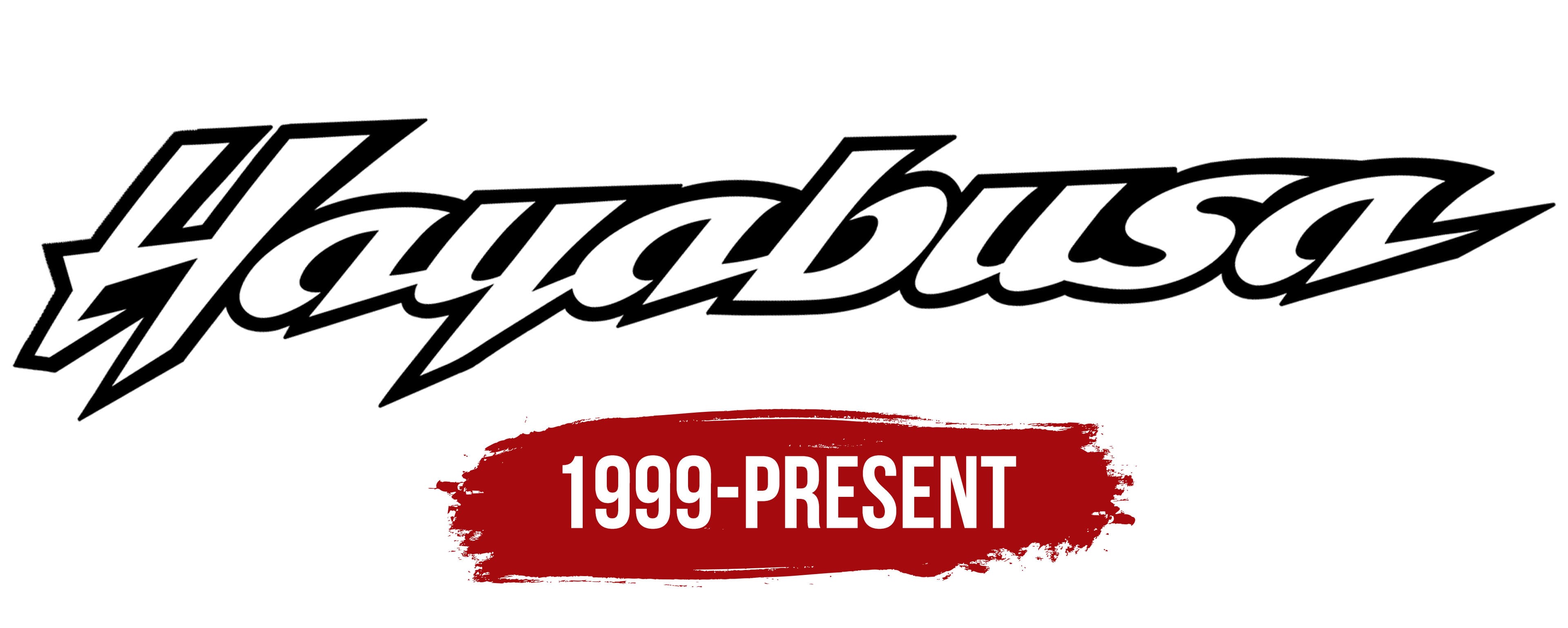
The emblem perfectly represents the world’s fastest motorcycle, focusing on what matters most: speed. When you look at the logo, you can feel the whistle in your ears from the bike passing by. The sign is full of movement and striving for victory. Each character has leadership. There is nothing superfluous in the elements distracting the eye. Only Hayabusa is flying towards the target.
The brand logo is verbal, without images and figures. It consists of a name written in white letters with a massive black stroke. A strong tilt to the right shows speed. The model can accelerate up to 312 km/h. In this, it corresponds to the name. The peregrine falcon, when falling vertically, can exceed 380 km/h and is considered the fastest bird in the world.
What is Hayabusa?
This is one of the most recognizable high-performance motorcycles, embodying the sport bike crafted on a Japanese production line. Named after the fastest bird in the world, the peregrine falcon, this motorcycle dominates roads and racetracks with its powerful engine and aerodynamic design. Its unique construction, including a wind tunnel-tested fairing and smooth, rounded lines, enables it to reach incredible speeds while maintaining stability at high velocities.
Interestingly, the brand’s name was chosen to emphasize the victory over competitors. Hayabusa’s main rival is Honda’s Blackbird model. In nature, peregrine falcons hunt thrushes, destroying them.
All elements of the logo are connected sequentially and serve as a prototype of the racetrack, with obstacles that the “iron predator” can overcome. There are straight sections, zigzags, turns, cliffs, and springboards. The motorcycle is easy to handle and maneuvers well, thanks to the perfect body kit.
The alternation between wide and thin glyphs indicates the balance of functions. Most owners note that the bike has good characteristics that are not reduced for the sake of speed.
Sharp parts emphasize risk and danger. The rider needs to make quick decisions if he wants to drive such a motorcycle.
The black backing forms a single figure from the logo. Its undulating edges resemble a motorcycle’s bulging, bumpy shape.
Sometimes a Japanese character in white, black, or red is used instead of the English name. Speed is also read in its lines, as in the standard English version.
Font and Colors
The logo’s main colors correspond to the black-and-white plumage of the peregrine falcon; they are also the bike’s primary colors. The white color evokes a sense of flight and embodies the title of the fastest production motorcycle the brand earned in the late 90s. Black gives confidence and stability.
The font is voluminous capital with a rightward inclination. Indicates development and movement. The sharp ends of the glyphs speak of purposefulness and unwillingness to concede primacy.