


 Holiday Inn Logo PNG
To associate the Holiday Inn logo with relaxation and comfort, the designers made it visually light. Soft lines with partially rounded corners create a feeling of relaxation and ease. These are the main characteristics the hotel chain wants to emphasize in its advertising campaigns.
Holiday Inn began after Memphis entrepreneur Kemmons Wilson took a 1amily road trip in 1951. Traveling from Tennessee to Washington, he found roadside motels dirty, cramped, inconsistent, and often expensive for families because many charged extra for children. Back in Memphis, he borrowed $325,000 and built a motel chain around fixed standards.
The name comes from the 1942 film Holiday Inn, starring Bing Crosby. Architect Wallace Johnson used it as a placeholder on the plans, and Wilson kept it. The first Holiday Inn opened on August 1, 1952, on Summer Avenue in Memphis, with 120 rooms. From the start, it offered air conditioning, in-room phones, free parking, a pool, an on-site restaurant, and free stays for children under 12.
In 1957, Wilson turned the business into the Holiday Inn of America franchise system. Growth was fast: 50 motels by 1958, 100 by 1959, 500 by 1964, and the thousandth location in San Antonio in 1968. Competitors such as Ramada Inns, Howard Johnson’s, and Best Western chased the same market. In 1965, Holiday Inn and IBM created Holidex, a centralized computer reservation system that let guests book rooms across the chain.
By 1972, Holiday Inn had more than 1,400 hotels worldwide. After Wilson’s 1979 heart problems, the company moved through a new corporate phase. In 1985, it became Holiday Corporation, with brands such as Embassy Suites, Crowne Plaza, Hampton Inns, and Harrah’s. Bass PLC bought the international business in 1988 and the North American business in 1990, then launched Holiday Inn Express. After later restructuring, InterContinental Hotels Group acquired Holiday Inn in 2003.
Meaning and History
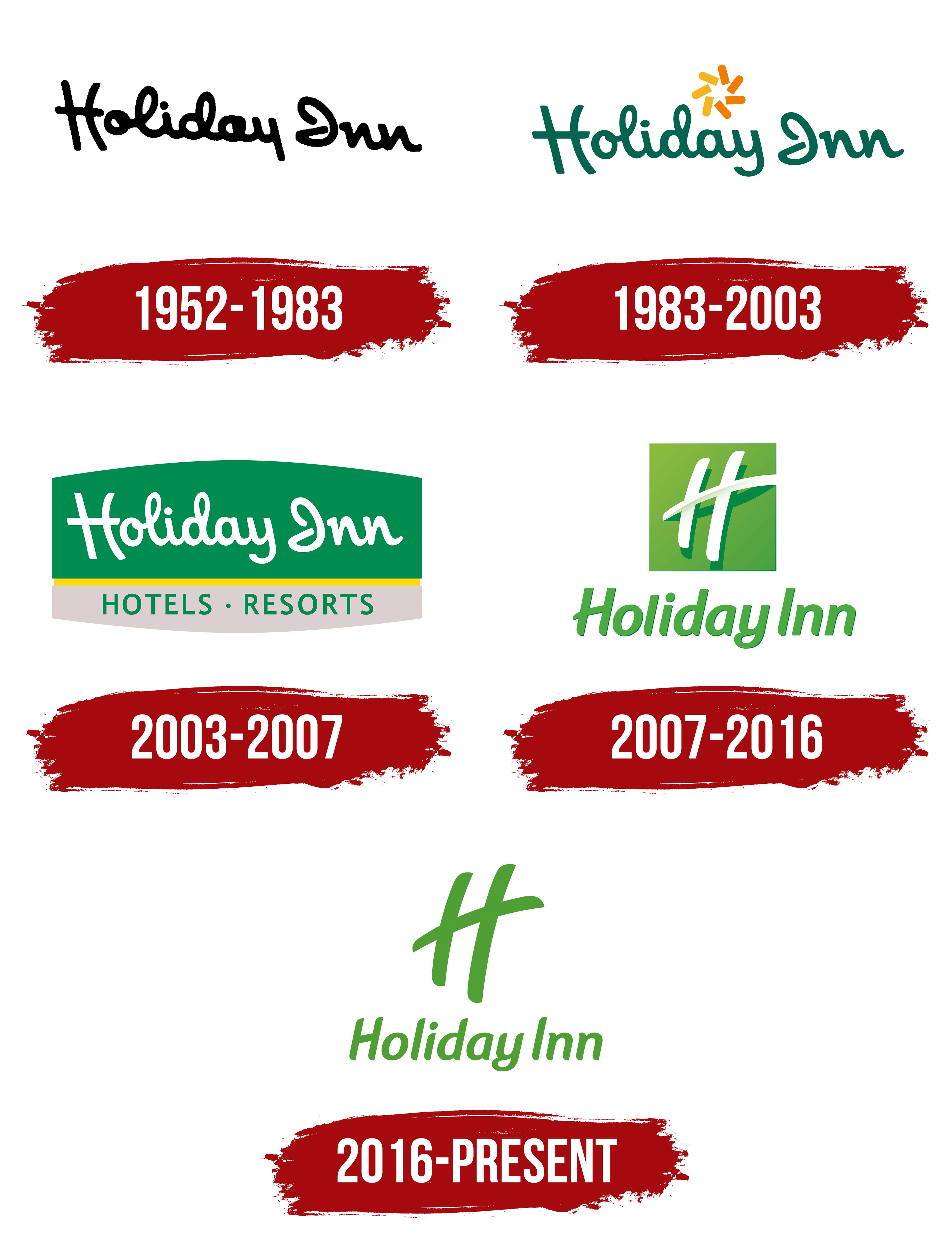
The logo has undergone several redesigns to mark major milestones in Holiday Inn’s development.
What is Holiday Inn?
A chain of hotels for every budget, founded in America in 1952. Express: budget vacation; Garden Court: national style; Select: business trips; Resort: resort hotels. Headquarters in Buckinghamshire.
1952 – 1983

The logo is a real miniature image. It combines the hotel’s tower with a roadside stele sign. The banner has the name and an arrow pointing to the hotel. All this stands on a brick-lined lawn. The artist Jean Barber created the sign.
The hotels themselves did not resemble towers. The skyscraper is rather a hint of a special service. In America, the higher the number, the more prestigious it is to live in it. Penthouses have always occupied the upper floors. At Holiday, all rooms are like penthouses.
The phrase Holiday Inn translates to “Holiday hotel.” The name is taken from the film of the same name, released a few years earlier (1942). An architect involved in building the chain’s first hotel drew an analogy.
The star on the logo’s tower resembles a Christmas one (the film’s action took place on Christmas Day). The star, set inside the five-sided structure, also pointed to the five-star hotel, where visitors could expect the best service.
Below the banner, a white sign read “The nation’s innkeeper.” It can be translated as “national tavern.” It showed that the network claims to be the best.
This statement explains why Kemmons Wilson entered the hospitality business. The hotels where they lived as a family during the holidays had many shortcomings. The businessman decided to rectify the situation. Build a network of establishments with comfortable conditions.
They were located along the roads, like roadside motels, so the name “tavern” fit well. Information was posted on white plates bearing real-steel banners. For example: “Welcome to California,” or “signature steaks, drinks from 11 am to 2 am for only $ 100,” etc.
1983 – 2003

In 1982, the founder left the company. The new managers no longer wanted to use the expensive and bulky sign (each one cost up to $13,000 to make).
The 1983 rebrand completely changed the chain’s logo. The emblem was the name in reverse-slope capital letters, with a Christmas pinwheel rising above the end of the word Holiday.
The script creates a feeling of home, comfort, and simplicity. The font takes the user back to the times of letters. When there were no computers. You needed time to write a letter, put your soul into it, and open up. On paper, everyone has their unique handwriting.
All this shows Holiday Inn’s special care for guests, its individual approach, and its efforts to create conditions for each guest. It also hints at the hotel’s originality. They are not made to be copied. Each has its special atmosphere.
The inscription’s rightward tilt suggests conservatism and tradition. No noise disrupts rest or exciting innovation. Calm reigns in hotels, and well-trained staff work.
The pinwheel above the name parallels the star in the previous logo. She symbolizes celebration, joy, and a good mood. It consists of seven yellow-and-orange petals. This makes her look like the sun. As the luminary gives warmth, Holiday Inn gives its guests comfort and a warm atmosphere.
2003 – 2007

The next change made the logo look like an entrance sign. Against a larger green background, the name was placed at the top. And below, on a gray background, a clarifying inscription: “Hotel. Resort.” Fifty years have passed since the first institution opened. People no longer remember the 1942 Christmas movie. As a result, they lack the necessary associations when they see the name. Clarification helps to understand that the institution offers accommodation and resort entertainment.
At the same time, green is associated with comfort, and gray is associated with a business approach. The yellow stripe between the backgrounds shows that the hotel separates leisure and work. Visitors rest; they receive the most attention, and the staff works constantly and imperceptibly.
The Interbrand agency designed the logo and partnered with the brand for many years, participating in subsequent redesigns.
2007 – 2016

The brand’s owners, the English group InterContinental Hotels, decided to relaunch and modernize the chain. Many old hotels were closed. The brand’s presentation has changed dramatically again.
Above the new logo is a green square reminiscent of a neon sign. Above the square is the three-dimensional letter H. In outline, it resembles the roads where hotels were usually located. Two sticks, two roads, two countries. The story began in America and continues in England. The transverse element extends beyond its borders and, arched, rests on the background at both ends. It resembles a bridge connecting highways. The general idea of hotels (to provide comfort) remains the same across countries.
Below the square is the title. Its font has completely changed. It became smooth and rounded, with a slight leftward inclination. The ideal style suggests cleanliness, comfort, and order. The hotel is always ready to meet clients’ needs, smoothing out sharp corners. Conservatism is replaced with movement that keeps pace with the times.
2016 – today

The neon square was removed from the logo, leaving only the letter H. This is a tribute to simplicity and freedom. The font has been tweaked slightly to better align with the uppercase letter’s outline. The emblem evokes a feeling of spaciousness. The hotel rooms feel spacious. Nothing is superfluous, but everything you need is there.
Font and Colors
All Holiday Inn logos include shades of green. It represents comfort, hospitality, and care. Older, darker shades signal luxury, while the tones in the latest visual signs are light and bright. They promise a healthy atmosphere, relaxation, and high spirits.
The font of the latest visual mark resembles the beveled elements of Pierce Bold.