


 Hoover Logo PNG
Henry Dreyfuss created the Hoover logo with the red circle in the 1950s. He played with the first letter of the brand name, presenting it as two parallel lines intersecting at an angle with the third stripe. Because of the white ring that serves as a frame, the emblem resembles a prohibition road sign.
Hoover began in 1907 with James Murray Spangler, a night janitor in a Canton, Ohio department store. Suffering from asthma, he blamed the dust raised by carpet brushes for his coughing. He attached an electric fan to a carpet sweeper, added a soap box and a broom handle, and built an early portable electric vacuum cleaner.
Spangler sent a sample to his cousin Susan Hoover, who showed it to her husband, leather-goods manufacturer William Henry Hoover. On August 5, 1908, Hoover bought the patent for $36,000 and founded the Electric Suction Sweeper Company in North Canton. Spangler stayed as production manager and received royalties from each sale.
At first, six workers made six machines a day in a corner of Hoover’s leather shop. The Model O weighed about 18 kilograms and cost $60. In 1909, more than 2,000 units were sold. Hoover used a ten-day free trial advertised in The Saturday Evening Post and sent door-to-door salesmen to demonstrate the machine at home. After Spangler died in 1915, the firm became Hoover Suction Sweeper Company, then The Hoover Company in 1922.
Hoover expanded into Canada in 1911 and into Britain in 1919, and opened its Perivale factory in 1932. In Britain and Ireland, “hoover” became a generic word for a vacuum cleaner, while Electrolux fought for market share. The Hoover family sold the company to Chicago Pacific in 1985, and Maytag bought Chicago Pacific in 1989 for $1 billion. The failed Hoover Europe flight promotion of 1992 led to lawsuits, $60 million in claims, and executive dismissals. In 2006, Whirlpool acquired Maytag, while Hoover’s North American business went to TTI and its European operations to Candy.
Meaning and History
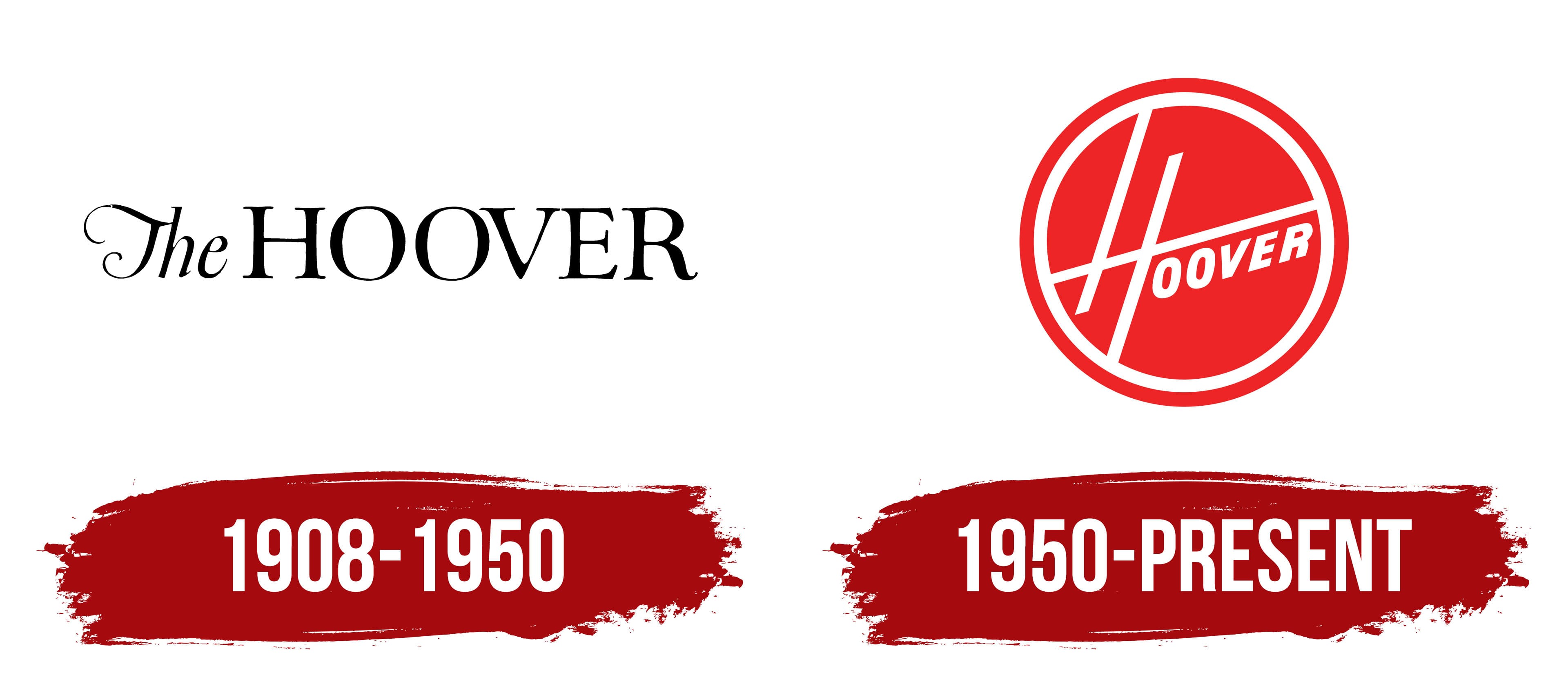
Hoover owes much to American industrial design pioneer Henry Dreyfuss. This is the man from the 1930s who helped expand the range of household appliances, made the vacuum cleaner more aesthetically pleasing, and improved its design. Dreyfuss is also considered the logo’s creator, featuring a red circle with a white inscription. The iconic symbol has been used for many years and has hardly changed since its inception. It is balanced in color and shape, so consumers recognize Hoover products by the round symbol with diagonal letters.
What is Hoover?
Hoover is the world’s oldest vacuum cleaner manufacturer. This company was founded in the USA in 1908 and eventually entered the UK market, becoming so famous that its name became synonymous with vacuum cleaners. Techtronic Industries Company Limited, based in Hong Kong, now operates the home-appliance brand.
1908 – 1950

Until 1950, Hoover household appliances were marked with a word mark, which also appeared in advertising. It contained the brand name followed by the article “The.” For the first half of the inscription, a thin, elegant font was used, stylized as handwriting. The second part was done by contrasting antiqua with long serifs.
1950 – today

The iconic Hoover logo is similar to a no-go sign in that it’s also red and round. And inside it is a white ring, divided into two parts by a diagonal strip of the same white color. It intersects with two other lines and forms a stylized “H.” Below the long diagonal are the remaining letters: “O,” “O,” “V,” “E,” and “R.” They are built from the bottom up with a ladder. All glyphs are capitalized, bold, and slightly tilted to the right.
The graphic Hoover sign with white lettering in a red circle has a long history. It is known that he was featured in Life magazine in the early 1950s. The first products to feature the logo were the Hoover 638 and 1224 vacuum cleaners. It continues to be used on the brand’s home appliances and promotional materials. At the same time, an important rule is observed: the word necessarily forms an angle of approximately 55 degrees.
Font and Colors

To avoid loading the logo with unnecessary details, the designers decided not to use a serif font. Instead, they limited themselves to bold, grotesque, capital letters, capitalizing all letters and adding a slight slope for symmetry. And only the first “H” became an exception to the rule.

The Hoover emblem is painted bright red because it was introduced in the 1950s, just as the company began replacing the gloomy, restrained palette with bright colors. At that moment, the red Hoover 29 vacuum cleaner was released, replacing the brown and black models.