


 Huggies Logo PNG
Designers created the Huggies logo based on the brand’s concept. So it came across as serious, like parental care, but with playful elements that every child’s life lacks. The logo combines opposites: softness and austerity, orderliness and chaos.
Huggies was created as part of Kimberly-Clark’s 1966 attempt to enter the disposable diaper market. The company was already known for paper products, including Kleenex, which was launched in 1924. Still, the diaper market was controlled by Procter & Gamble, whose Pampers had appeared in 1961 and already had loyal buyers.
In 1968, Kimberly-Clark tested Kimbies. Scientist Frederick Hrubecky designed a diaper shaped closer to a baby’s body and patented the idea in 1973. The company spent $1 million on new folding equipment for its Memphis plant. Yet, a strike disrupted production, and Kimbies never became a real threat to Pampers.
By the mid-1970s, Kimberly-Clark faced a choice: build a stronger product or leave the category. In 1977, it launched Kleenex Super Dry Diapers as a budget line while secretly developing a premium diaper. In 1978, Kleenex Huggies reached stores. Its hourglass shape, elastic leg gathers, and closer fit helped reduce leaks. The name came from “hug,” matching the idea of a diaper that wrapped the baby more naturally.
The market response was fast. By 1982, Huggies led the U.S. premium diaper segment. In 1983, Kimberly-Clark added refastenable tapes, and in the early 1980s, it introduced superabsorbent polymers that held moisture far better than older materials. By the mid-decade, Huggies had passed Pampers in the United States. The brand later expanded with Pull-Ups in 1989 and Little Swimmers in 1997-1998. After Kimberly-Clark merged with Scott Paper in 1995 for $9.4 billion, Huggies remained its main baby-care brand and continued its long rivalry with Pampers.
Meaning and History
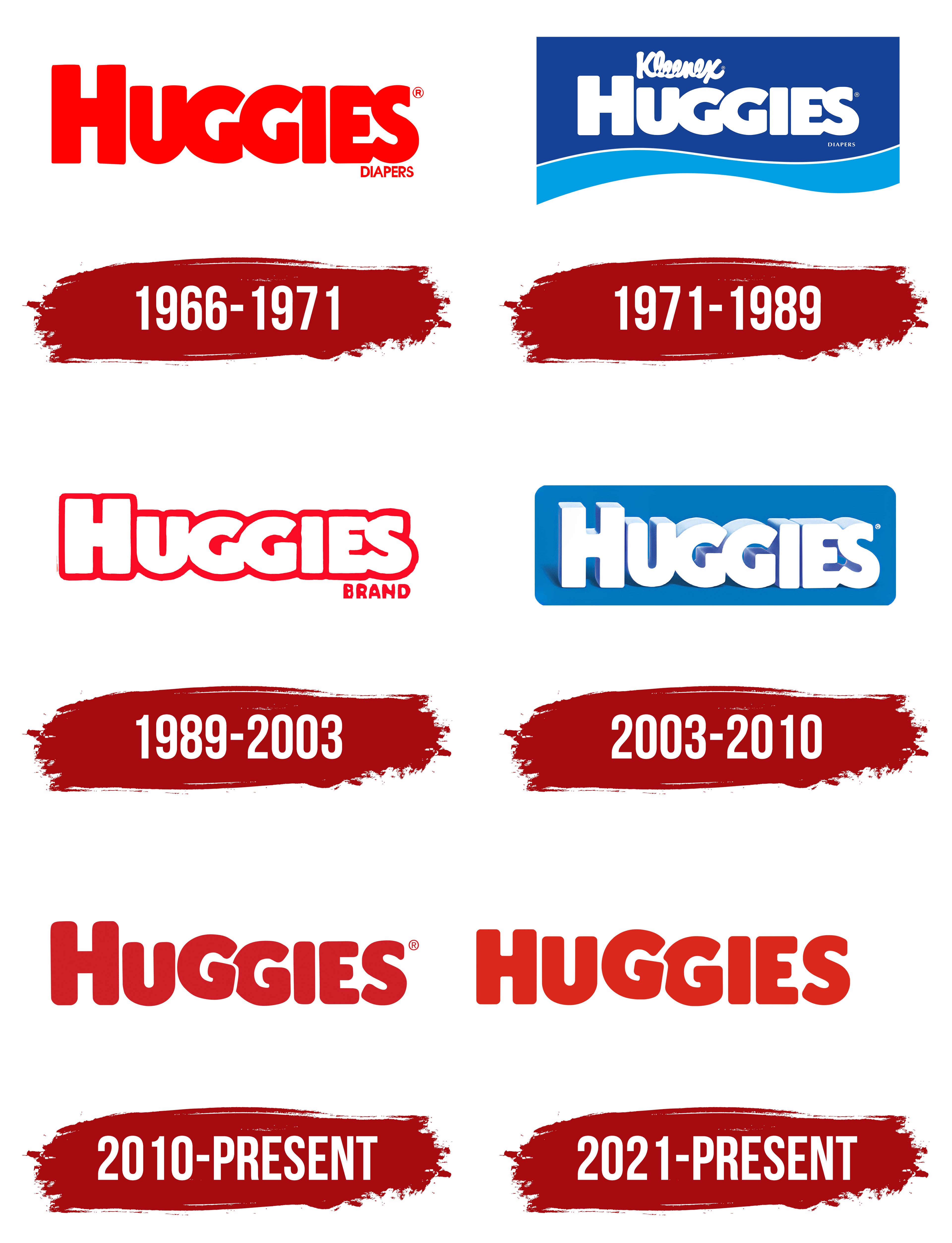
Throughout the brand’s history, six logo variants have been presented to potential buyers of Huggies. Each redesign introduced a new wordmark style, making it more attractive. Brand recognition is high. Billions of people worldwide have heard of the company.
What is Huggies?
It is the world’s most famous diaper company. Almost every parent has heard of this brand and bought products for their baby.
1966 – 1971
The first logo version was introduced in 1966. It lasted five years. It was a red word inscription in capital letters. However, the first “H” was slightly larger than the other letters. A classic bold font with thick lines and rounded corners was used. The letters had practically no space between them. Each letter had a barely visible black outline. In general, the inscription looked harmonious on different backgrounds.
1971 – 1989
The first redesign, which came in 1971, changed the logo’s color palette to blue and white. The brand name was written in white on a dark blue background. The font used was identical to the original, but with wider letter spacing. A blue wavy line was also added to the bottom.
1989 – 2003
Another change modernized the logo. At this stage, two color palette variants were used: red-white and blue-white. In turn, the letters have become smoother and thicker. The blue outline and blue shadows give the image a three-dimensional feel. In the logo’s white-and-red variation, the word “brand” appears in the lower-right corner. It is in a classic sans-serif typeface.
2003 – 2010
In the new redesign, the image’s volume is even more noticeable. It is created with bold letters set in a double outline in blue and sky blue. As a rule, the verbal inscription was located on a blue background. Although all the letters are on the same line, they may appear to be written diagonally.
2010 – today
Two color palettes were used throughout the company’s existence: red and blue. At the same time, the next redesign made the red version the main one. The bold, non-standard font with rounded letterforms was used again. At the same time, the spacing between the characters became more pronounced. In turn, in the letters “GG,” you can see a jumping effect. This evokes children’s products and a livelier logo.
The verbal inscription is usually set on a white rectangle. However, it may change color depending on the packaging type. The most common packaging used is a heart-shaped emblem with a thick white outline and white lettering. The logo looks welcoming and friendly, evoking care and warmth.
2021 – today
The latest redesign has reverted to the format it adopted in 2010. However, the color has become brighter and lighter. Each letter also has a white outline, especially the “G” letters.
Font and Colors

Throughout the company’s existence, many font variations have been used for the Huggies brand. A common feature was clear, wide letterforms. In some versions, the effect of “jumping” letters was used. This directly reflects the company’s focus on children’s products.
As with the font, various color palette options are used. In most cases, we use white-blue and white-red. However, in some embodiments, we use a cyan or black outline to add three-dimensionality to the image.