


 IMSS Logo PNG
The Mexican Social Security Institute oversees medical and pension services, so the IMSS logo symbolizes care for vulnerable people. It symbolizes support, not just in name, but in practice, because the advocate’s image is carefully crafted.
Instituto Mexicano del Seguro Social, or IMSS, was created on January 19, 1943, under President Manuel Ávila Camacho. Its roots lay in the Mexican Constitution of 1917, which required the state to establish a social insurance system for workers. A similar proposal by Lázaro Cárdenas in 1938 was rejected, but a new bill was passed in late 1942.
The Social Security Law was published on January 19, 1943, creating IMSS with tripartite funding from employers, workers, and the state. In 1943, the institute had 207 employees and its first office in Mexico City. Medical services officially began on January 6, 1944. By 1946, hospitals had opened in Narvarte, León, and Puebla, while the network included clinics, laboratories, outpatient points, and pharmacies.
In 1952, under Antonio Ortiz Mena, IMSS expanded beyond medical care into a broader social security model, adding culture, sports, housing, and leisure. In 1962, nurseries and kindergartens were added to serve the children of working mothers. By 1970, around 10 million people were insured. The 1973 reform widened coverage, and IMSS-COPLAMAR, launched in 1979, brought mobile medical services to rural areas.
A major pension reform was introduced by the 1995 Social Security Law, which entered into force on July 1, 1997. It replaced the pay-as-you-go model for new workers with individual retirement accounts managed by private Afores. It raised the contribution period from 500 to 1,250 weeks. IMSS worked alongside ISSSTE, the system for state employees, which adopted a similar reform in 2007. In 2005, a strike threat led to the replacement of director Santiago Levy Algazi. IMSS later remained Latin America’s largest social protection system.
Meaning and History
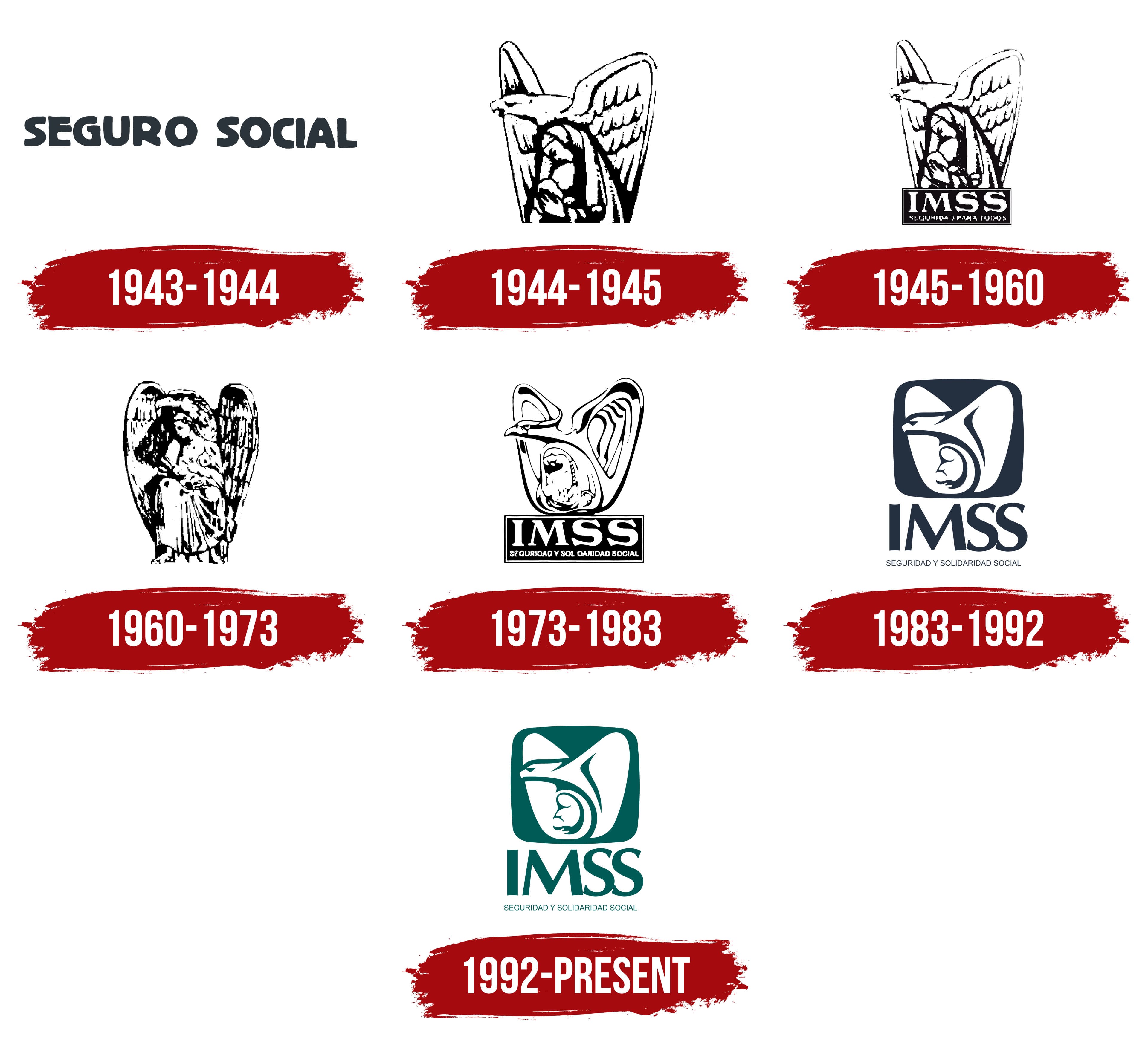
Since IMSS’s establishment, the institute’s visual recognition has gradually grown and now stands at its peak. Meanwhile, seven logo variants have been used. Most of the changes were minimal. Only the first version is unique, as it contained no elements other than the verbal inscription.
What is IMSS?
This vital social institution in Mexico has addressed medical and social issues for almost a century.
1943 – 1944

The initial version of the IMSS logo was presented almost immediately after the Social Institute was created. It lasted only a few months and contained only the verbal inscription “SEGURO SOCIAL.” Although black letters on a white background looked gloomy, they conveyed IMSS’s purpose and objectives. A classic bold sans-serif font was used. The spacing between capital letters was minimal, except between words.
1944 – 1945

The first redesign significantly changed the logo. Instead of a verbal inscription, it featured the IMSS emblem. It was based on an eagle with its head turned to the left and wings raised. Between them is a woman with a child. Visually, it looks as if the bird is protecting people. The Institute’s emblem is designed in black and white, yet it still looks modern and confident.
1945 – 1960
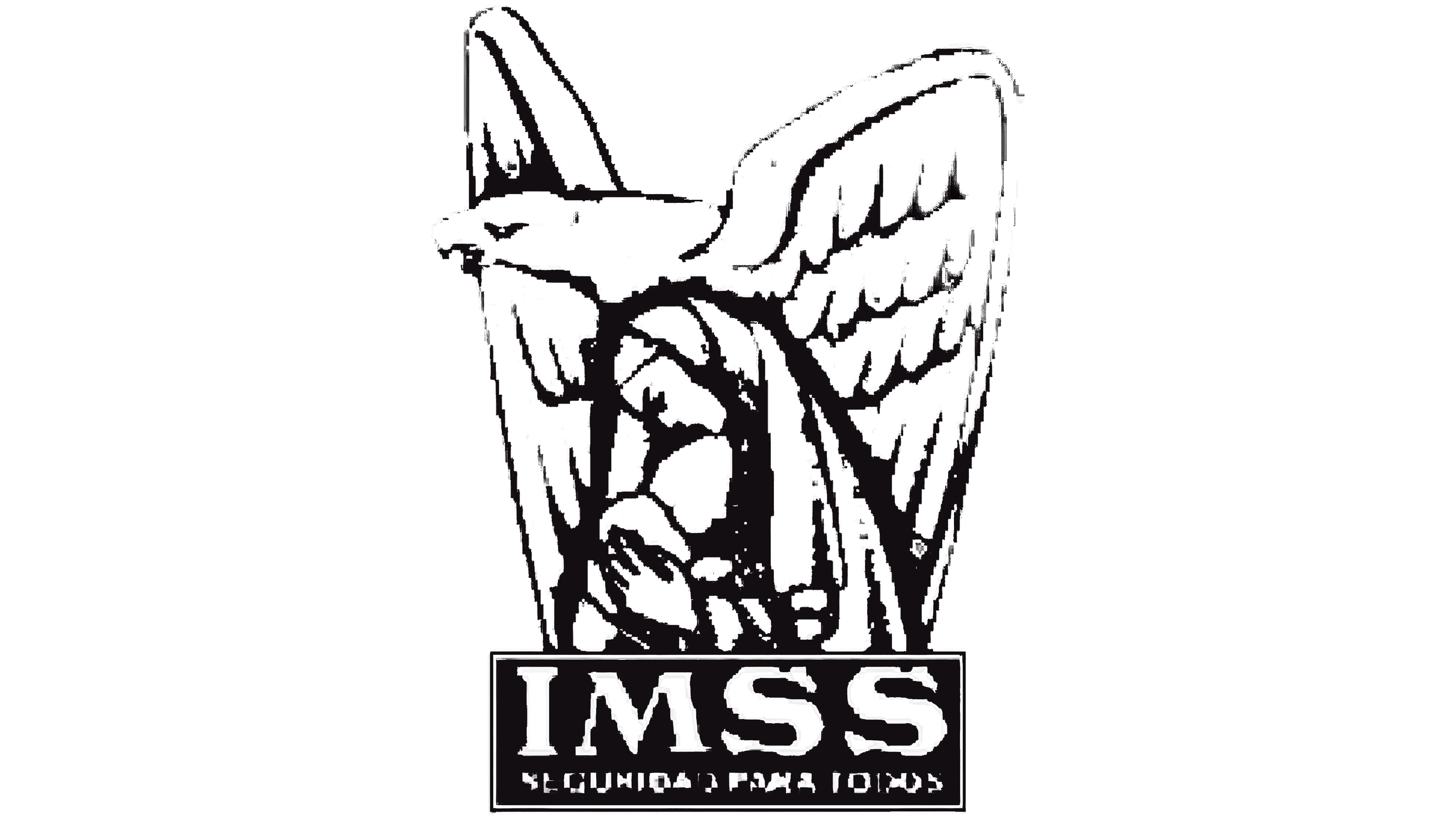
It was decided to highlight the mother and child in the image, which had not been so noticeable against the powerful eagle’s background. Moreover, the bird now sits on a rectangle that frames the word inscription. The top line says “IMSS,” and the bottom line shows the Institute’s name. At the same time, this part is set in barely noticeable type, which, in some logo variations, becomes almost unreadable. The main inscription is made in a classic bold sans-serif font. The letters are white on a black background.
1960 – 1973

The redesign removed the “IMSS” name from the logo again. The main image has also been changed. The woman with the child was now full-length, as was the eagle. Now he looked even more powerful, completely protecting his companions.
1973 – 1983

The image has been changed again. Although all three characters remained intact- the eagle, the woman, and the child- they were now drawn in a futuristic style with confident, rounded lines. The logo returned to its rectangular shape with a two-line word inscription. The letters were white on a black background. The top line read “IMSS” in bold sans-serif type, and the bottom line showed the Institute’s full name.
1983 – 1992

This logo redesign brought significant changes. For example, the Institute’s emblem was inside a black square. The image became more concise and minimal while still reflecting IMSS activities. Below the square, the Institute’s abbreviation appears in black letters on a white background. The wordmark is based on a classic bold font with thick lines and rounded corners.
1992 – today
For the first time in the Institute’s history, it abandoned the faded black-and-white tones. The latest redesign is based on deep green. This version of the logo is identical to the previous one, but the lines are bolder and brighter, so the image is conveyed more clearly.
Font and Colors

The classic bold sans-serif font was used to write the verbal inscription. In some versions of the logo, in addition to the abbreviation IMSS, the Institute’s full name was also used, but it was set in small, hard-to-read letters.
A black-and-white color palette was used until the last redesign, which was subsequently changed to green and white. The latter option looks more harmonious and confident. Green is associated with life and development, which is extremely important for the company, which is part of the Ministry of Health.