


 Invicta (car) Logo PNG
Each model features an expressive Invicta logo on the hood, fenders traditionally found on automotive brands, and unusual colors. It resembles a soaring bird, with feathers painted in bright, expressive shades. The logo’s main message is to evoke positive emotions and associations with freedom, speed, and ease. This is exactly what a well-known brand’s powerful cars provide.
Noel Macklin, a former Royal Navy officer, founded Invicta in 1925 after trying two short-lived car ventures, Eric-Campbell and Silver Hawk. Backed by Oliver Lyle of the Tate & Lyle family, Macklin started production at Fairmile Cottage in Cobham, Surrey. The first Invicta used a 2.5-liter Meadows six-cylinder engine and a four-speed gearbox, with coachbuilders such as Carbodies, Vanden Plas, and Corsica supplying the bodies.
The brand quickly moved toward larger engines and sporting credibility. By 1928, Invicta offered a 4.5-liter engine. Violette Cordery, Macklin’s sister-in-law, helped build the marque’s reputation by setting records at Brooklands and Monza, then driving an Invicta around the world in 1927. In 1931, Donald Healey won the Monte Carlo Rally in an Invicta S-Type.
The S-Type, shown at the 1930 London Motor Show, became the peak of the original Invicta era. It combined a low chassis, a 4.5-liter Meadows engine, and strong handling, with about 75 examples built. Macklin later moved production to Chelsea and shifted focus to Railton. By 1935-1938, Invicta had effectively stopped operating.
The name returned in 1946 with the Black Prince. This ambitious aluminum-bodied car used a Brockhouse hydraulic torque converter rather than a conventional gearbox. Only 16 were built before liquidation in 1950. In 1980, Michael Bristow acquired the trademark, leading to the Invicta S1, shown as a prototype in 2002. With a carbon-fiber monocoque and Ford V8 power, it targeted the same handmade British sports-car niche as Lotus Elise and TVR, with production running from 2004 to 2012.
Meaning and History

Invicta is a prestigious automotive manufacturer with a long history. The company has several exclusive car lines and a series of powerful sports cars powered by 6-cylinder engines. Original equipment is a hallmark of this brand’s models. All Invicta machines are based on specific technologies developed by the brand’s experienced engineers.
This makes them incredibly fast and maneuverable, which sets them apart from other automakers’ cars. Another distinguishing feature is the expressive visual identity. On the hoods of Invicta sports cars, you can see a composite logo consisting of an inscription and a winged figure. This combination demonstrates the firm’s character and values.
What is Invicta?
Invicta is a well-known automobile manufacturer that produces passenger and sports cars. Production facilities are located in England, and products are shipped to various countries. The brand prides itself on its exclusive S1-series sports cars and the legendary Black Prince cars. Invicta also produces other reliable, high-performance cars.
These are high-quality, reliable, and comfortable, delivering vivid emotions to their drivers. The last desire is expressed in unusual colors. Typically, automotive brands choose strict shades and an achromatic palette. Invicta is more original in this regard. It combines rich blue, red, and green. Classic Black is available in a limited edition.
1925 is considered the founding year of the automobile manufacturing enterprise. It was created by two avid car enthusiasts, Oliver Lyle and Noel McLean. Initially, the production facilities were located in Cobham, and after five years, the company moved to Chelsea. The factories are currently located in Wiltshire. Throughout the company’s history, different periods have brought cardinal changes. Despite this, the visual concept remained the same.
Modern customers can see the logo under which the first models were produced. This approach to corporate identity design suggests the brand is especially reverent of its history and heritage. This is not surprising since Invicta vehicles today exemplify a combination of innovation and original engineering.
Emphasis is placed on using the latest front-end production solutions. The Invicta lettering is set in modern typefaces with a cleaner, tidier look. They are associated with novelty, striving for excellence, and friendliness. An additional feature is vertical placement. The letters are spaced closely, and the background is a light gray tint.
In this design, the inscription is easy to read and looks quite elegant. On the sides, figures resembling bird wings appear. This is a symbol with a special semantic load. It shows what customers who choose the Invicta brand can get. Key advantages include speed, convenience, freedom, and ease. The final element of the concept is harmonious coloring. Bright colors symbolize success, positivity, energy, and calmness.
Font and Colors
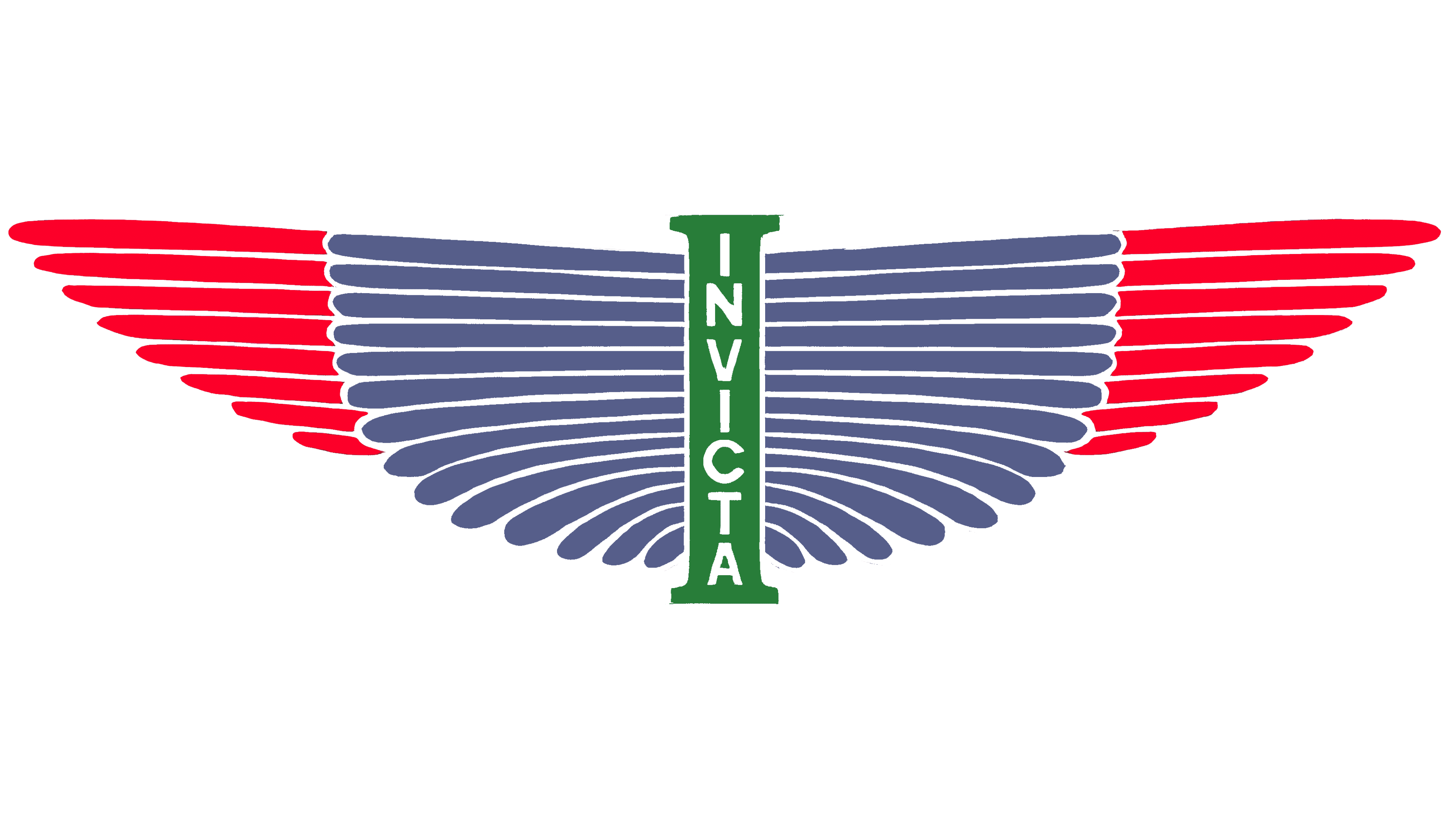
The original winged emblem, paired with the legendary brand name, maintains a harmonious identity. This is a non-standard automotive logo. Still, it fits perfectly into the overall picture. An excellent layout is achieved with a modern sans-serif font and a catchy color scheme. The color scheme balances cool and warm tones.
This palette choice demonstrates rigor and strict adherence to established standards, energy, and progressiveness. The palette’s main hue is blue, which colors most of the stylized feathers. It symbolizes reliability, honesty, and professionalism. The logo also includes red and green accents. The first symbolizes strength, pressure, and action, and the second symbolizes calmness and stability. The combination of these characteristics can be traced directly to a well-known brand.
Invicta is developing dynamically while doing everything gradually and evenly. The final part of the bright emblem’s message is the original font. It refers to modernized sans-serif variations that demonstrate renewal, innovation, and a desire for improvement. This is what is at the heart of Invicta’s activities. The brand adheres to these core principles while also striving to improve its machines through new high-tech developments.