


 Japanese domestic market (JDM) Logo PNG
The Japanese Domestic Market (JDM) logo is businesslike and stylish, accurately reflecting the prospects for continued expansion of this trend. It communicates its concept and status professionally. To achieve this, the designers’ confident strokes sufficed, identifying the national culture as positively oriented towards continuous development.
JDM, or Japanese Domestic Market, refers to cars, motorcycles, and parts built in Japan for domestic sale, not to a single company. Its roots go back to the postwar auto industry. In 1949, Japan created the kei car category, giving small vehicles tax and registration advantages. In 1955, the Ministry of International Trade and Industry promoted a “people’s car” program, leading to models such as the Subaru 360.
During the 1960s, rising incomes created Japan’s private car boom. Ownership among individuals grew from 14 percent in 1962 to over 50 percent by 1970. Competition intensified through the BC war between Toyota Corona and Nissan Datsun Bluebird, pushing local manufacturers to improve compact sedans.
The 1970s oil crisis strengthened Japan’s focus on efficient engines and lighter bodies. At the same time, safety concerns led JAMA to require a 180 km/h speed limiter on new domestic-market cars. In 1988 and 1989, Toyota, Nissan, Honda, Mazda, and Mitsubishi followed a voluntary 280 PS power cap, even as models such as the Nissan Skyline GT-R R32, Toyota Supra 2JZ-GTE, and Honda NSX were known to exceed that figure in practice.
By the 1980s and 1990s, JDM culture centered on cars such as the Skyline GT-R, Supra Mk4, NSX, Mazda RX-7, Mitsubishi Lancer Evolution, and Subaru Impreza WRX. Japan’s strict shaken inspection system pushed many well-kept cars into export markets. The US 25-year import rule later made these models collectible. The 280 PS agreement ended in July 2004, with the Honda Legend becoming the first domestic model officially rated at 300 PS.
Meaning and History

The requirements set forth by the JDM culture for domestic passenger transport differ from those applied to exported cars. However, this rule applies only to goods, as the logo is understandable to both domestic and foreign consumers. It is based on purely Japanese images and is easily decipherable. The emblem plays out several key nuances:
- the unofficial name of Japan (Land of the Rising Sun);
- colors of the national flag (red and white);
- the population’s love of domestic-market products (auto marketing).
What is the Japanese Domestic Market (JDM)?
JDM stands for the Japanese Domestic Market, a term denoting goods that meet the mandatory criteria of the Japanese domestic market. That is, they can be used in this country. Their distinguishing features are reliability, style, beauty, safety, innovation, and performance. It is also the name of a particular cultural movement associated with cars, parts, and tuning accessories made in Japan.
The latter means that the followers of the JDM movement stick this sign on their cars as a symbol of pride in Japanese technology. The Japanese Domestic Market logo is simple: it has only two parts, text and graphics.
The abbreviation is rendered in a grotesque font, uppercase. The letters are large, monolithic, and wide. “D” and “M” are connected, and a narrow dividing strip is laid between “J” and “D.” The full term is typed in lowercase glyphs, except for the first characters of each word.
To the right is a flag featuring a sun with 16 rays that extend to the edge of the rectangle. The center is a solidly filled-in red circle. This bright symbol is situated on a black background. It originated in 1603 and was used by the military during the Edo period, and was revived in 1954 as one of the main symbols of Japanese culture.
Font and Colors
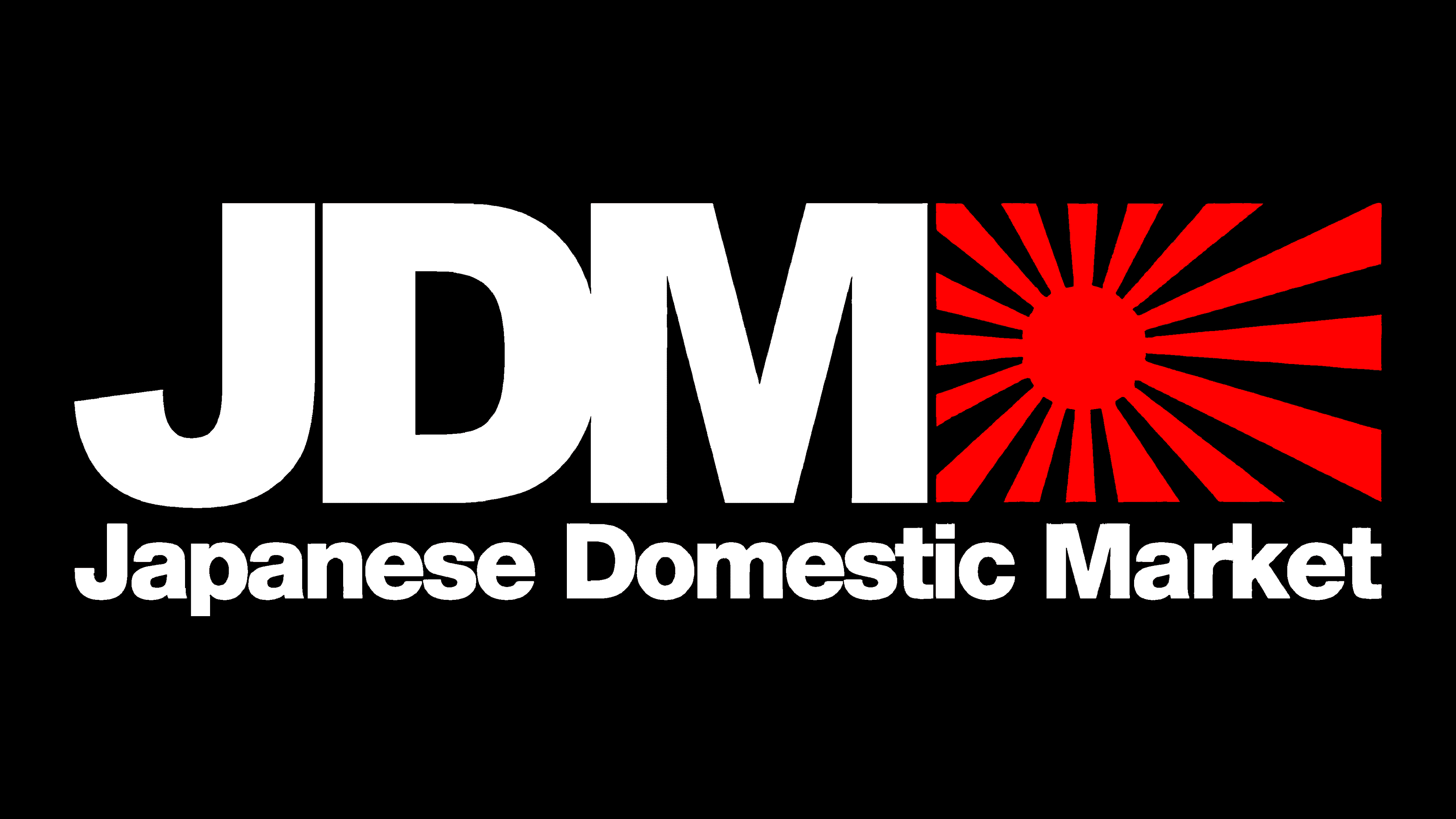
The designers chose a sans-serif font with wide, bold letters for the inscription. It resembles Neology Grotesque ExtraBold by Shinntype. The color scheme consists of red (for the sun) and white (for the text).