


 JDM Logo PNG
The vibrant JDM logo, named Shoshinsha, excels at its function. It grabs the attention of those around, warning: “Caution, novice driver!” Therefore, cars with such a label in Japan are often seen as a mandatory attribute for inexperienced drivers, who can only remove it one year after obtaining their license.
Japanese driver stickers associated with JDM culture originate from Japan’s road safety system, not from any car brand. JDM refers to the Japanese Domestic Market, covering vehicles and parts made for use in Japan. After World War II, car ownership grew rapidly, and the 1960 Road Traffic Act established the legal basis for traffic regulation.
In 1972, Japan introduced the Shoshinsha mark, better known as the Wakaba mark. The green-and-yellow V-shaped symbol represents a young leaf and is required for new drivers during their first year after receiving a standard license. It must be placed on the front and rear of the car, at a height between 0.4 and 1.2 meters. Drivers who fail to use it face a fine and license points.
Wakaba also gives legal protection. Other drivers are not allowed to cut off, tailgate, or pressure a car carrying the mark. In 1997, Japan added a senior-driver sign called the Korei mark. Older drivers criticized its first orange-and-yellow leaf design, so in February 2011 it was replaced with the green four-leaf Yotsuba mark. In 2008, Japan added a butterfly-style sign for deaf and hard-of-hearing drivers.
The Wakaba mark later moved beyond traffic law. It appeared in video games, workplace badges, hospital cards, and in 2015 entered Unicode as the 🔰 emoji, “Japanese Symbol for Beginner.” Outside Japan, JDM fans in the United States, the United Kingdom, Australia, and New Zealand began placing Wakaba stickers on Japanese cars as a sign of interest in Japanese car culture. At the same time, some collectors used the Koreisha mark on older vehicles.
Meaning and History

The JDM Leaf mark on personal transportation in Japan is mandatory. It warns other traffic participants that a novice is driving the car. The Wakaba sign has been in use since 1972. According to the rules, it must be placed on the front and back of the car’s body and remain there for at least 12 months after obtaining the driver’s license. Such an emblem signals to others that the driver is a novice who is not yet confident in their actions and needs to fully understand how to behave on the road.
But if a car owner feels uncertain after a year, they can keep the sticker on their vehicle. That is, Shoshinsha is the official symbol for beginner drivers. The JDM Leaf logo can also indicate a beginner’s status in any other field. For example, employees of some companies wear a special symbol on their badges until they gain the necessary experience.
What is JDM?
JDM is an abbreviation for the Japanese Domestic Market, a national culture of producing goods for domestic use. They are characterized by impeccable quality, excellent reliability, and high technology. Within this trend, the population uses several types of JDM Leaf markings, sticking the so-called Shoshinsha sign on cars to indicate that the driver is a beginner.
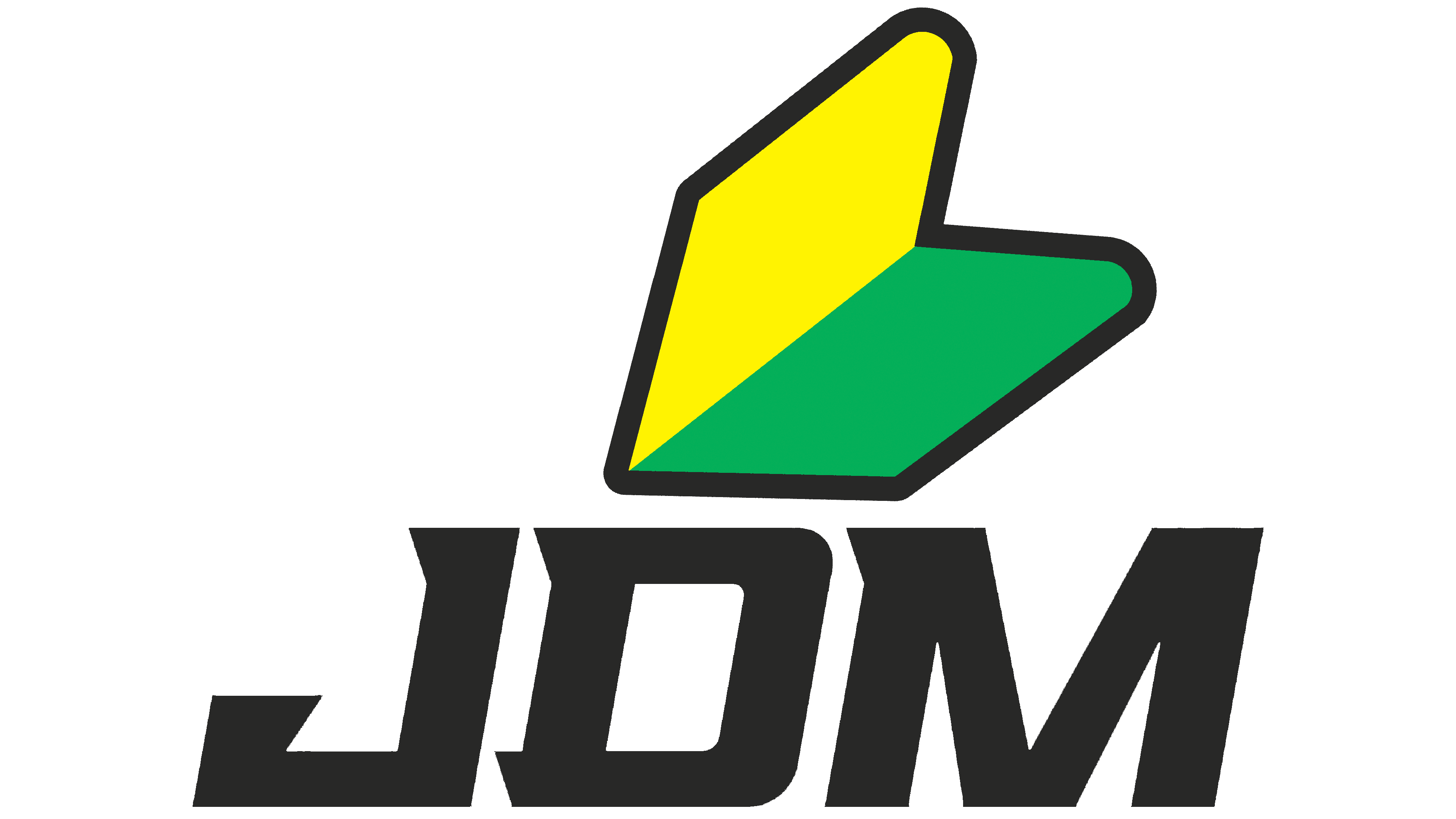
The emblem looks like the tip of an arrow with an indentation in the middle. It has wide symmetrical “wings” colored in different shades. The left side of the complex geometric figure is yellow; the right is green. The upper protrusions have smooth curvature at the ends, and the lower part is pointed at least internally, as the external line is less sharp.
The position of the Wakaba symbol can vary, as it can be flat, tilted, or set on edge. By the way, the icon counts six faces. They are smooth and straight, indicating the car’s excellent aerodynamic capabilities. Moreover, the logo gives a sense of dynamics and energy. A black border strip runs along its perimeter.
Font and Colors

The JDM Leaf logo (or, more precisely, Shoshinsha) is graphical and therefore contains no text. But the color palette is very bright and saturated, so all road users can instantly spot this symbol. It’s colored in yellow and green. Regarding the automotive movement, the first symbolizes care, trust, and caution, while the second signifies awakening, life, and development.