


 Jio Logo PNG
The emblem shows full coverage in the telecommunications space. The Jio logo promises: working with the company is a precise hit. Excellent visibility, audibility, and a continuous, clear signal are the operator’s main features.
Jio’s origins date back to Mukesh Ambani, who, after a split with Anil Ambani, no longer controlled telecom assets such as Reliance Communications. To re-enter the sector, Reliance Industries acquired Infotel Broadband Services in 2010 for 4.8 billion rupees, gaining 4G spectrum across all Indian circles.
Over the next six years, the company invested about 1.5 trillion rupees in infrastructure, building fiber networks and towers nationwide, including underserved regions. In December 2015, a large-scale internal trial distributed free SIM cards to employees to test capacity and reliability under real usage.
On September 5, 2016, Jio launched with free voice and data under the Welcome Offer. Within 83 days, it reached 50 million users, outpacing Facebook and Twitter. The pricing shift forced Airtel and Vodafone India to reduce tariffs, while operators like Aircel exited the market between 2017 and 2019.
In March 2017, free access ended, but tariffs remained lower than previous market levels. By late 2017, Jio had become India’s largest mobile broadband provider. In 2018, it introduced Jio GigaFiber, later renamed JioFiber, and entered the fixed broadband market with a commercial rollout in September 2019.
By April 2019, the user base reached 300 million. The Jio Phone, a low-cost 4G feature phone, sold over 50 million units in its first year, expanding access beyond smartphone users.
In 2020, Jio Platforms raised about $20 billion from investors, including Facebook, Google, KKR, and Silver Lake, allowing debt reduction after heavy infrastructure spending.
In 2021, Jio launched JioMart integrated with WhatsApp. In October 2022, it began 5G rollout in major cities, completing nationwide coverage by December 2023.
Meaning and History
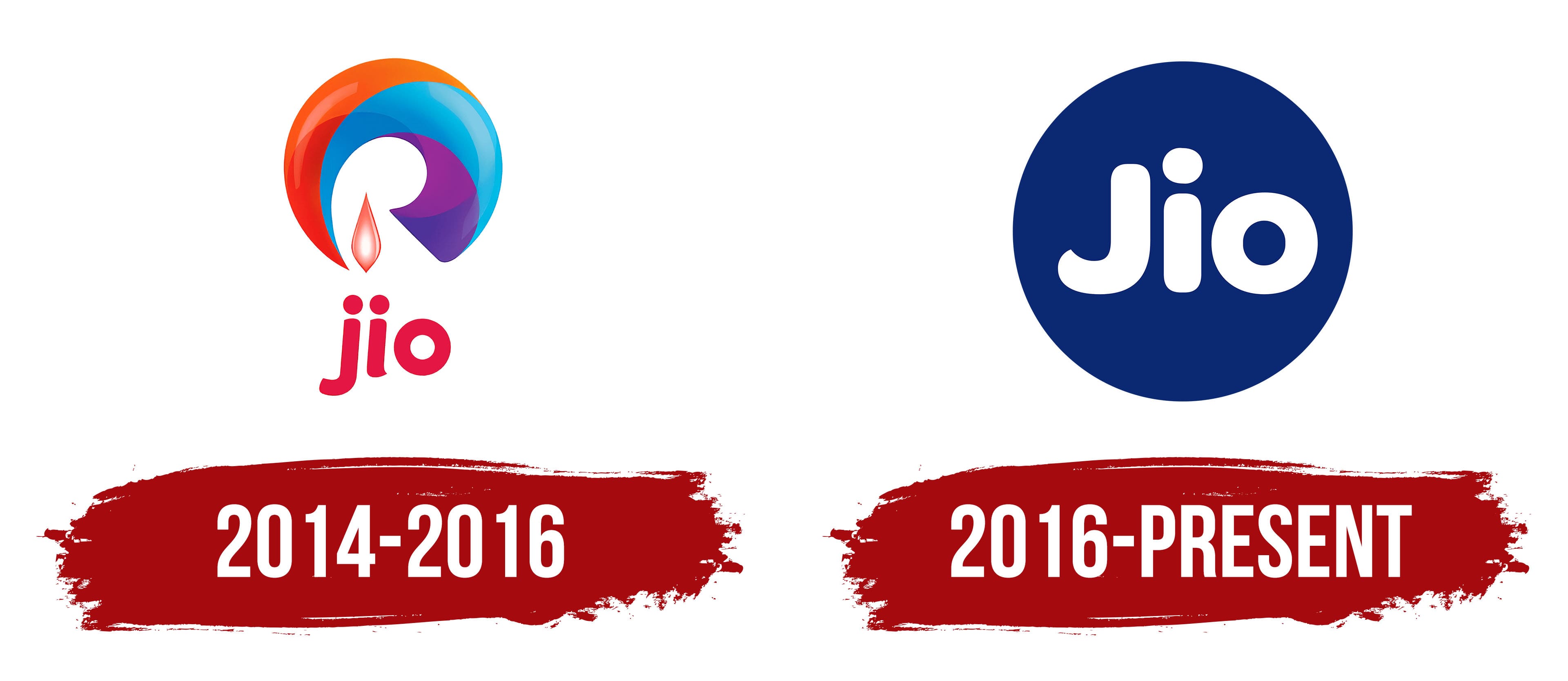
Although it recently emerged as a telecommunications operator, it has existed since 2007. It began operating in Ambawadi, Ahmedabad, Gujarat, where it was registered as Reliance Jio Infocomm Limited. The service changed its name several times, and with each change, its visual identity mark changed as well, until it adopted its current logo. The conglomerate Reliance Industries Limited now owns this chain, which it relaunched in 2016. It is now the world’s third-largest mobile operator by subscriber count. Since its inception, Jio has had two emblems.
What is Jio?
Jio, or Reliance Jio Infocomm Limited, is an Indian telecommunications company and the country’s largest mobile operator. It manages a national LTE network covering 22 districts. The test launch took place in 2015, with the official launch in 2016. The head office is located in Navi Mumbai (Maharashtra).
2014 – 2016
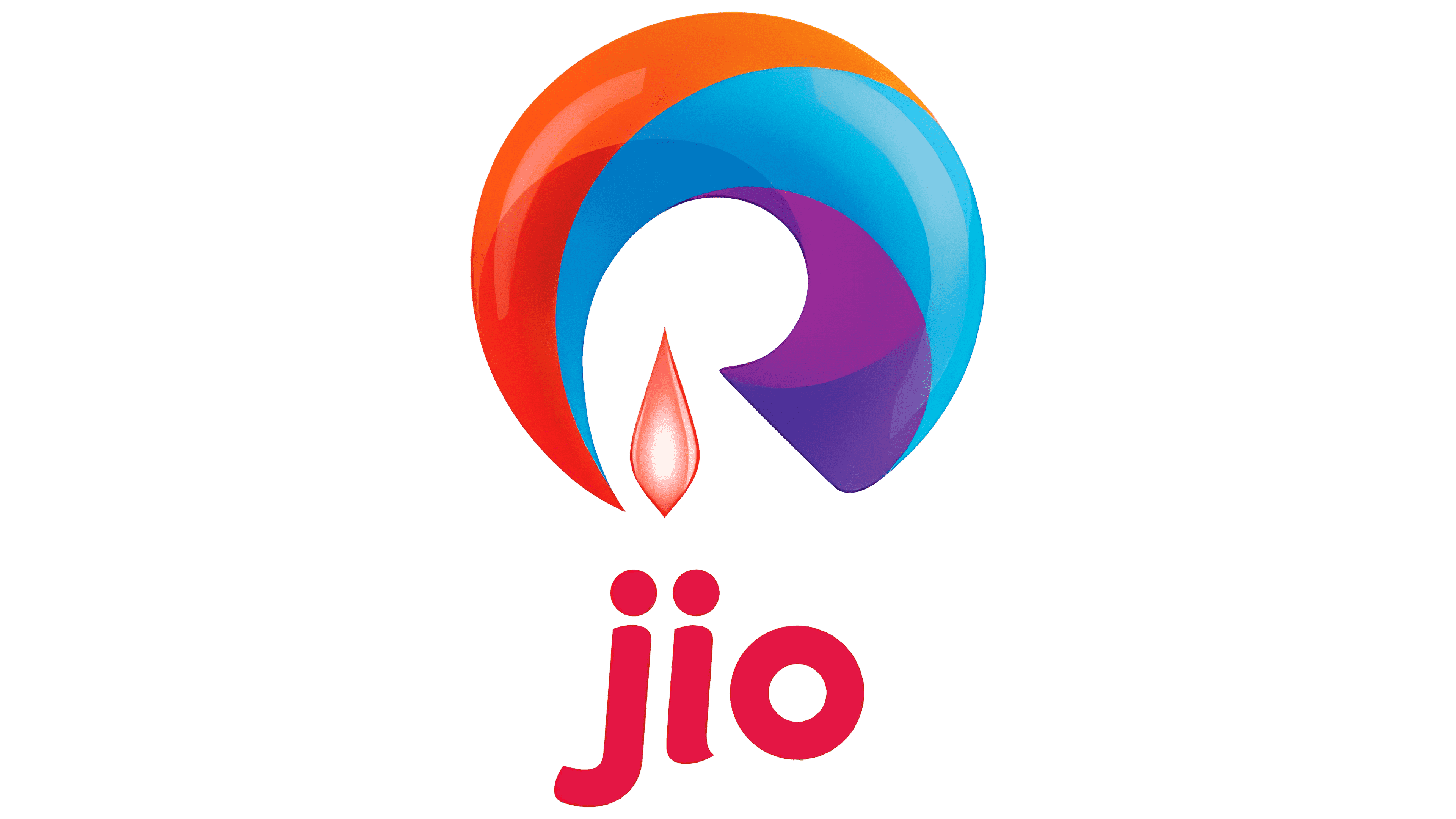
This period includes the pre-launch version, which was scheduled for 2015 but was postponed by almost 12 months. The logo depicts a rounded wave with a multi-color gradient. These include orange, red, blue, cyan, and purple. The alternating shades create shaded areas, so the object also appears as a hollow dome.
Below is an element resembling a candle flame or a closed flower bud with a white core and pink edges. Below is the abbreviated company name. The word “jio” is written in deep red lowercase letters.
2016 – today
The current version is minimalist: nothing is superfluous. It has only two key elements: the name and the circle it sits in. The word “Jio” sits centrally, equidistant from the top and bottom edges. Moreover, the dot on the letter “i” is slightly higher than the capital “J,” making the logo unique. It also exists in several variations: a blue-and-red circle, a blue square, and a slogan. Each version is relevant and used as appropriate.
Font and Colors
The main element of the Jio telecommunications service is a circle. It embodies the wide reach and unbreakable bond of subscribers. The second most important element is the company name. It sits in the center and is rendered in a contrasting color. In the first logo used in beta mode, the name is shifted downward, and the circle is not closed, appearing as a wide, broken ring.
The word “Jio” is written in large uppercase and lowercase letters. The lines are thickened, smooth, and rounded. The dot above the “i” sits above all other characters. The signature palette consists of two colors: white and Medium Persian Blue (shade #005AAC). Red and blue options are also available and equally valid.