


 Kaspersky Logo PNG
The Kaspersky logo symbolizes reliability and security in cybersecurity. Its minimalist design underscores the company’s seriousness and authority, its commitment to high standards, and its effectiveness in combating digital threats.
Kaspersky’s history began in 1989, when the Cascade virus infected Eugene Kaspersky’s work computer. A graduate of the Higher School of the KGB with training in cryptology, he wrote a removal tool and began collecting modules for other malware. In 1990, he formed a team to develop AVP Toolkit Pro. The program gained international attention in 1994 after placing first in an independent antivirus test conducted by Hamburg University.
Kaspersky Lab was officially founded on June 26, 1997, by Eugene Kaspersky, Natalia Kaspersky, and Alexey De-Monderik. Natalia proposed using the Kaspersky name, despite Eugene’s initial reluctance. AVP was later renamed Kaspersky Anti-Virus after another company registered the AVP trademark in the United States. Offices followed in Japan, Germany, France, Spain, Italy, and China, while the company introduced hourly antivirus database updates.
In 2008, Kaspersky created the Global Research and Analysis Team, known as GReAT, to investigate advanced cyberattacks. Its researchers identified Flame in May 2012 and linked parts of its code to Stuxnet. In January 2013, GReAT disclosed Red October, a cyberespionage operation targeting more than 100 diplomatic, government and scientific organizations across 39 countries.
Political pressure intensified in 2017, when the US Department of Homeland Security ordered federal agencies to remove Kaspersky software. The company denied allegations of ties to Russian intelligence and challenged the ban in court. In 2018, it launched a Global Transparency Initiative with centers for source-code review. In 2019, Kaspersky Lab shortened its name to Kaspersky.
Meaning and History
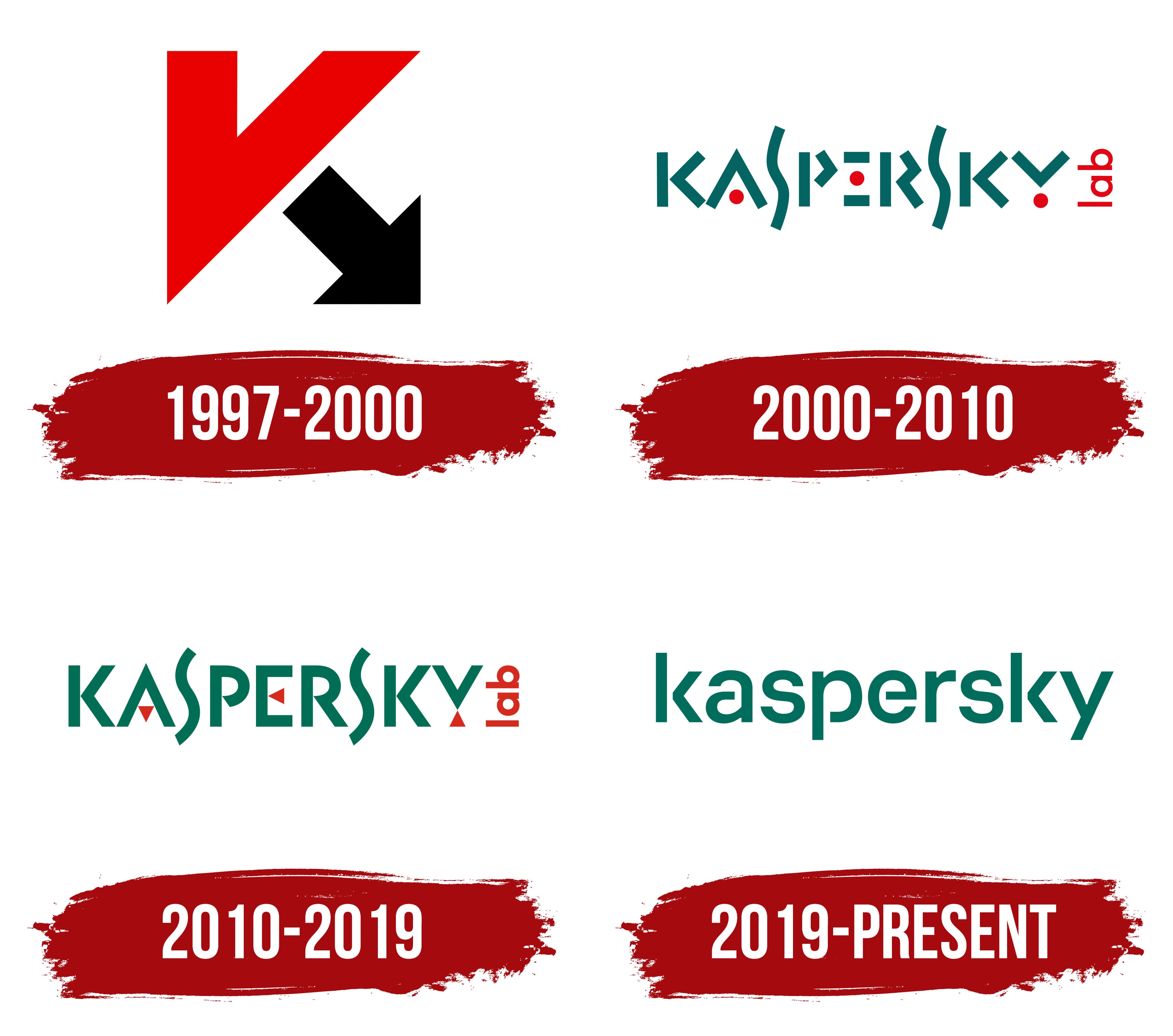
What is Kaspersky?
It is an international company providing cybersecurity software. Its offerings include antivirus solutions for personal computers, mobile devices, and corporate networks. Company specialists quickly detect new viruses and malware. It’s a dedicated lab that regularly publishes analytical reports and research on global cybersecurity trends.
1997 – 2000

The Kaspersky Lab logo featured a symbolic depiction of the letter “K” in red and black. It was developed when the brand was founded by Eugene Kaspersky, Natalya Kasperskaya, and Alexey De-Monderik after they left KAMI.
The letter “K” was formed by two intersecting elements: a dominant, bold red arrow pointing downward and a complementary black arrow pointing upward and to the right. Both elements had a distinctly angular design with precise geometric proportions. The red arrow visually dominated, symbolizing active protection and readiness to respond to threats, while the thinner black arrow added depth and complemented the composition’s dynamic feel.
The color palette relied on a sharp contrast between bright red and black. In the context of the company’s work, red symbolized danger, urgency in responding to security threats, and strength and an aggressive defensive strategy. Black added rigor, reliability, and stability, underscoring the company’s commitment to cybersecurity.
The logo’s design was intended as a metaphor for attack and reliable defense, aligning with the company’s focus on information security. The style was angular and bold, characterized by sharp edges and lines that reflected the company’s technological profile, its determination to confront threats, and the professionalism of its specialists.
The original Kaspersky Lab logo visually represented combat readiness, conveyed through its shape and color, helping the brand establish itself in the market as a reliable defender against cyber threats.
2000 – 2010

The new Kaspersky Lab logo marked a shift in the company’s visual concept. The wordmark consisted of two elements with different stylistic and color treatments.
The brand name “Kaspersky” was set in a custom typeface based on simple geometric forms. The letters were composed of dark green segments with clean lines, precise angles, and balanced proportions. A notable feature was the use of red dot elements in certain letters, such as the “P,” which added a strong visual accent and emphasized the company’s technological focus. In addition, the letters “A,” “E,” and “Y” replaced traditional horizontal lines with red triangular inserts, creating a form reminiscent of Greek symbols and highlighting the company’s scientific approach to information security.
The vertically placed word “Lab,” written in small red lowercase letters, provided a visual contrast to the main name and reinforced the company’s positioning as an innovative research laboratory. The logo’s palette combined dark green and bright red tones. Green symbolized reliability, safety, and trust, while red served as an accent for signals of alert, urgency, and swift response.
According to Andrew Winton, Vice President of Marketing at Kaspersky Lab, the choice of Greek-inspired letter shapes was deliberate, intended to convey the brand’s scientific and intellectual character. The geometric letterforms, the interplay of lines, and the placement of accent dots emphasized minimalism, evoking associations with the precision of computer systems and technology.
The logo reflected the company’s core principles: technological sophistication, a research-driven approach, and reliable data protection. It successfully combined minimalist geometric typography with vivid color accents.
2010 – 2019

The Kaspersky Lab logo, updated in 2010 and used until 2019, evolved from the 2000-2010 version, retaining its overall structure while introducing noticeable changes to the shapes of certain letters and graphic elements. In this version, the “Kaspersky” wordmark used a smoother, more rounded typeface, in contrast to the strict geometry of the previous version. The letters appeared more unified, improving overall legibility.
The font, set in dark green characters, lost its previous abstract style. Letter segments were joined with rounded ends and curved lines, giving the symbols a more natural, cohesive look. Instead of the red dots used earlier, triangular inserts in the same red color were placed in the letters “A,” “E,” “P,” and “Y,” adding a technological accent and visual dynamism. The triangular elements symbolized direction and precision, evoking associations with a cursor or pointer in a digital interface.
The second word, “Lab,” still appeared vertically, in small bright red lowercase letters, emphasizing the company’s research and scientific status. The palette of dark green and red retained its symbolic meaning: green stood for protection, security, and reliability, while red represented warning and rapid response.
The logo became a visual metaphor for the balance between innovation and reliability, with clean letterforms and contrasting elements that visually communicated the company’s precision and technological expertise.
2019 – today

The Kaspersky logo, introduced in June 2019, was the result of a comprehensive rebranding effort aimed at transforming the company from a specialized antivirus developer into a comprehensive cybersecurity solutions provider. The brand name was shortened to “kaspersky,” removing the emphasis on “Lab” and reflecting the company’s new, more global status.
The style was developed by the international agency Moving Brands in collaboration with Kaspersky’s in-house team. Its visual foundation is built on strict geometric letterforms created with mathematical precision, symbolizing the brand’s engineering approach, reliability, and technological focus.
The custom-designed typeface, named Kaspersky Sans, is a sans serif with a minimalist, open design, precise proportions, and strict geometry. Each letter of the logo was carefully crafted for maximum simplicity and precise line work, maintaining high readability and visual clarity across both digital and print formats. The typeface supports both Latin and Cyrillic scripts, ensuring its use across all company products and communications.
The logo’s color palette preserved the traditional dark green, symbolizing stability and security. Still, it was enhanced with bright accents and gradient elements to increase visual flexibility and adaptability in the digital space.
Eugene Kaspersky detailed the logo approval process in his blog, noting that various concepts were considered, including one featuring the brand’s mascot, Midori Kuma. The final choice was the concept featuring geometrically precise letters, which emphasized the company’s technical nature and engineering expertise. The new logo was officially presented at the Security Analyst Summit in Singapore in the summer of 2019.
The updated logo symbolizes the company’s transformation from a niche antivirus software developer into a global provider of comprehensive cybersecurity products and services.
