 Google Gemini Logo PNG
The Google Gemini Logo embodies easy, convenient interaction with technology. The project offers tools for creating content and analyzing data, making it accessible and useful across fields and an important part of everyday life.
Google Gemini grew out of Google’s AI research efforts after Google merged Google Brain and DeepMind in April 2023. The project accelerated after OpenAI released ChatGPT in November 2022, creating pressure on Google’s search and AI products. In February 2023, Google introduced Bard, based on LaMDA and later PaLM 2, but its first public demonstration included an incorrect answer about the James Webb Space Telescope. The incident affected Alphabet’s stock value and highlighted the difficulty of competing with rapidly growing AI services.
On December 6, 2023, Google officially presented Gemini as a multimodal model family designed to process text, images, audio, video, and code. The first versions included Gemini Ultra for complex computing tasks, Gemini Pro for general use, and Gemini Nano for local processing on devices such as the Pixel 8 Pro. Google compared Ultra with OpenAI’s GPT-4, although independent evaluations showed different results depending on testing methods.
In January 2024, Gemini Pro expanded inside Bard, and on February 8, Google replaced the name Bard with Gemini. The company released iOS and Android apps, allowing users to access the assistant across devices. In March 2024, Gemini Ultra became available through Google One AI Premium for $19.99 per month, competing with ChatGPT Plus.
Google later integrated Gemini into Gmail and Docs for writing, summaries, and document analysis. AI Overviews appeared in Search in May 2024 but required adjustments after users reported inaccurate answers. At Google I/O 2024, the company introduced Gemini 1.5 Pro with a one-million-token context window and Gemini 1.5 Flash for faster tasks.
Meaning and History
What is Google Gemini?
It is a powerful artificial intelligence system that handles text, images, video, code, and other data types. It is integrated into various digital products, including search, browser, and email services. It is available in several versions, from the most powerful to mobile-optimized. The technology helps developers, researchers, and everyday users solve complex problems, from programming and analyzing information to creating content and communicating naturally.
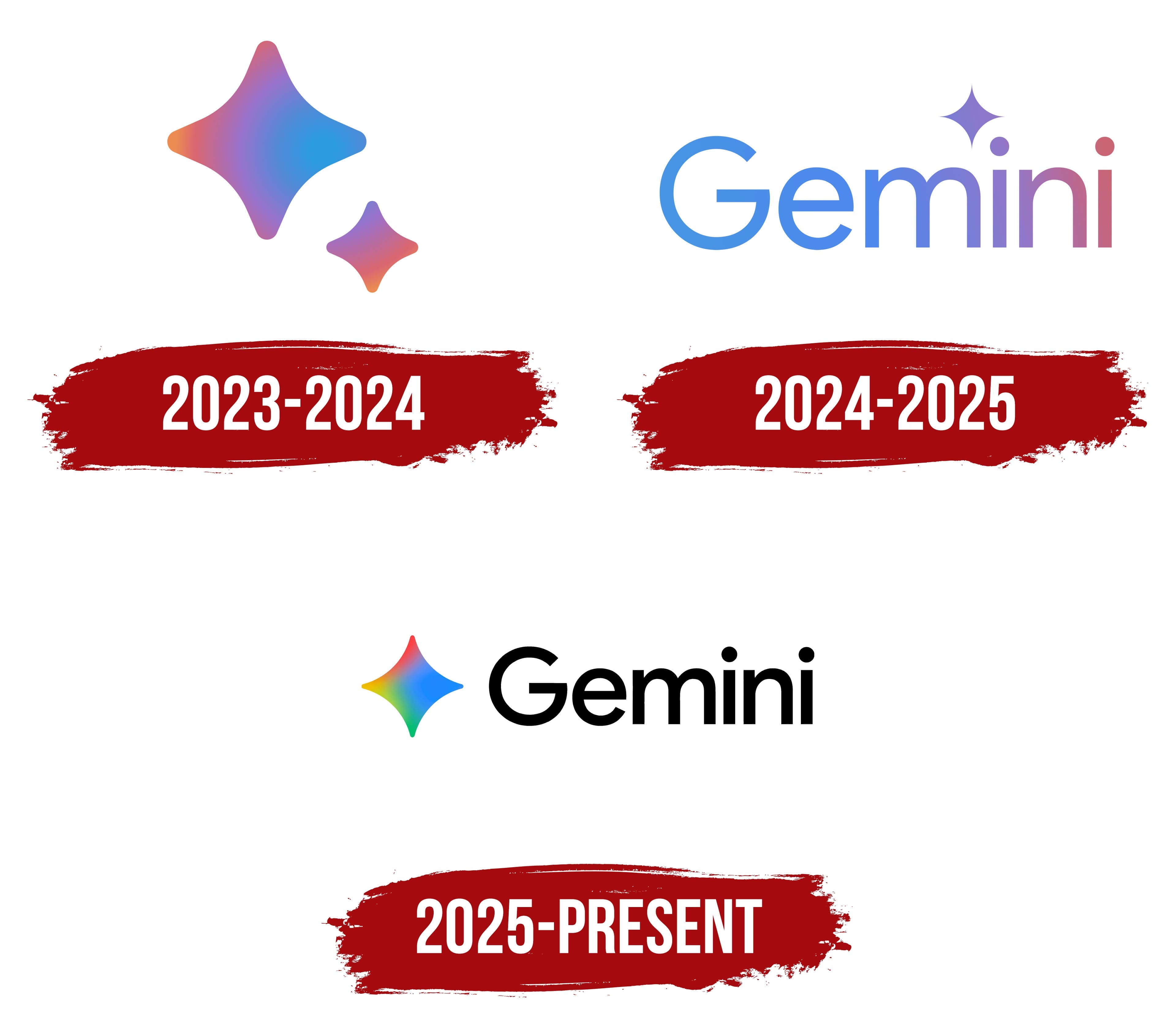
2023 – 2024
The logo for Google’s AI service Bard was unveiled in March 2023. Its design featured two smooth abstract shapes styled to represent a glow or glimmer of light.
The shapes avoid sharp corners or straight lines, instead using gently rounded edges to create a soft, approachable look. One shape is larger, while the smaller shape sits slightly below and offset to the side, balancing the composition. Together, these elements metaphorically resemble sparks, emphasizing the product’s innovative nature and cutting-edge technology.
The color palette uses a gradient that smoothly transitions from warm orange shades through purple to blue. This enhances associations with fluidity, movement, and flexibility, symbolically reflecting the AI’s continuous development and adaptability.
Overall, the design effectively conveys user-friendly interaction and access to advanced technologies, such as artificial intelligence.
2024 – 2025
Google officially rebranded its artificial intelligence on February 8, 2024, merging its Bard and Duet AI services under the new brand name Gemini. The new logo was developed by Google’s internal design team in collaboration with the branding agency Koto.
The new logo is based on Product Sans, Google’s proprietary typeface known for its simple shapes and lack of serifs. The letterforms in “Gemini” are smooth and slightly rounded, with no sharp corners or abrupt transitions. The stroke thickness is consistent, and the proportions are balanced, conveying friendliness and digital clarity.
The logo’s color palette features a subtle gradient that starts with a cool blue on the left and transitions to a violet-red on the right. This gradient conveys the brand’s dynamic character, symbolizing innovation, technological advancement, and the AI platform’s multifunctional nature. The color scheme integrates logically with Google’s overall visual identity while remaining distinct, emphasizing the product’s AI-specific nature.

Next to the letter “i” is a four-pointed star with sharpened edges, evolving from a previously more rounded shape. The star represents inspiration, creativity, intellectual brilliance, problem-solving, and the fulfillment of creative ideas.
Overall, the new visual style combines historical elements from earlier logos with a contemporary approach, accurately reflecting the platform’s identity as a next-generation intellectual and communication product.
2025 – today

The new version of the Gemini logo was first spotted in early July 2025, appearing simultaneously with updated mobile app icons on Android and iOS, as well as on Google Play and Gemini’s official account on the social network X. These logo changes were part of a broader visual strategy aimed at unifying Google products under a cohesive design system, initially begun with the redesign of the Google “G” icon in May 2025, which shifted from solid block colors to a smooth gradient.
The new design’s key element is a star symbol with softly rounded edges, creating a gentler form than the previous, sharper version. This adjustment was made to ensure comfortable visibility even at minimal sizes, making the logo friendlier and universally adaptable across platforms and media.
The star’s color palette now features a gradient incorporating Google’s signature colors: red, yellow, green, and blue. These colors symbolically link Gemini to Google’s broader ecosystem, maintaining brand recognition and emphasizing its integration into the company’s main product lineup.
The typography for the word “Gemini” remained unchanged, using Google’s proprietary Product Sans font, known for its geometric precision, consistent stroke width, and lack of serifs.
The star symbol serves as a metaphor for inspiration and intellectual advancement, highlighting Gemini AI’s ability to support productive interactions and enhance user creativity. Visually, the star resembles a bright burst of light, reinforcing associations with innovation and digital activity.
Gemini’s updated design has become an organic part of Google’s overall brand architecture, successfully blending historical elements with contemporary visual branding trends, while ensuring continuity across the company’s product family.