


 NordVPN Logo PNG
The NordVPN logo symbolizes digital protection and security. The mountain imagery conveys the service’s strength and reliability, designed to ensure user privacy and protect information online.
NordVPN grew from Tesonet, founded in Vilnius in 2008 by friends Tomas Okmanas and Eimantas Sabaliauskas. After testing 34 ideas ranging from games to web hosting, they identified demand for privacy tools. In 2012, they launched a virtual private network registered in Panama, where rules did not require retention of user activity data.
The service expanded without outside investment, using revenue to build its server network. Mobile applications for iOS and Android appeared in 2016, extending access beyond computers running Windows, macOS and Linux. By covering phones and desktops, NordVPN broadened its audience while continuing to develop its privacy infrastructure.
In 2019, the company disclosed unauthorized access to one Finnish server during 2018. The breach involved a third-party data center, and no activity logs were exposed because the service did not retain them. NordVPN responded by accelerating control of its infrastructure, commissioning independent no-log audits and adding security measures. It also introduced NordVPN Teams, later NordLayer, and the WireGuard-based NordLynx protocol, positioned against ExpressVPN on speed.
Nord Security raised its first outside capital in April 2022, receiving $100 million in a round led by Novator Ventures. That year it merged with Surfshark, while both VPN products retained separate brands and development teams. Warburg Pincus invested another $100 million in September 2023, lifting the company’s valuation above $3 billion.
Meaning and History
What is NordVPN?
It is a major international online privacy service registered in Panama. The company operates thousands of servers across dozens of countries on multiple continents. Key features include double traffic encryption and malware protection. Its user-friendly graphical interface lets users select servers directly from a global map. The platform is commonly used to access streaming content without regional restrictions and ensures security on public Wi-Fi networks.
2012 – 2018
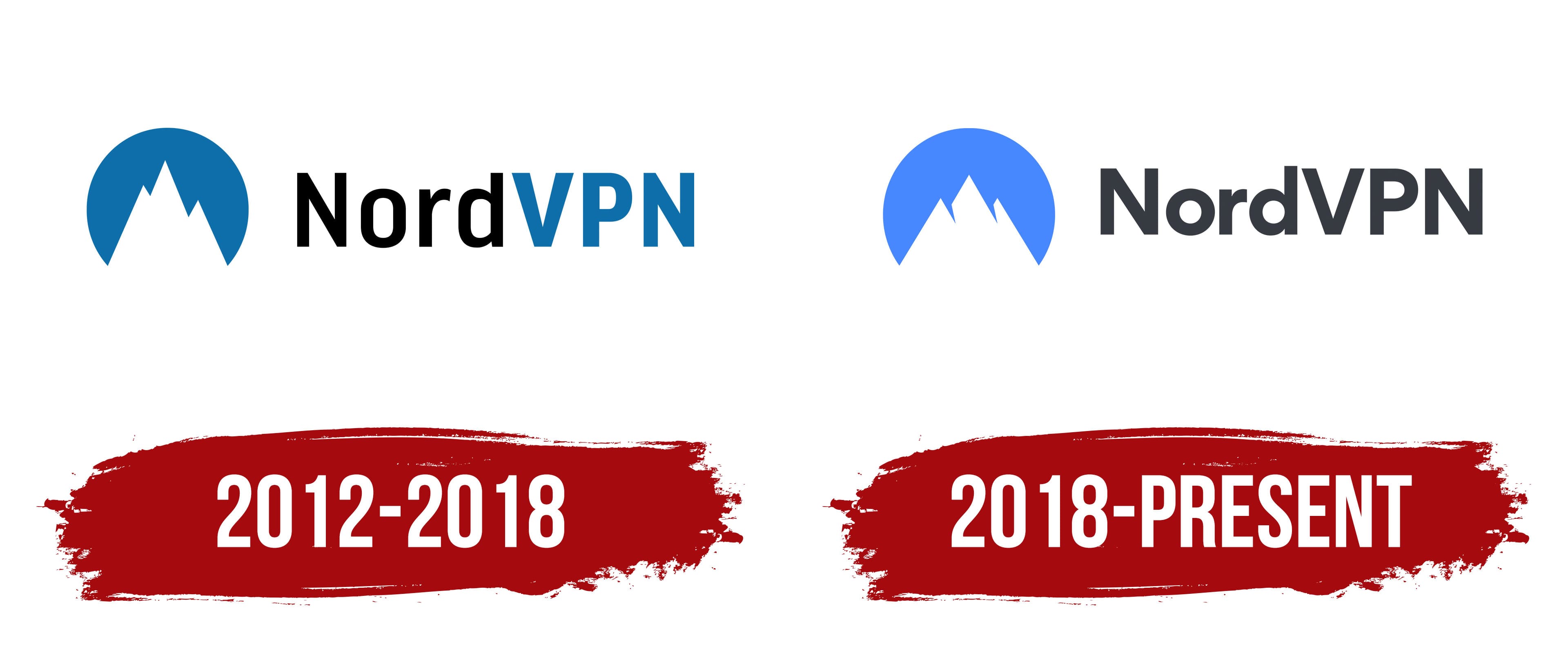
The first NordVPN logo, introduced with the service’s launch, reflected the company’s aim to create an authentic visual language that combined technology, Nordic identity, and trust as a key product quality. Developed at a time when cybersecurity was emerging as a mainstream service, it conveyed associations of protection and simplicity.
The logo’s composition was based on a dual combination of symbol and wordmark. On the left was a circle filled with cool blue, containing the sharp peaks of a mountain range. The mountain shape followed an asymmetric principle: peaks differed in height and contour sharpness, creating a sense of movement and depth. The visual motif was interpreted as a metaphor for Nordic nature and its qualities of impenetrability and isolation. In the brand’s logic, mountains represented security because they provide distance, protection, and shielding from external influence, aligning with the core function of a VPN service.
On the right was the “NordVPN” wordmark. The typography featured a strict sans-serif style with moderately condensed proportions. The first word, “Nord,” was set in a lighter weight, while “VPN” appeared in a heavier, bolder form, creating an internal emphasis on the functional component. This rhythm separation within a single line enhanced legibility and balanced the brand and technical elements. The typeface referenced an industrial style, where clarity, precision, and compactness play central roles.
The color palette used two shades of blue: a darker tone for the mountains and a brighter tone to highlight “VPN.” This cool spectrum evoked a sense of technological trust, neutrality, and calm stability. The combination reinforced northern associations and created a visual metaphor of transparency and a clear tunnel, intuitively linked to secure internet traffic.
Created in collaboration with the founders, including Tomas Okmanas, the logo conveyed the concept of “Scandinavian security,” combining technological sophistication with visual simplicity. It became the starting point for NordVPN’s visual system, retaining its core elements (mountains, blue, minimalist typography) in subsequent iterations.
2018 – today

The redesign of the NordVPN logo marked the company’s transition to a more mature, refined, and adaptable visual system. It reflected a strategic transformation of the brand, from a cybersecurity startup to a global digital service focused on trust, openness, and technology.
The composition kept the structure of the previous version but underwent significant formal and stylistic changes. The circle with the mountain silhouette remained on the left, but the peak became symmetrical: two side-by-side summits of equal height with smoother outlines. This harmonization made the silhouette less aggressive and more visually balanced. The mountain motif still conveyed reliability, isolation, and control, key values for VPN products, but the presentation became softer, aligning the brand’s visual language with universal digital minimalism.
The color structure also changed. The dark blue of the previous logo was replaced with light blue, a more airy, technological, and “friendly” shade. This color creates a sense of openness, transparency, and accessibility, reducing the visual distance between the brand and the user. It symbolized the digital space as secure yet not closed off.
Typography was unified. Unlike the earlier version, where “Nord” and “VPN” appeared as two typographic blocks with different weights, the entire wordmark was now set in a single, bold sans-serif typeface with soft shapes and a uniform size. The font was clean, geometric, and evenly spaced. “Nord” was capitalized, while “VPN” was set in uppercase. This preserved the semantic emphasis on the technical component while maintaining typographic unity. Visually, the typeface resembled a modernized version of Trade Gothic with elements of the humanist grotesque.
The updated logo became a tool for adapting the brand to modern interfaces and digital products. It preserved its symbolic roots and historical continuity while being transformed into a minimalist, scalable, and intuitively recognizable mark.
Font and Colors

The color palette of the NordVPN logo, in use since 2018, leans toward greater lightness and digital neutrality. The original blue was replaced with light blue, perceived as more open and less formal. White remains as the background for the mountain silhouette, symbolizing the service’s purity and transparency. The dark tone of the lettering, once black, shifted to muted gray, reinforcing the brand’s technological and approachable image. The color set evokes associations with cloud technologies and digital security, making the brand appear friendlier and more relevant.
The logo’s font is in a single style: bold sans serif with precise kerning and balanced geometry. The letters have heavy strokes and smooth contours, giving them a modern look. The text follows a mixed-case principle: the first part (“Nord”) uses an initial capital followed by lowercase letters, and the second part (“VPN”) is in uppercase. This visually separates the brand name from the service designation while preserving typographic unity. The typeface closely resembles Trade Gothic Condensed in its proportions and glyph shapes, creating a strict yet approachable image suitable for technology products.