


 Audacity Logo PNG
The Audacity logo is associated with practicality and freedom in sound creation. The program grew out of a university lab where enthusiasts developed a tool to make working with sound intuitive and accessible. This editor has become the choice for those who value convenience and open possibilities, combining simplicity and power.
Audacity began in 1999 at Carnegie Mellon University, where graduate student Dominic Mazzoni worked with professor Roger Dannenberg on automatic music transcription. Without a tool to view waveforms and analyze audio, Mazzoni created CMU Visual Audio, later renamed Audacity. He published code on SourceForge, and version 0.8 appeared on May 28, 2000.
The program entered a market dominated by costly editors such as Adobe Audition and professional DAW software. Audacity offered a free, open-source alternative across several operating systems. It briefly became one of the few native editors for Apple’s OS X. At the same time, Linux users gained access to a capable audio tool, and Windows users received a replacement for paid software.
An international volunteer community soon formed around the project. Dannenberg continued developing Nyquist, the scripting language used for audio effects, while Mazzoni left the university to focus on Audacity. SourceForge named it Best Multimedia Project in 2007 and 2009, and PC World included it among the 100 best products of 2008. Before hosting moved to FossHub in 2015, downloads had passed 200 million.
Muse Group acquired Audacity in April 2021 and promised to keep it free and open source. Proposed telemetry, a new contributor agreement, and a privacy policy covering system data and IP addresses caused criticism and inspired forks such as Tenacity. Muse Group revised the policy, limited IP retention, and kept the project under the GPL license.
Meaning and History
What is Audacity?
This versatile open-source audio editing software allows users to create and process sound. It is useful for beginners and professionals, with tools for multitrack recording, noise reduction, and spectrum analysis. The program supports plugins, processing of various audio formats, and live sound recording, making it popular in home studios, educational institutions, and professional projects. The user community actively shares add-ons and training materials, helping to develop and adapt the platform to different needs.
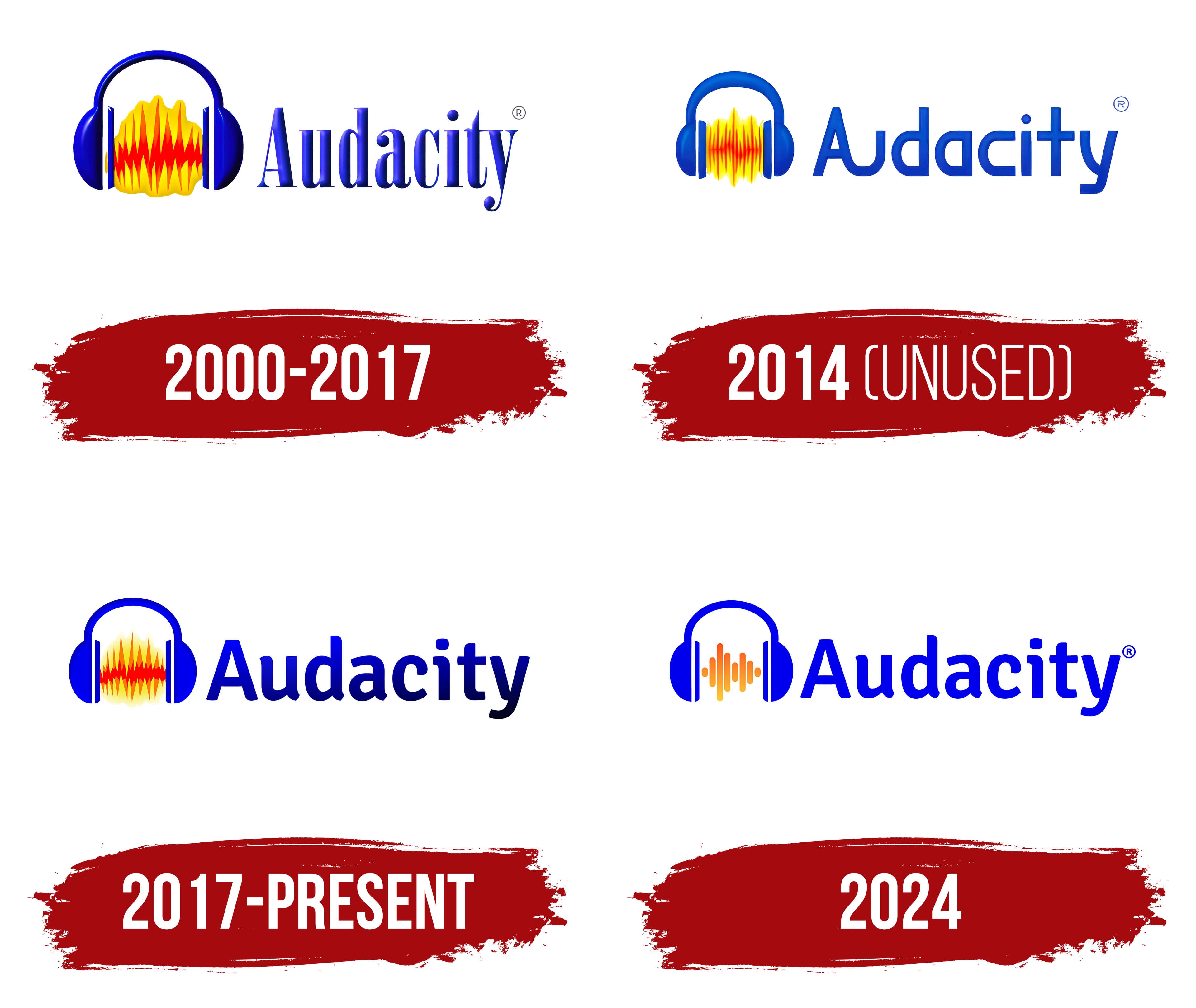
2000 – 2017

The Audacity logo, created in the early 2000s, features purple headphones, sound waves, and text. The design emphasizes the program’s main direction: working with sound.
The purple earbuds take center stage. Their soft, rounded lines are associated with comfort and modern technology, while the color creates creativity. Inside the headphones, sound waves similar to flames are depicted. The gradient from yellow to orange creates dynamism and conveys energy, emphasizing the sound’s editing and amplification.
The text is set in Onyx and placed next to the graphics. Narrow serifed letters with a gradient create a three-dimensional effect, adding depth and emphasizing the program’s professionalism. The purple text color supports the overall style, linking the text and graphics into a single image.
The emblem expresses Audacity’s main characteristics: convenience, functionality, and energy. It focuses on the program’s capabilities in sound processing.
2014 (unused)

The logo, designed by ChrisF, offered a new version of Audacity’s design. The update changed the color palette and font style. The purple color was replaced with a rich blue, contrasting with the orange-yellow sound waves.
The headphones are still recognizable in the silhouette but have become more concise. The lines have become clearer, making the overall look more versatile. Sound waves, reminiscent of flames, have retained energy and dynamics. The gradient from yellow to orange adds a sense of movement and brings the design to life.
The text is in the modern geometric grotesque style. The font’s smooth lines and minimalism emphasize its functionality. The unique combination of the first two letters was notable. The blue text harmoniously complements the graphic elements, creating a cohesive image.
Although this logo was never approved, it attempted to update the program’s style. It reinterpreted familiar details, preserving their connection to the theme of working with sound.
2017 – today

In 2017, the Audacity logo was updated for the first time in many years. The basic concepts of headphones, sound waves, and text have been retained, but the design has been updated to be more modern and better suited to digital platforms. The new style is minimalistic and flat.
The headphones have adopted simplified lines and appear lighter. The blue color has become rich and pure, reflecting modernity and versatility. Yellow-orange sound waves resembling pulsating peaks remained. They convey energy and movement, while the gradient adds brightness and liveliness.
The text has also changed. For this, they chose the Signika Semibold font, with soft, rounded strokes that create a friendly impression. Smooth lettering makes the inscription easy to read, and subtle accents in the details add a unique touch.
The updated flat logo design is fresh and bright, maintaining a connection to the program’s familiar image while making it recognizable to users.
2024
The logo was a new interpretation of the Audacity program’s visual style. It retained the previous fragments but reworked their form and style. The project remained a concept and was not officially adopted.
The headphones’ design has become more streamlined through simplified lines. Their rich blue color emphasizes modernity and versatility. Sound waves, instead of the previous flashes of fire, became vertical columns with a smooth gradient from orange to yellow, symbolizing the visualization of sound.
The text has been updated, making it softer with rounded letter outlines. The font is a modern sans serif. The blue text harmonizes with the headphones, creating a cohesive, easy-to-see image.
Sound wave gradients emphasize dynamics and energy, reflecting the work with audio files. The design looks good on digital platforms, from large screens to small app icons.
The concept shows how to update the program’s style while maintaining appeal. Although the project was not realized, it became an interesting example of a modern approach to a familiar image.