


 Carnegie Mellon University Logo PNG
The Carnegie Mellon University logo underscores the institution’s prestige and broad recognition within the global education community. The emblem reflects the university’s worldwide renown, with its influence spanning six continents. The logo underscores the university’s substantial contributions to education and science, positioning it among the world’s leading educational institutions.
Carnegie Mellon University traces its roots to 1900, when industrialist Andrew Carnegie founded the Carnegie Technical Schools in Pittsburgh. He aimed to give working-class families access to an education that combined practical and artistic knowledge. The schools merged in 1912 to form the Carnegie Institute of Technology, gaining a reputation for strong scientific and engineering programs.
In 1913, Andrew Mellon created the Mellon Institute of Industrial Research to advance applied science for industry. Although the two institutions developed separately, they often collaborated on chemistry and engineering projects, especially during World War II.
By the 1950s, Carnegie Tech had become a pioneer in emerging fields, founding the nation’s first computer science department in 1956. A decade later, in 1967, Carnegie Tech and the Mellon Institute merged to form Carnegie Mellon University, uniting technical research with humanities and business education.
During the following decades, the university advanced rapidly in computing and robotics. The Robotics Institute opened in 1979 and became a leader in its field. Growth continued in the 1990s with the expansion of the Tepper School of Business, and in the 2000s, CMU expanded abroad with campuses in Qatar and Australia.
In recent years, the university has made major investments in research infrastructure, including the construction of Scott Hall in 2015 and the AI Engineering Institute in 2021. The university remains a global center for innovation in robotics, artificial intelligence, and cybersecurity, advancing its vision of blending science, creativity, and applied learning.
Meaning and History

What is Carnegie Mellon University?
This distinguished private research university is in Pittsburgh, Pennsylvania. It is recognized for excellence in science, technology, engineering, and mathematics (STEM), as well as strong business, arts, and humanities programs. It provides a wide range of undergraduate and graduate degrees. The university is especially known for its computer science, robotics, and artificial intelligence programs, which consistently rank at the top.
1900 – today

The Carnegie Mellon logo consists of the university’s name in rich red. The serif letters vary in glyph thickness, giving the emblem elegance and expressiveness. Placing the text on a single line symbolizes the continuity and integrity of the university’s long history.
The university’s name is associated with three well-known figures and philanthropists: Andrew Carnegie, a Scottish-American industrialist, and the Mellon brothers, prominent bankers and businessmen. In 1967, the institutions founded by these individuals merged to form Carnegie Mellon University. During this period, the university developed its logo.
The color red symbolizes nobility, high ideals, and aspirations that the university has preserved and developed throughout its history. The emblem underscores the institution’s prestige and authority, which it rightfully holds as a top-30 university.
Despite its apparent simplicity, this visual mark carries deep meaning tied to the university’s traditions, history, and high academic standards.
The Seal
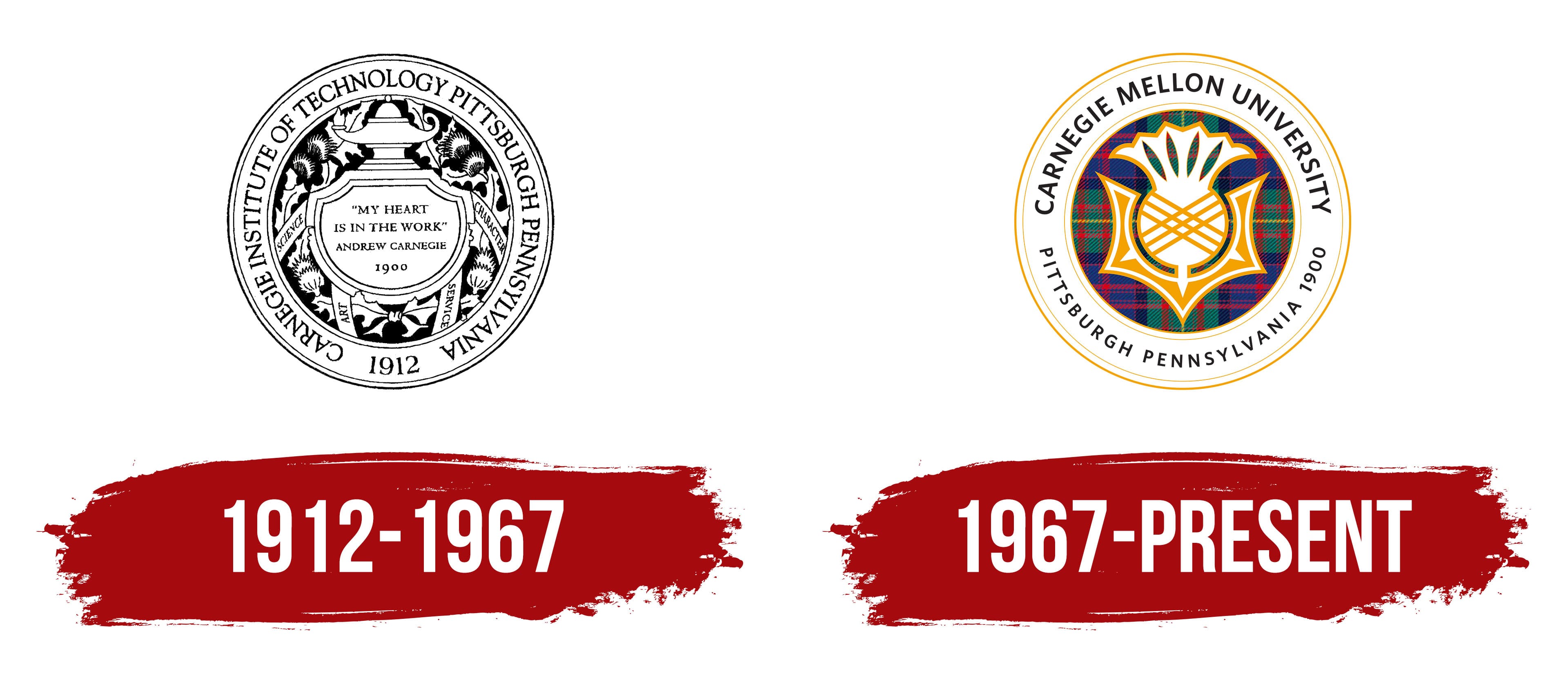
1912 – 1967

The first university seal was used in 1912, when the Carnegie Technical Schools gained institute status, a designation that lasted until the universities merged. The edge of the seal reads “Carnegie Institute of Technology,” along with the year and place of founding: “Pittsburgh, Pennsylvania, 1912.”
At the center of the seal is a tablet engraved with the philanthropist’s words upon donating funds to establish the institution: “My heart is in the work.” Above the tablet is a lamp, symbolizing the light of truth.
Ribbons extend from the tablet, inscribed with the key characteristics of an educated person: science, art, service, and character. The composition portrays Carnegie as a moral, well-rounded individual guided by charity and truth. He dedicates his life to service and to advancing science and art.
The seal’s background features thistle leaves and flowers, the symbol of Scotland, Carnegie’s homeland. This plant embodies resilience and the ability to overcome challenges.
1967 – today

The new university seal includes its name and place of founding, but it incorrectly lists the founding year as 1900, when Carnegie Technical Schools were established. This choice is not entirely accurate, as it refers to the founding date of the preceding institution.
The center of the seal features a stylized thistle, Scotland’s national symbol and Andrew Carnegie’s homeland. The background features fabric in the style of Scottish national costumes, highlighting the founder’s cultural roots and heritage.
The sharp thorns around the flower symbolize the protection and resilience necessary for growth and prosperity. This reflects the university’s mission to provide young people with reliable protection and support until they gain the knowledge and confidence to enter the world and make it better.
The seal honors the memory of a man who improved many lives by founding educational institutions and libraries, emphasizing his contribution to education and enlightenment.