 FreeBSD Logo PNG
The FreeBSD logo emphasizes the operating system’s technical stability and open nature. Its simple design symbolizes reliability, functionality, and the project’s value for the professional community.
FreeBSD traces its roots to AT&T’s Unix, created at Bell Labs by Ken Thompson and Dennis Ritchie in 1969. UC Berkeley licensed the source code in 1974, and Bill Joy led development of the Berkeley Software Distribution, released in 1977. BSD added TCP/IP networking, virtual memory and the Fast File System, technologies later used across commercial Unix systems and early internet infrastructure worldwide.
In 1992, William Jolitz and Lynne Jolitz released 386BSD for personal computers built around the Intel 386 processor. Slow updates and a growing patch backlog led Jordan Hubbard, Rod Grimes, and other developers to form FreeBSD in June 1993. The first release arrived in November. A lawsuit over Unix code forced a full audit, and FreeBSD 2.0 appeared in November 1994 with disputed files removed.
During the 1990s, Walnut Creek CDROM distributed the system and reinvested revenue in development. The BSD license allowed companies to use the code in proprietary products without publishing modifications. IBM adopted related technology in server products, Nokia used it in telecom equipment, and NetApp based ONTAP on it. Juniper built JunOS around the system’s core.
Netflix later deployed FreeBSD for video delivery, while WhatsApp used it to handle early messaging traffic. The FreeBSD Foundation was established in 2000 to fund developers, infrastructure, and legal support. FreeBSD 14.0 followed in November 2023 with support for newer processors and updated security mechanisms.
Meaning and History
What is FreeBSD?
It is a free, Unix-like operating system known for its stability and high performance. It features advanced networking capabilities, the robust ZFS file system, and efficient process isolation. Major internet companies and network-equipment manufacturers use the OS for its reliability and fault tolerance.
1993 – 2006

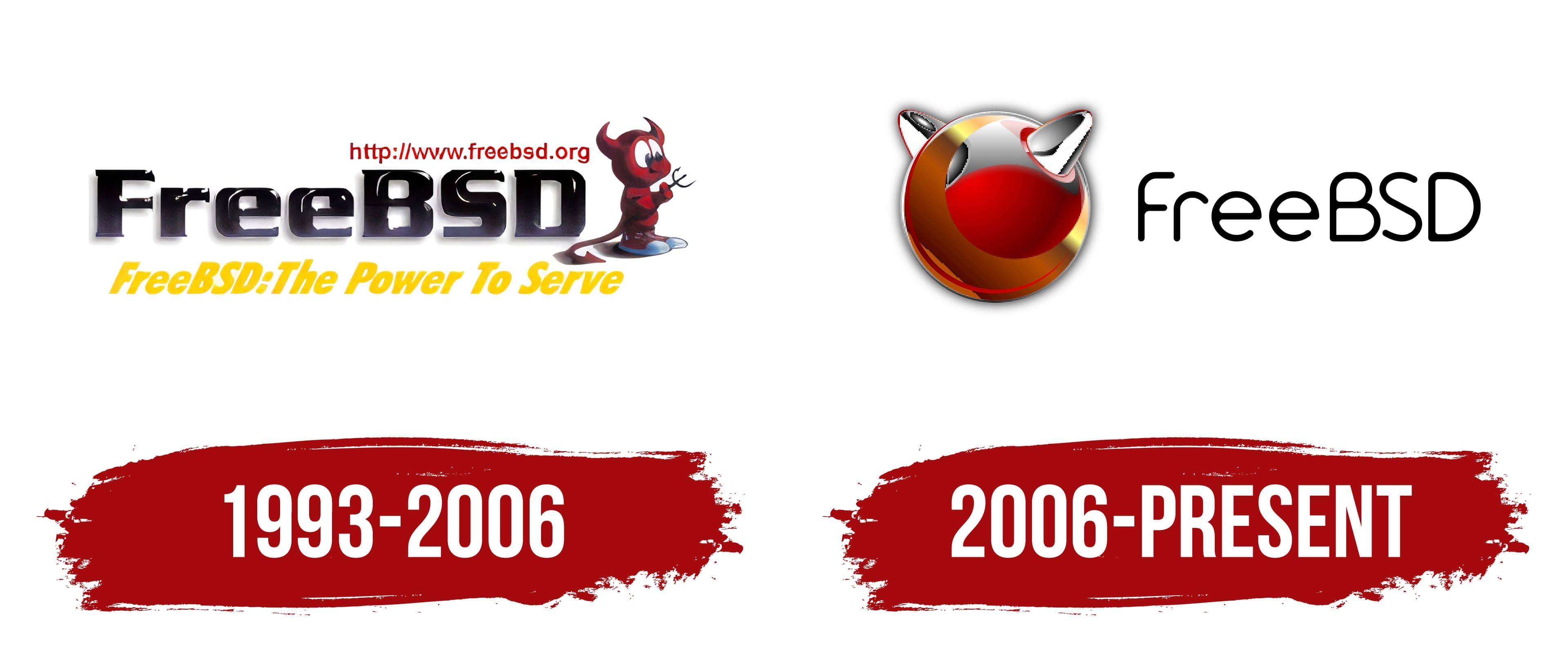
The FreeBSD logo featured a bright, cartoon-style depiction of a friendly character known in the community as “Beastie.” The red demon holding a trident was an intentional reference to the UNIX term “daemon,” which refers to a background system service. The trident’s three prongs symbolized the fork command in UNIX systems, which creates a new process.
Phil Foglio originally designed the character in 1976 for UNIX community T-shirts, and John Lasseter later reimagined it in 1984 with more detail and expression. For FreeBSD, artist Tatsumi Hosokawa adapted the image by adding richer shades of red and replacing the demon’s plain shoes with colorful sneakers, adding playfulness and recognizability.
The color palette featured bold, saturated tones, with the primary red emphasizing vibrancy, activity, and enthusiasm associated with developing and using free software. Red symbolized the FreeBSD community’s energy, initiative, and openness. The demon’s bright sneakers added informality and humor, reflecting the spirit of creativity and freedom central to open-source culture.
The typography used two different typefaces. The upper “FreeBSD” portion was set in large, bold letters with a smooth, glossy finish and dimensional shadows, giving the name a tech-forward yet playful, casual style. The tagline “The Power To Serve” below was set in bold, italic, and yellow, adding dynamism while emphasizing the operating system’s stability, confidence, and professionalism. The chosen palette and font style made the design highly recognizable and underscored the system’s uniqueness in the UNIX-like platform market.
By 2005-2006, the Beastie character sparked discussion about its suitability for corporate environments, leading to a contest for a new, simpler, and more scalable logo. However, Beastie remained the community’s unofficial mascot and symbol.
Copyright for the original image belongs to Marshall Kirk McKusick, one of BSD’s key developers, who permits its use in BSD programs only with his consent.
The FreeBSD logo was a carefully crafted visual metaphor that linked UNIX technical concepts with the friendly, open-source culture, becoming one of the most recognizable and popular symbols of free software.
2006 – today

Following the contest organized by the FreeBSD Foundation, the new logo reflected a push for universality and practicality needed in the modern digital landscape. Anton Gural of TomskSoft created the concept, offering an original reinterpretation of the classic BSD mascot, the Beastie daemon. Instead of a cartoon image, he proposed a minimalist 3D sphere in rich red with gradient highlights, accented by two stylized silver horns. The emblem became associated with the demon’s head, but its abstract nature avoided past debates over character symbolism while preserving the brand’s historical connection.
Red symbolizes the energy, strength, and determination of the FreeBSD project, while the silver highlights on the horns and glossy surface add a technological feel, emphasizing the operating system’s innovation and modernity. The contrast between red, silver, and black enhances the emblem’s visual impact across digital and print formats.
The “FreeBSD” wordmark uses a bold, rounded sans serif with a handwritten feel. The exact typeface has not been officially disclosed, though the community has noted its visual similarity to Comfortaa and Energist. This typography reinforces the platform’s friendly, open character, balancing technical rigor and accessibility while maintaining legibility. Foundation guidelines call for maintaining the logo’s proportions and avoiding distortion when using it.
This version coincided with FreeBSD’s move into a new stage of development, focused on greater scalability and a simpler presence in the global IT market. The new visual identity directly responded to corporate users’ and the community’s need for a neutral, professional-looking symbol that could be easily adapted to any application.