


 Zapier Logo PNG
The Zapier logo symbolizes workflow automation and application integration. It succinctly conveys quick, seamless service-to-service interaction, saving users time and effort.
Zapier was founded in 2011 in Columbia, Missouri, by Wade Foster, Bryan Helmig and Mike Knoop. They had repeatedly seen web services fail to exchange data automatically, forcing users to copy information by hand. Their platform connected applications without requiring code, and the concept won Startup Weekend Columbia. The name combined “Zap,” suggesting an instant action, with API, the interface used for data exchange.
In 2012, the founders joined Y Combinator, whose alumni included Dropbox and Airbnb. After the program, Zapier raised $1.3 million to expand its team and platform. Unlike consumer-focused IFTTT, Zapier targeted small and medium-sized businesses with workflows linking email, CRM systems, social networks, and project-management tools.
By 2014, the company had reached operating profitability while relying on customer demand rather than repeated large funding rounds. Its library of integrations kept expanding as more business applications joined the service. Zapier adopted a fully distributed workforce early in its development. In 2017, it offered financial support to employees willing to leave San Francisco for other cities, reinforcing its remote-first model.
Partnerships with major platforms, including Google, helped place Zapier inside a growing network of business software. By the mid-2020s, the service connected more than 5,000 applications. It covered an expanding range of business tasks, while annual revenue had exceeded $310 million.
Meaning and History
What is Zapier?
An online tool for automating interactions between various services without requiring technical skills. Users create workflows by selecting simple triggers and desired actions. For example, an incoming email can be automatically converted into a task or a spreadsheet entry. Zapier integrates with thousands of popular platforms and social networks. Automation can be set up in just a few clicks, eliminating the need for programming or complex APIs. The service’s team is globally distributed and works remotely.
2011 – 2013
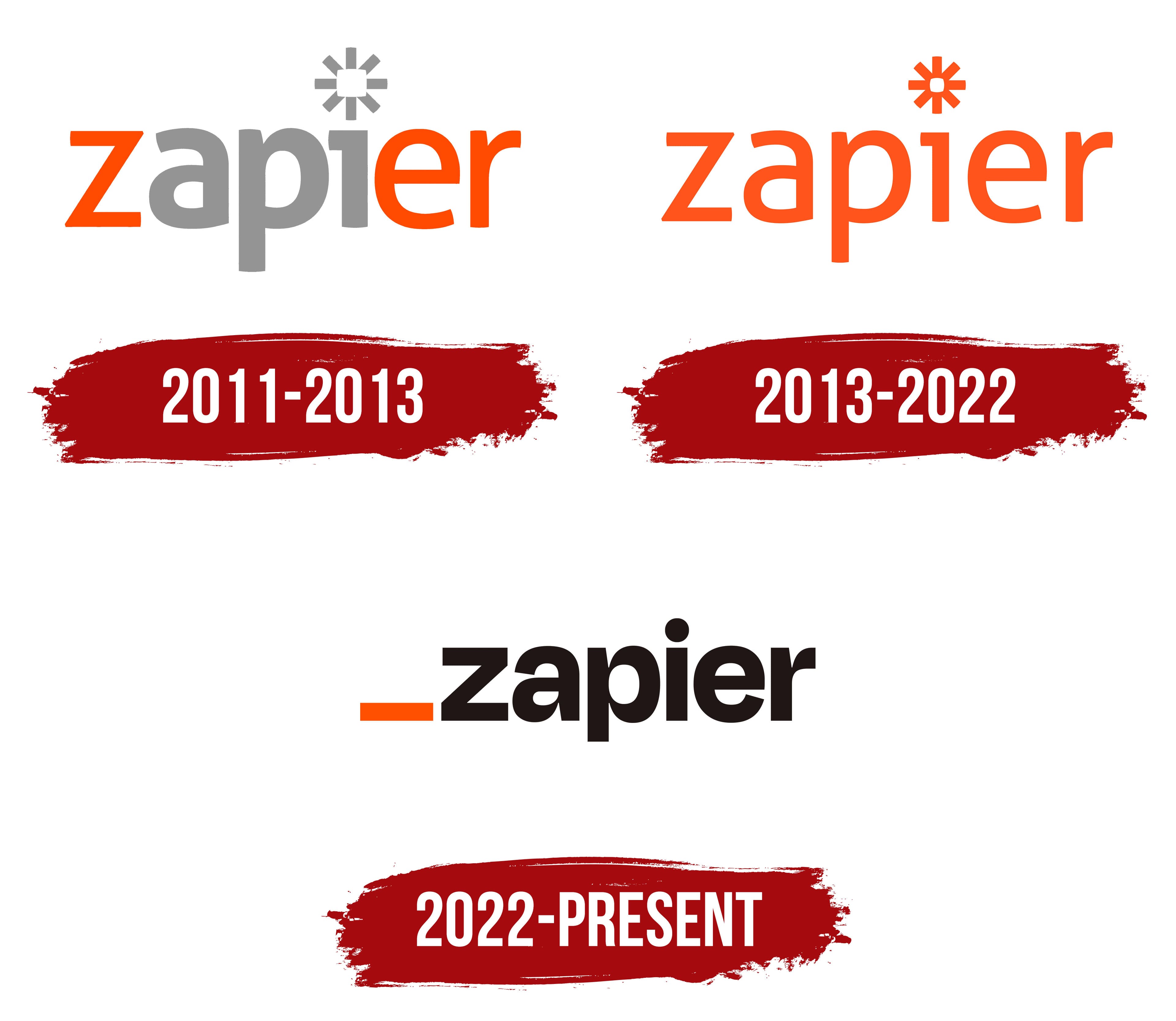
The creation of the first Zapier logo reflected the company’s technological focus and its specialization in process automation. The founders of the project, Wade Foster, Bryan Helmig, and Mike Knoop, decided to visually highlight the part of the name “API” that refers to Application Programming Interfaces.
The text was divided into two color zones. The letters “Z,” “E,” and “R” were rendered in orange, conveying energy and activity. The central part, “API,” was set in a heavier typeface and rendered in gray, emphasizing the technical nature of the name and the brand’s field of work.
Above the letter “I” was an element resembling a simplified gear. The symbol visually represented automation and system interaction, signifying the company’s functional nature.
A smooth, sans-serif typeface was chosen for the logo, similar in style to VAG Rounded. The simplicity of the forms gave the mark a sense of balance and a technological character.
The combination of orange and gray, along with the minimalist design, effectively conveys Zapier’s essence as a platform that connects applications and automates their operations.
2013 – 2022

Zapier’s redesign marked the company’s transition to a more minimal visual style. The image became simpler, and the color palette was reduced to a single tone: bright orange, which became the brand’s main color. The color symbolized workflow automation, acceleration, and simplified service integration.
The typography was reworked. The typeface gained even outlines and soft shapes. The letter structure became balanced and smooth. Stylistically, the font was close to commercial families such as Neo Sans and Proxima Nova Soft, known for their rounded lines and visual neutrality.
The mark above the letter “i” was also changed. The previously used large gear was replaced with a smaller symbol associated with automation and technical integration.
The redesign aimed to simplify the brand’s perception and strengthen its minimalist aesthetic. The restrained structure emphasized the tool’s usability for working with applications and services. This logo reinforced Zapier’s position as a modern integration solution.
2022 – today

The new Zapier logo was introduced to coincide with the company’s tenth anniversary. It was created by the internal branding team, which focused on simplifying the form and strengthening the visual system’s professional character.
The main change was replacing the symbol above the letter “i.” The asterisk used previously was removed. In its place, an orange horizontal underline appeared at the beginning of the company name. The line symbolized the launch of automated processes and reflected the service’s key function.
Instead of the previous rounded typeface, a font with stricter outlines and precise geometry was used. Stylistically, it was reminiscent of Proxima Nova or Gotham, lending the logo a business-like character and emphasizing the brand’s technological direction.
The main text was rendered in black, while orange was used only in the horizontal line.
The update reflected the company’s maturity and its positioning as a reliable professional tool for automation and service integration.
Font and Colors

The new emblem was designed to create a denser, more confident typeface that conveys the system’s structure and the service’s precision.
The typeface is compact, with no excessive letter spacing. The sans-serif font is structurally close to Helvetica Neue or Gotham Bold. Due to its tight structure, the word appears solid. The letters “r,” “p,” and “a” feature cuts that add a technical character to the typography. The font enhances the impression of engineering precision and reflects the company’s technological focus.
The color system retained bright orange as the key design element. The color was inspired by NASA astronaut suits, associated with exploration and discovery. Orange is associated with energy and progress. The main text of the logo is in black, adding restraint and emphasizing the brand’s professional character.