


 Kia Logo PNG
The company logo reflects smooth movement and a harmonious blend of “stuffing” and exterior design. “Vehicles that come off our assembly line are able to overcome any bends in the road,” the Kia logo says to customers.
Kim Chul-ho learned metalworking in Japan as a teenager, working at a steel plant before opening a small bicycle parts business in Osaka. In 1944, he returned to Korea and founded Kyungsung Precision Industry, a maker of steel tubes and bicycle parts. After the Korean War devastated local industry, the company kept production going with scarce materials, including oil drums and steel cable. In 1951, it built Samchuly, Korea’s first mass-produced bicycle. In 1952, the firm was renamed Kia Industries.
Kia then moved into motor vehicles. In 1957, it began making motorcycles under the Honda license, and in 1962, it started producing trucks under the Mazda license. In 1973, Kia opened its Sohari plant, shortly before founder Kim Chul-ho died. In 1974, Kia launched Brisa, Korea’s first gasoline passenger car. The state tightly controlled the domestic market, while Hyundai became Kia’s main local rival.
In 1981, under Chun Doo-hwan’s military government, Kia’s car division was forced to close, leaving the company limited to small trucks. Kia returned to passenger cars in 1986 through a deal with Ford, building Mazda 121-based cars for the U.S. as the Ford Festiva and Ford Aspire. Kia Motors Corporation was registered in 1990. Kia Motors America opened in 1992, and U.S. dealers began selling the Sephia and Sportage in 1993.
The 1997-1998 Asian financial crisis pushed Kia into bankruptcy. Ford tried to buy it, but Hyundai won the 1998 auction and took a 51% stake in Kia. In 2004, Kia hired Peter Schreyer from Volkswagen. His “tiger nose” grille reshaped the brand’s image. In 2011, Kia sold over 2 million cars, and in 2021, it became Kia Corporation.
Meaning and History
The modern brand name is simple but meaningful. It was created from two hieroglyphs: “ki” (indicating upward movement, the beginning of a continuous action) and “a” (house, Asia). One interpretation is “native of Asia.”
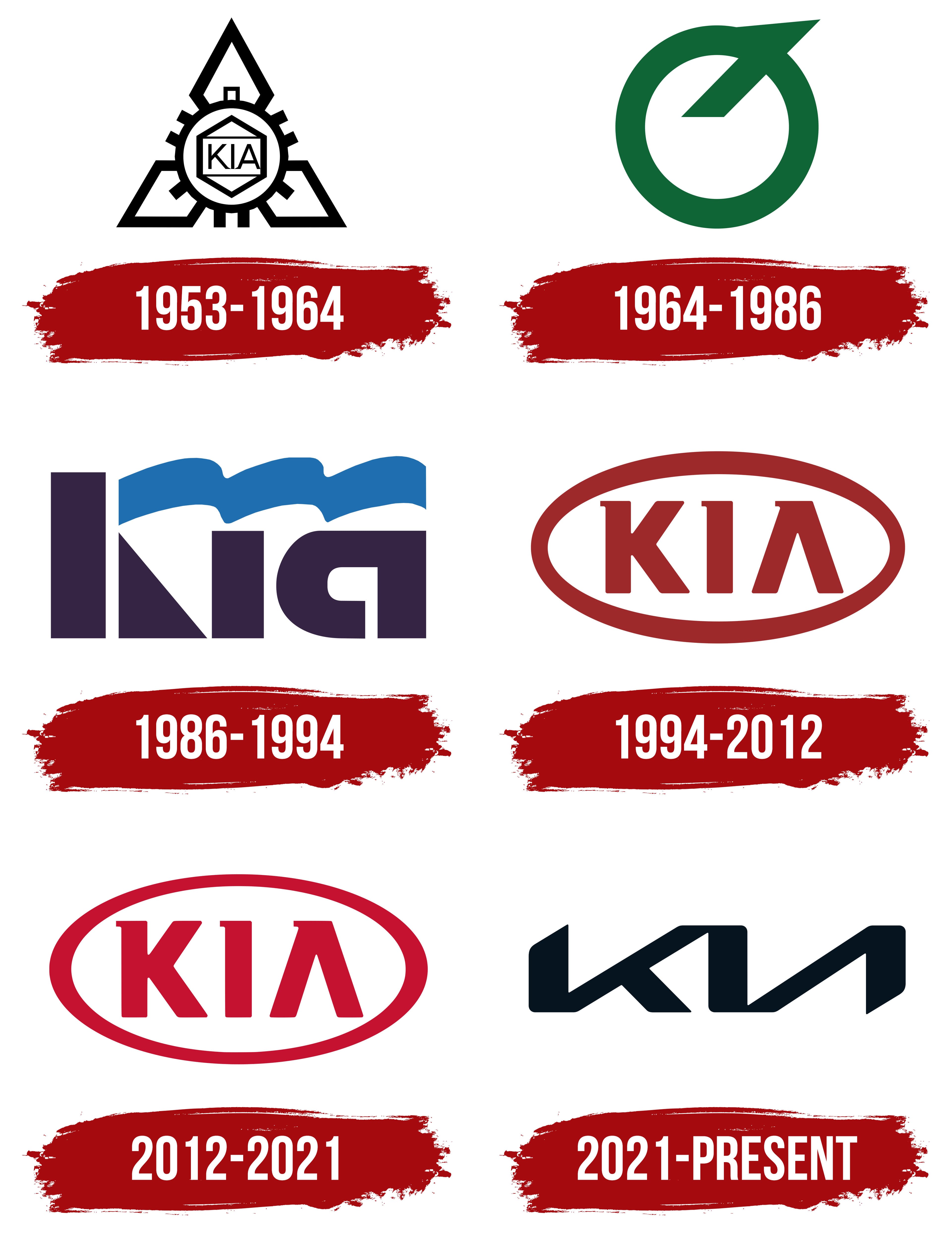
Before the company recognized the automotive industry’s potential, it used multiple logos, each with distinct colors and designs. Significant changes came in 1994, when Kia adopted the famous lettering symbol inside the oval. Over time, it was modified and eventually disappeared, giving way to a minimalist, abstract wordmark.
What is Kia?
Kia is a South Korean corporation that ranks second in size among all automakers in its country. It was established in 1944 and initially produced only bicycle parts. It later expanded its product line to include motorcycles, trucks, and cars. Kia’s current parent company is Hyundai Motor Group.
1953 – 1964
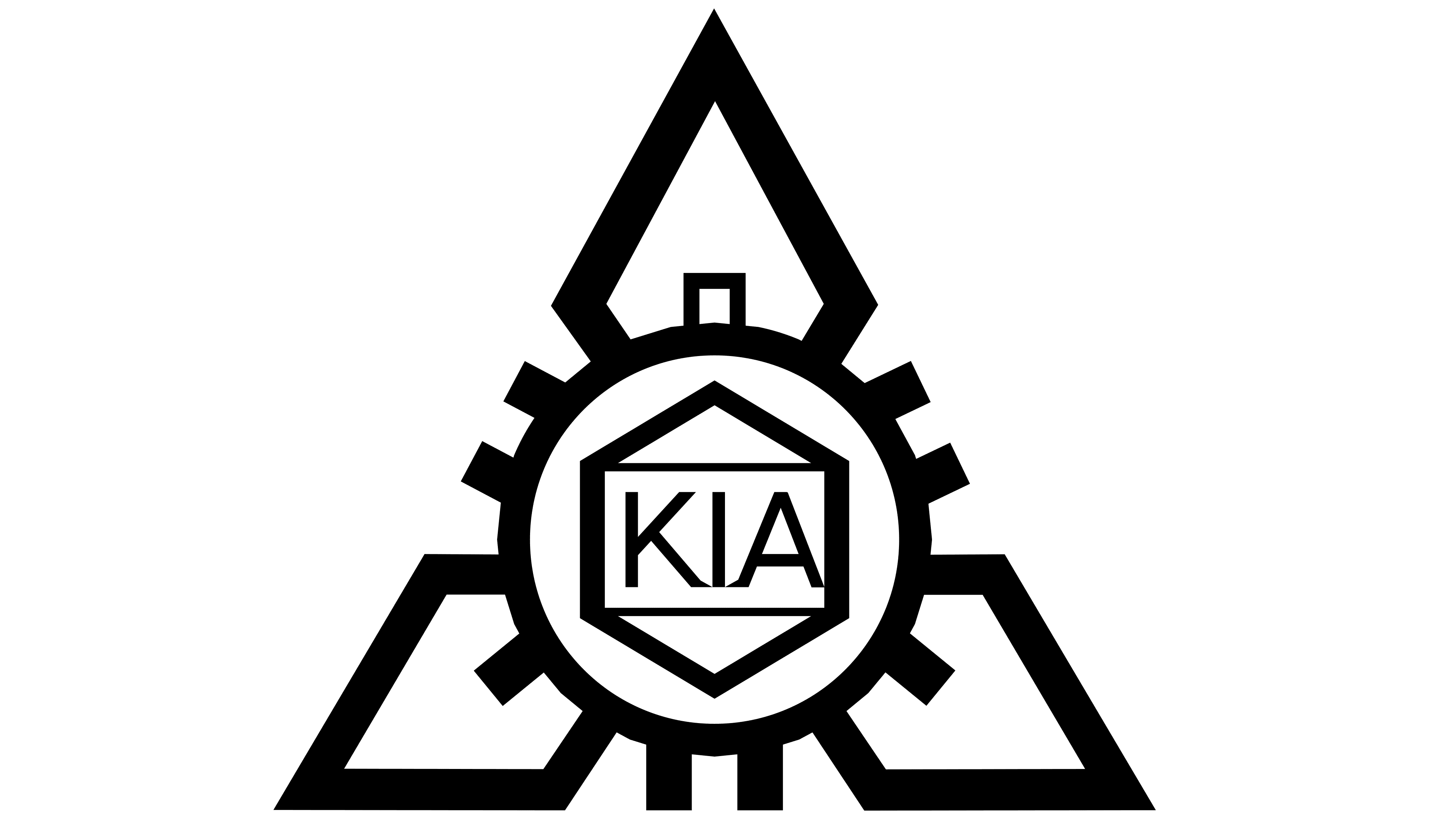
In 1953, the Kyungsung Precision Industry became Kia Industries. This change barely affected its range: it continued to produce bicycle parts and, only four years later, switched to producing Honda motorcycles. However, the rebranding was reflected in the logo. It featured a complex geometric composition with many polygons, including squares, rectangles, triangles, and diamonds. The centerpiece, a circle with rectangular jaggies, looked like a cogwheel. Inside it was the word “KIA.”
1964 – 1986

1964, the inscription disappeared, and the emblem took on a simplified form. It was a green circle with an angled ledge at the top right, like an inverted Q. It resembled the stylized “K” badge used on vehicles sold only in South Korea.
1986 – 1994

In 1986, the firm returned to the automotive industry. This followed a forced hiatus after dictator Chun Doo-hwan banned passenger car production in 1981. The first car of the new era was the Kia Pride, commissioned by Ford and Mazda. Kia Motors was little known and considered a low-cost producer of labor-intensive vehicles, but it received the right to export the Pride under its own brand. However, because of its contractor status, the company used a logo that portrayed it as a steel pipe factory. The inscription was stylized as a factory: the letter “K” was shaped like a chimney, and above the “ia” there was a wavy blue line resembling puffs of smoke.
1994 – 2012
In 1994, the company expanded its lineup by introducing the Sportage SUV and the Mentor family car. The emblem with the factory’s image appeared briefly at the center of the red oval, then was replaced by the inscription “KIA.” Notably, the “A” lacked a crossbar, so the letter looked like an unfinished delta symbol. The word and frame around the oval were chrome on cars, and the interior was burgundy. The white background was used in documents and promotional materials, and the company name and outline were red.
2012 – 2021
After Hyundai saved Kia from bankruptcy, the logo changed slightly again. The badge on the Sorento 4×4 and Picanto vehicles now has a dark gray background. The official emblem remains unchanged, but the red has become noticeably brighter.
2021 – today

The company has adopted the new logo of a German agency in anticipation of the flagship electric vehicle due in 2021. This became known in late 2019, when Kia patented the symbol, which consists of the connected letters “K,” “I,” and “A.” A similarly styled badge previously appeared on the Imagined concept car in Spring 2019.
The logo’s official presentation took place in January 2021, in the sky over Incheon. The company held a grand celebration and set a new world record by deploying the largest number of drones in a pyrotechnic show, all of which simultaneously released fireworks. Many lights formed the inscription “KIA” and the new motto, “Movement that inspires.”
Font and Colors
The latest symbol change coincides with the adoption of the Plan S business strategy. At its core, it reflects Kia’s gradual shift toward producing electric vehicles. As a result, the brand’s emblem looks ambitious and modern: upward lines represent growth, and symmetry shows decisiveness. The wordmark has a specific rhythm: it resembles a heart rate graph or a wave, evoking movement.
The company’s name is stylized as a handwritten signature, using the same font as the design. All three letters are connected, with most lines running parallel. “A” is in italics. As before, it has no crossbar. New typography makes the lettering resemble the iconic NASA worm of the 1980s. However, unlike the old NASA logo, Kia emphasizes sharp angles and no curves.
After the redesign, Kia replaced the traditional red with black. According to the documents, the word “KIA” may be white on a dark background. A simple palette and two-dimensional form are other manifestations of minimalism.