 La Prairie Logo PNG
The La Prairie logo is hardly noticeable, much like the magical effect of the microelements in the brand’s elite cosmetics. The emblem invites users to admire the result. What creates this effect remains a mystery.
La Prairie dates back to 1931, when Paul Niehans led a clinic in Montreux and applied experimental cell therapy to a critically ill patient. The outcome shaped his research direction after World War I and anchored his focus on rejuvenation medicine.
Clinique La Prairie operated on Lake Geneva in a converted mansion. Over time, more than 5,000 patients passed through it. Among them were Winston Churchill, Charles de Gaulle, Hirohito, Marilyn Monroe, Greta Garbo, and Pablo Picasso. In 1953, Pope Pius XII underwent treatment, which expanded international awareness. In 1960, Niehans published “Introduction to Cellular Therapy”.
In 1978, La Prairie launched as a standalone cosmetic line with Cellular Skincare, built around the Exclusive Cellular Complex. The formula remained undisclosed, and the brand positioned products as an extension of clinical work rather than standard cosmetics.
In 1987, the Skin Caviar line introduced caviar extract in cobalt-blue packaging. By the 2020s, most of the brand’s bestsellers came from this range.
In 1991, Beiersdorf acquired the brand, adding an ultra-premium segment alongside Nivea. Research operations moved to Zurich, while production stayed in Switzerland.
During the 1990s and 2000s, the ассортимент expanded into makeup, fragrances, and specialized treatments. In 2008, Platinum Rare launched during the global financial crisis. Key competitors included Sisley Paris and Estée Lauder with Crème de la Mer.
In 2022, the brand introduced an updated logo referencing the typography of the original Clinique La Prairie signage from the 1930s.
Meaning and History
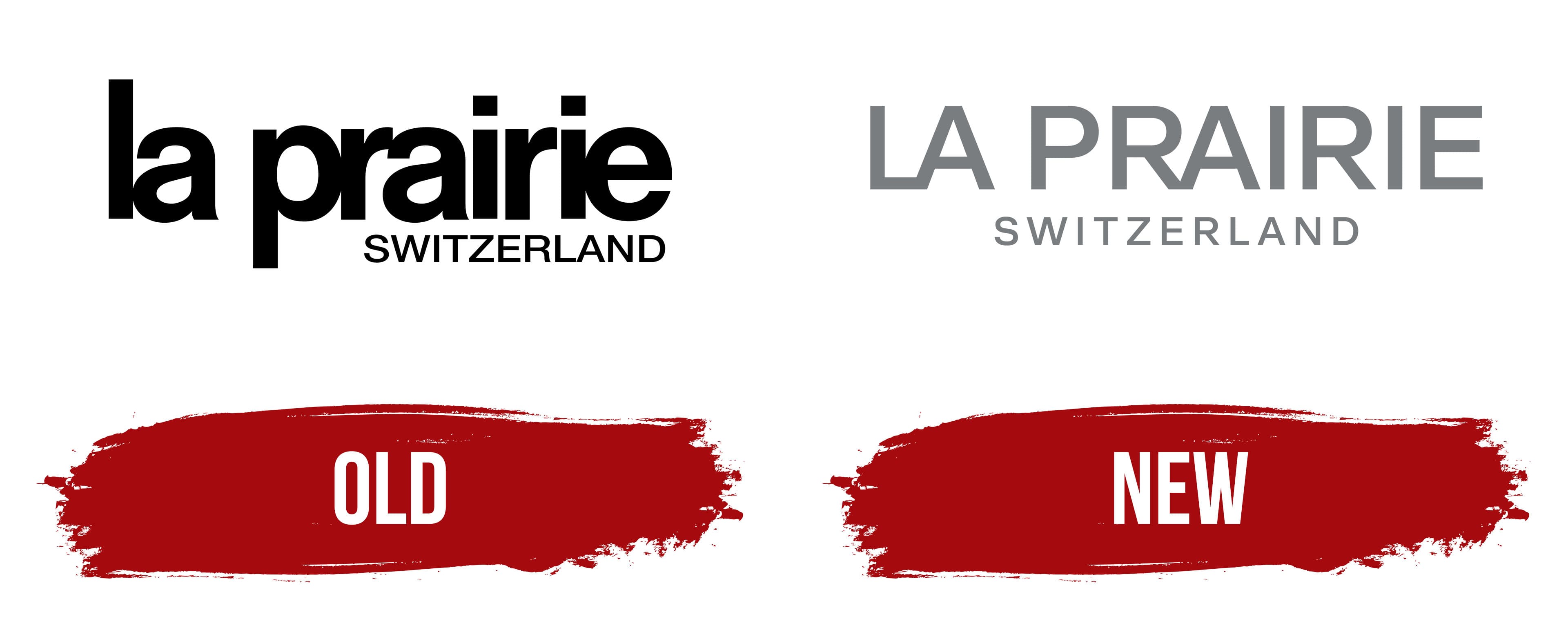
In its early months, the La Prairie emblem surprised everyone with its laconicism. The developers even tried to “save” space by tightly compressing some letters. This minimalism appealed to management because the inscription is easy to read and has its own flavor, distinct from competitors’. In total, the brand has had only one logo variant in its history.
The logo contains no graphic images or symbols; it uses only verbal designations. Specifically, it includes the brand name. The inscriptions are arranged in two tiers: the upper one bears the phrase “la prairie” (brand name), and the lower one bears the word “switzerland” (country of origin). The original letter design makes the emblem unique: the designers combined “la,” “pra,” and “ie.”
What is La Prairie?
La Prairie is a cosmetics line that originated in the spa salons of the resort town of Montreux. It contains unique water and is designed to combat skin aging, making it an anti-aging cellular therapy brand from Switzerland. Surgeon Paul Niehans founded the brand, and Beiersdorf currently owns it.
Old

The La Prairie logo is concise, precise, and simple because it contains only the cosmetics company’s name and its country of origin. Both words are used, but in a different style. The first inscription is in a bold, semi-connected, lowercase font with rounded corners. The second is typed in capital, narrow, angular characters, made with straight lines. The rows are right-aligned. The glyphs are painted black, making them visible against a white background.
New

The modern logo is unified in style: both the first and second lines are reduced to a single design. The designers used the style of the word “Switzerland” as a basis, resulting in thin, smooth, capitalized, unrounded lettering. The developers moved the lower rad to the center, increasing the spacing between characters. At the top, they left the letters “LA” and “RA” connected as a pair. The emblem is now painted in dark gray.
Font and Colors

The text is in a sleek sans-serif typeface from the Sans Serif group. It is simple and geometric. The upper characters are lowercase; the lower ones are uppercase. Squares are used instead of dots above “i.” The logo is monochrome: black and white.