


 Lavazza Logo PNG
Buyers can only exclaim in admiration. As the Lavazza logo shows, the product retains rich aromas and a unique taste regardless of the processing method. As a result, the coffee is of the highest quality.
Luigi Lavazza was born on April 24, 1859, in Murisengo, a small town in Monferrato. After a severe hailstorm in 1885, he moved to Turin, studied commerce in the evenings, and in 1895 used 10,000 lire from his last employer and his savings to buy the Paissa Olivero grocery shop on Via San Tommaso.
Coffee was first sold there alongside spices, soap, oil, and alcohol. Lavazza began experimenting with blends for home use, mixing beans from different regions to create a steadier taste than single seasonal lots could offer. By 1900, the shop had six employees and a weekly revenue of 4,200 lire. By 1910, the business had moved to a larger site.
During World War I, Lavazza narrowed its range to oil, sugar, and roasted coffee. In 1927, Luigi founded Luigi Lavazza S.p.A. with a share capital of 1.5 million lire, with his wife, Emilia, and his children, Mario, Giuseppe, and Maria, involved. The company survived sanctions, Mussolini’s 1940 coffee import ban, and the bombing of its Turin plant by selling oil, soap, and candles. Coffee production resumed in 1946, and Aerostudio Borghi created the first official logo in 1947.
Later growth came through industrial roasting, advertising, and acquisitions. A major plant opened in Settimo Torinese in 1965. From 1977 to 1993, Nino Manfredi fronted Lavazza’s long-running campaign by Armando Testa. The Lavazza Calendar began in 1993 with Helmut Newton. In 2015, ISSpresso reached the International Space Station with Argotec and the Italian Space Agency. Lavazza later acquired Carte Noire and Merrild and took an 80% stake in Kicking Horse Coffee. It opened Nuvola in Turin in 2018 and reached €3.35 billion in revenue in 2024.
Meaning and History

A wide variety of logos reflects Luigi Lavazza SpA.’s rapid growth. Each new milestone in the company’s history marked the renewal of the visual identity. This was partly due to marketing needs because there was a period when coffee was sold only by weight. The manufacturer had to print his logo on separate cards issued to each customer to make the “impersonal” product recognizable.
It was once the backbone of Lavazza’s advertising strategy, as the coffee bean roaster’s name was often kept under wraps. It didn’t matter, since store sellers transferred loose coffee from a common container into regular bags and gave it to the final consumer in this form. To innovate, the company moved to manufacturing pre-packaged products. Her vacuum packaging helped her stand out from the competition because such coffee could be stocked on shelves in any store, not just in one with special storage conditions.
Packaging also allowed the manufacturer to abandon promotional cards and place its logo directly on the product. From that moment, Lavazza’s identity began to take shape. However, the wordmark never changed significantly – the designers only added additional decorative elements to it and slightly modified the proportions of the letters.
What is Lavazza?
This Italian coffee giant, born in Turin, began as a small grocery store and, over time, evolved into a multinational conglomerate, mastering the art of blending coffee beans to create unique flavors. The Lavazza family has run the business for four generations, and their roasting expertise has made the brand a symbol of Italian coffee culture. Offering everything from whole beans to coffee machines, the company embodies authentic Italian coffee through its signature espresso blends in cafes, homes, and offices worldwide.
1895 – 1927

In 1895, Italian businessman Luigi Lavazza bought a small shop and began selling hundreds of products, including coffee. According to his recipes, he experimented with the degree of grain roasting and with mixed varieties. As far as is known, the sign of his outlet contained the inscription “DROGHERIA LAVAZZA” in a custom font. The golden letters stood out against the green rectangle.
1927 – 1947
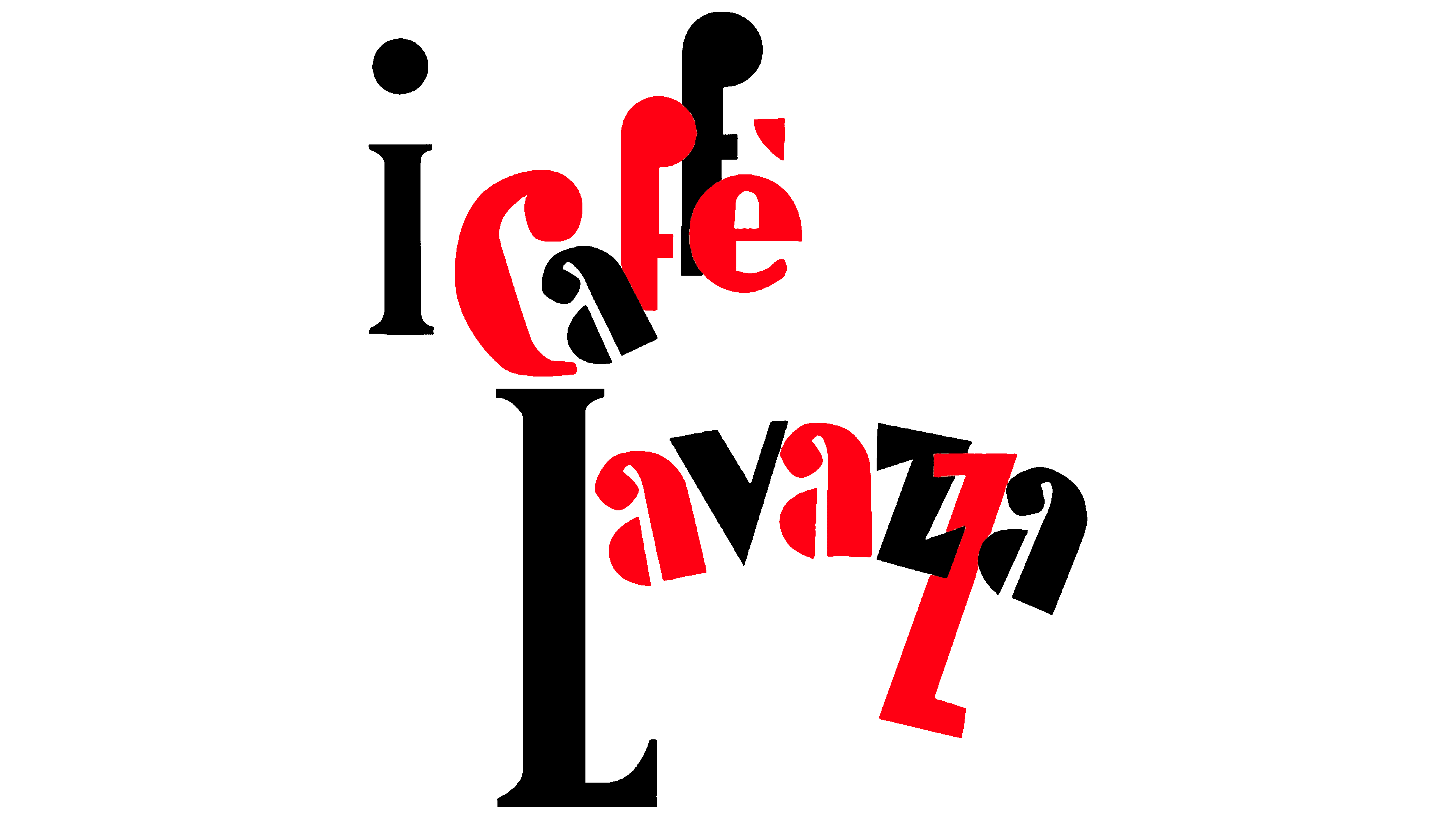
In 1927, Luigi Lavazza SpA was registered. At the same time, the grocery store, now a company, launched its first brand: “i caffé Lavazza.” The name appeared on parchment packages used to preserve the beans’ flavor. The inscription was avant-garde: the letters ran over one another, and the words, arranged in two lines, curved in a bizarre way. At the same time, red and black symbols alternated, making the emblem look brighter.
1947 – 1950
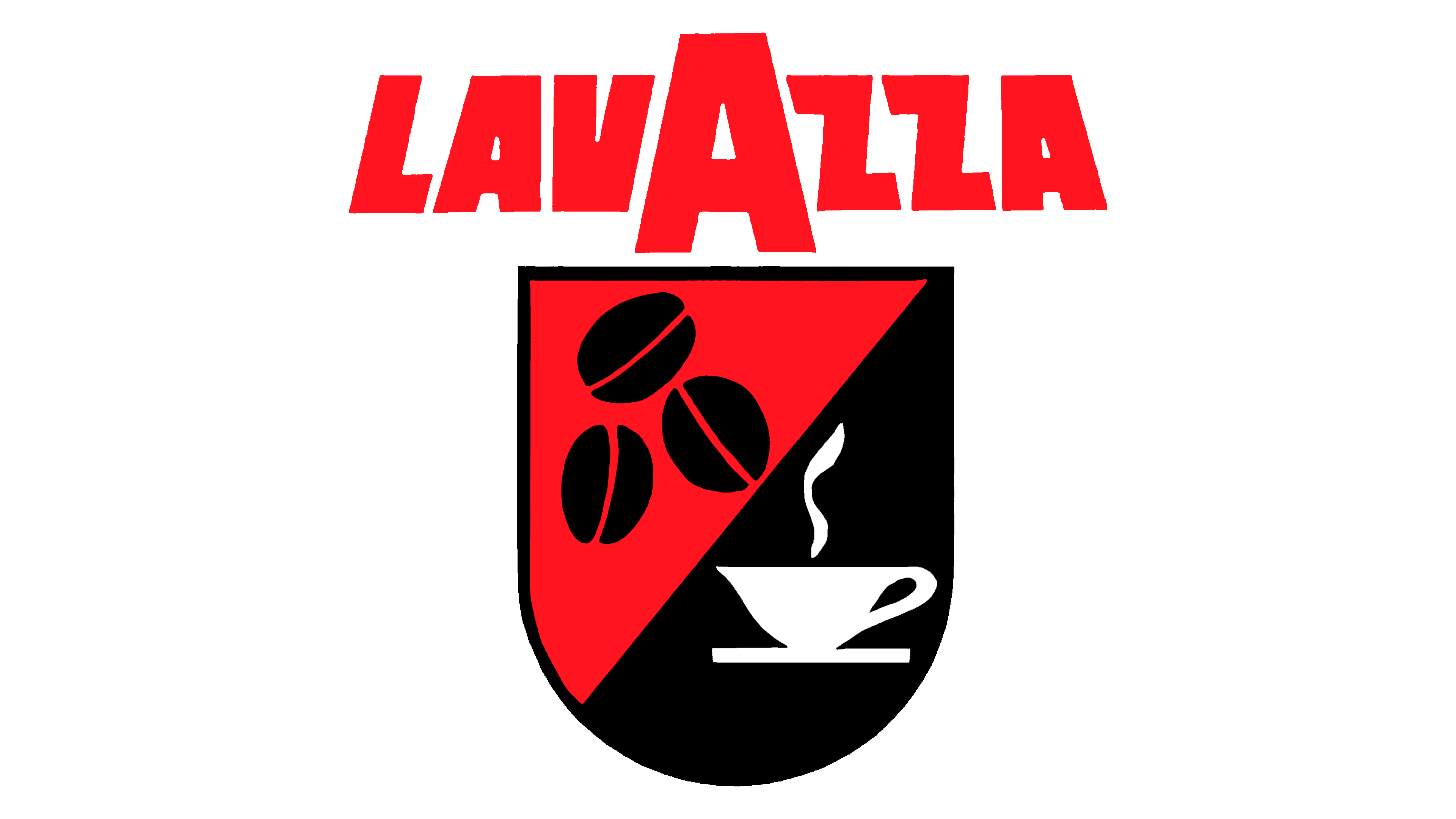
Immediately after the war, Lavazza adopted its debut corporate logo. The enterprise’s then-owner commissioned the Milanese designer Aerostudio Borghi to develop it. This is how the unusual inscription “LAVAZZA” appeared, with the middle “A” enlarged and serving as a kind of magnet: the letters on both sides leaned towards it. In the official version, the wordmark was red. A rectangular shield with a round base complemented it and was divided diagonally into two parts. The top half, dyed red, contained three black coffee beans. The underside of the shield was black, and a white cup sat on it, with steam rising.
At first, the logo appeared only on promotional cards distributed to customers, since coffee was sold in bulk. In 1949, the graphic symbol began to appear on cans because Lavazza patented a new way to package the product under pressure and began packaging ground coffee during production.
1950 – 1986
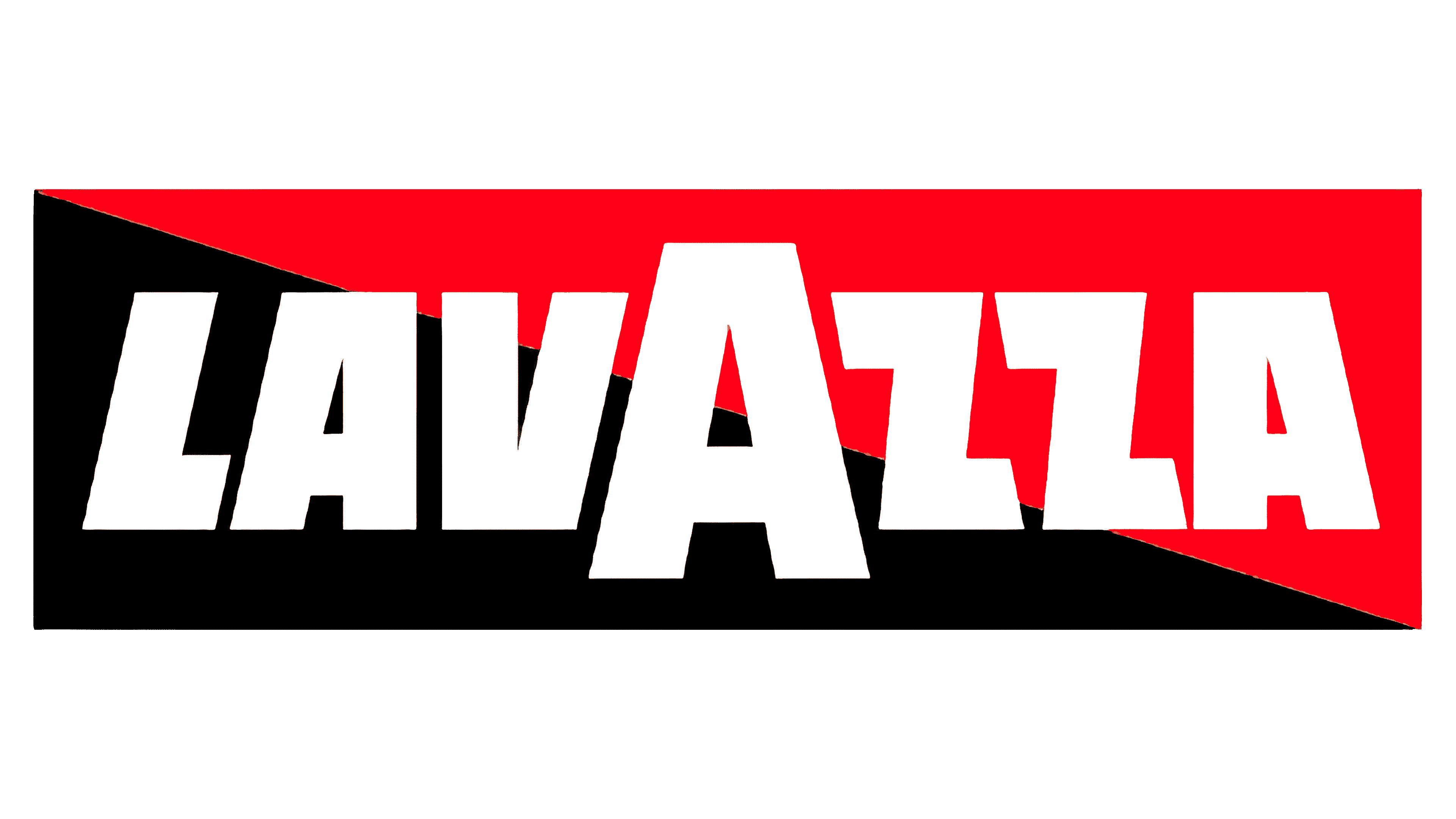
In 1950, among all logo versions, the company chose the white inscription “LAVAZZA” inside a red-and-black rectangle divided diagonally into two multicolored triangles. This design had been seen before, but it became widespread in the mid-20th century: the graphic composition was used on signs and vacuum packaging because it was easy to reproduce.
1986 – 1991
In 1986, a new milestone in Lavazza’s history began. To strengthen brand recognition in European markets, the company commissioned Maurizio Di Robilant to create a new logo. The design expert and founder of Robilant Associati reimagined the wordmark. He kept the stylized inscription but added a cloud of steam above the third letter (“V”) as if alluding to a cup of hot coffee. All elements were black, with no permanent background. This emblem was used internationally, positioning Lavazza as the guardian of Italian traditions.
1991 – 1995
In the early 1990s, Maurizio Di Robilant optimized the logo by slightly changing the lettering style. In the new version, all letters were straight, except the “L”, which had a slope. In addition, the designer modified the font, adding strokes of varying widths, and added a red underline below the word.
1995 – today

Emilio Lavazza, a fourth-generation Italian businessman, asked his friend Armando Testa to update the coffee brand’s logo. In 1994 (according to another version, 1995), Studio Armando introduced a wordmark without horizontal underlining or curly stems. The developer restored the letters’ characteristic slope so they “pull” toward the middle “A” and restored the 1986 typeface. This version of the design is used in Italy and abroad.
Font and Colors

The stylized inscription “LAVAZZA” has never changed, except for small experiments with the font’s shape. Throughout history, the middle “A” has remained almost 1.5 times higher than the other letters, an idea from Aerostudio Borghi. In recent years, designers have added and removed elements, starting with wriggling lines that imitate steam over a hot mug of coffee. It hints at the blended drink’s exceptional flavor.
The inscription on the Lavazza logo is in capital bold sans-serif letters. The company uses a custom typeface derived from a post-war wordmark Aerostudio Borghi developed in the mid-1940s. The inscription follows a traditional design: the first “L,” “A,” and “V” slope to the right, the middle “A” is flat (and enlarged), and the last “Z,” “Z,” and “A” slope to the left.
The current version is completely black. This is one of the colors of the original emblem created in 1927 for “i caffé Lavazza.” The second color, white, is used as the background. But red, presented before 1995 as a horizontal line, has not been used since.