


 Liebherr Logo PNG
The strict, massive Liebherr logo symbolizes inviolability, a fundamental approach, and confidence in the quality of its work. The emblem aims to evoke associations with the company’s reliable, durable equipment.
Hans Liebherr was born on April 1, 1915, in Kirchdorf an der Iller, southern Germany. Trained as a builder, he worked in construction before serving in a sapper unit on the Eastern Front during World War II. He returned in 1945 to a country in ruins and a construction sector lacking modern equipment.
In 1949, working in a wooden shed, he developed a mobile tower crane that could be transported by truck and assembled within hours without a foundation. On August 19, 1949, the patent was granted, and Hans Liebherr Maschinenfabrik was registered. The TK 10 debuted at the Frankfurt construction fair and soon gained orders from small contractors.
In the early 1950s, Liebherr launched in-house gear production to avoid supply bottlenecks. In 1954, the company introduced its first refrigerator, entering a growing household market. By 1956, it expanded into concrete mixers and transport equipment.
In 1958, the company opened its first overseas plant in Killarney, Ireland. Limited infrastructure led to hotel construction, creating a parallel business line. In 1960, Liebherr-Aero-Technik was founded in Lindenberg to produce aviation components. At the same time, Potain and Manitowoc expanded in the crane market.
In 1969, a mobile crane plant opened in Ehingen. Liebherr-America was established in Newport News in 1970. In 1977, Liebherr introduced the all-terrain crane LTM 1025. A major U.S. order for New York led to losses, and Liebherr halted crane production there by 1979.
In 1983, Liebherr-International AG was established in Bulle. Hans Liebherr died in 1993, and his children took over management. In 2007, the LTM 11200–9.1, with a 100 m boom and 1200-ton capacity, was recognized as the most powerful mobile crane of its time.
Meaning and History
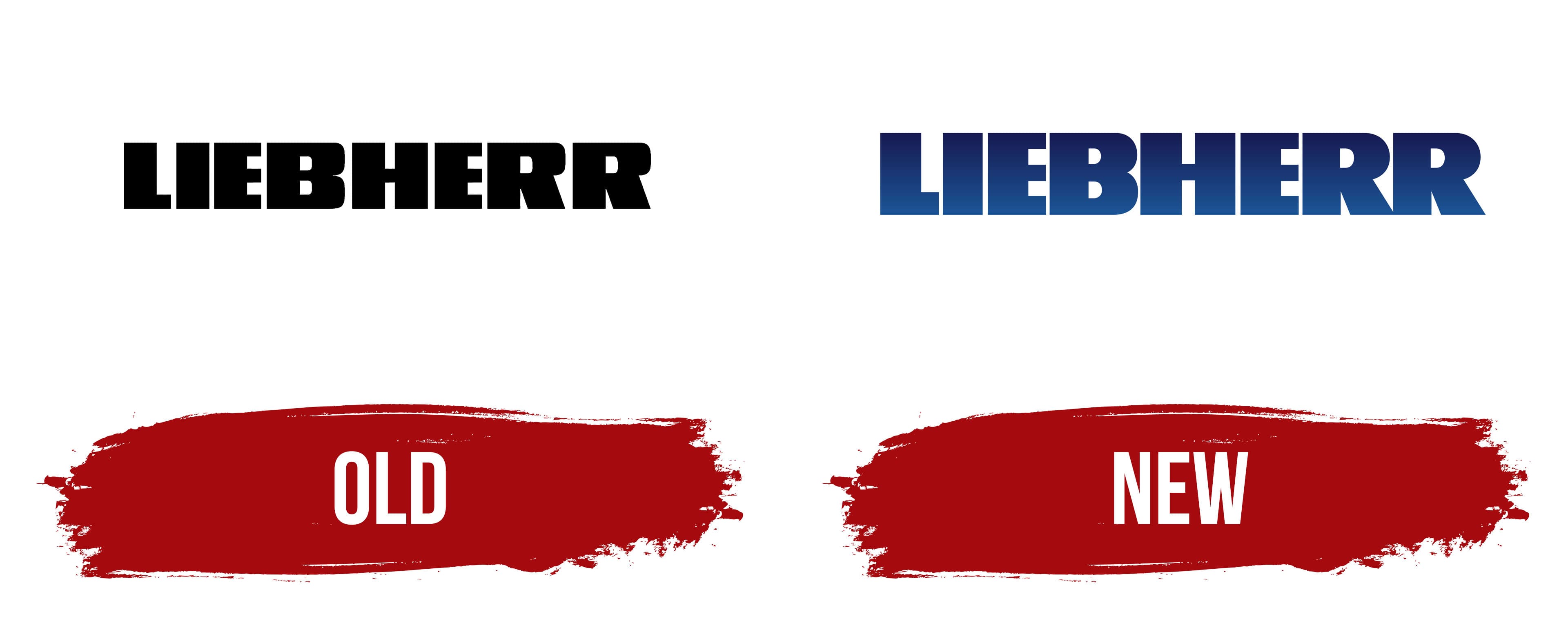
The logo of a German equipment manufacturer did not gain widespread recognition immediately. The company first had to work hard to improve product quality because this heavy, bulky sign is associated with it. Since 1949, the German brand has had only one emblem in two versions. They appeared sequentially after the redesign. This symbol, like the cars it decorates, is known to consumers worldwide.
What is Liebherr?
Liebherr is a conglomerate consisting of manufacturers of heavy-duty vehicles and household appliances. It was founded in Germany in 1949, but its headquarters are located in Switzerland. Initially, the company produced only tower cranes, then began manufacturing aircraft parts, refrigerators, freezers, food-processing equipment, trucks, drilling rigs, excavators, and more.
Old logo
The Liebherr Group entered the market in 1949. That same year, it introduced its first logo: simple, democratic Liebherr lettering. The word is set in a strict font, vaguely reminiscent of Bottle Kaps (by Alex Kaczun) or similar to Koloss SB (developed by Jakob Erbar).
Sans-serif letters, bold and wide. As a result, the manufacturer’s name feels “heavy.” The designers aimed to convey the company’s products, durability, and reliability.
New logo

The debut emblem was monochrome: the black lettering was on a completely white background. Later, the developers corrected this omission by offering many versions with new palettes. For example, they repainted the word “blue” in several shades at once. The smooth gradient created a three-dimensional effect. There were also variants with a black “Liebherr” inside a bright yellow rectangle.
As for the typeface’s evolution, it went unnoticed. Initially, letter-spacing was medium. Then the typographers shifted the letters, and the inscription became quite compact. But the experimenters did not stop there, reducing the gaps between the letters to the point that they complicated the logo’s visual perception.
Nevertheless, this is a distinctive feature of the Liebherr Group. Because of this effect, the emblem is highly recognizable. Some think that it even symbolizes the high quality of branded technology.
Font and Colors
Reliability, stability, massiveness, and practicality are fundamental principles that the Liebherr management reflected in their logo. The company chose a wordmark to express the concept. Although it contains no graphics, the text plays that role: each letter reads as a separate drawn element, most reminiscent of a geometric figure.
The symbols are so wide that their sides look like vertical rectangles rather than letter legs. Despite the massiveness, the internal gaps are visible because the designers chose a contrasting background. This is especially evident in the current version, where the signs are rounded and streamlined.

The emblem uses a unique typeface with no analogs, though it outwardly resembles two font types. It resembles Bottle Kaps in the side proportions and Koloss SB in style. The first option has width and massiveness; the second, rigor and evenness. Both concepts are reflected in the logo.
The letter palette is consistently dark. Mostly black is used on a white background. Blue with a gradient transition is rare and depends mainly on the shade of neighboring elements.