


 Macmillan Logo PNG
The publishing company uses an inspiring logo that is associated with boundless imagination. The Macmillan logo is a symbol of dreaminess and love for books. It motivates one to immerse oneself in an exciting story invented by the writers.
Macmillan Publishers began with Daniel and Alexander Macmillan, two brothers from a poor crofter family on the Isle of Arran in Scotland. Daniel was apprenticed to a bookseller after their father died in 1824, while Alexander first worked as a teacher before entering the book trade. In 1843, they opened their own shop in London on Aldersgate Street, then moved to Cambridge to work closer to a university audience.
The firm’s first titles appeared in November 1843, including The Philosophy of Training. Daniel handled business affairs, while Alexander shaped the literary direction. After Daniel died of tuberculosis in 1857, Alexander took full control. At that point, Macmillan was still small, publishing about 40 titles a year. Still, under Alexander, it grew to about 150 titles annually.
Macmillan’s reputation rose through books and journals that became part of literary and academic history. Macmillan’s Magazine launched in 1859. In 1865, the company published Lewis Carroll’s Alice’s Adventures in Wonderland. In 1867, Alexander traveled to the United States to develop an American office. Nature followed in 1869, Grove’s Dictionary of Music and Musicians in 1877, and Rudyard Kipling’s The Jungle Book in 1894. Its authors also included Alfred Tennyson, Thomas Hardy, and William Butler Yeats.
The U.S. branch became independent in 1896, the same year Alexander died. Later, Harold Macmillan, Daniel’s grandson and former British prime minister, served as the company’s chairman from 1964 to 1986. During that time, it expanded its academic and educational publishing. As rivals such as HarperCollins and Penguin Random House grew through consolidation, Holtzbrinck bought 70% of Macmillan in 1995 and the rest in 1999. In 2015, Macmillan Science and Education merged with Springer Science+Business Media to form Springer Nature.
Meaning and History
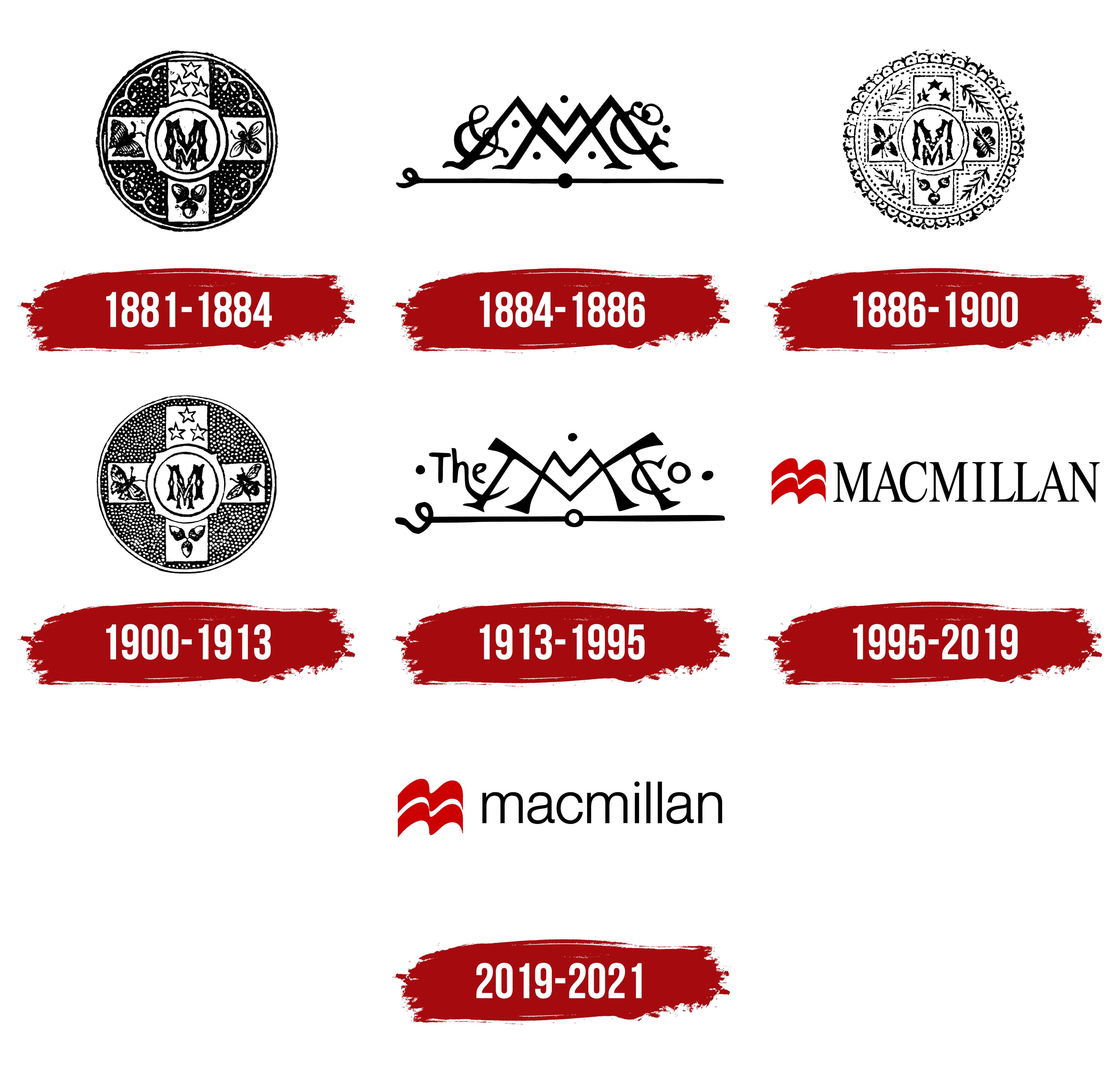
Brand recognition is quite high. Over time, seven versions of the logo were presented to the target audience. All of them are made with a rather modest color palette, yet they look elegant and confident.
What is Macmillan?
It is one of the United Kingdom’s oldest publishing companies, with over 170 years of history. Despite this, it works not only for the domestic market, as evidenced by its presence in many European and North American countries through representative offices.
1881 – 1884
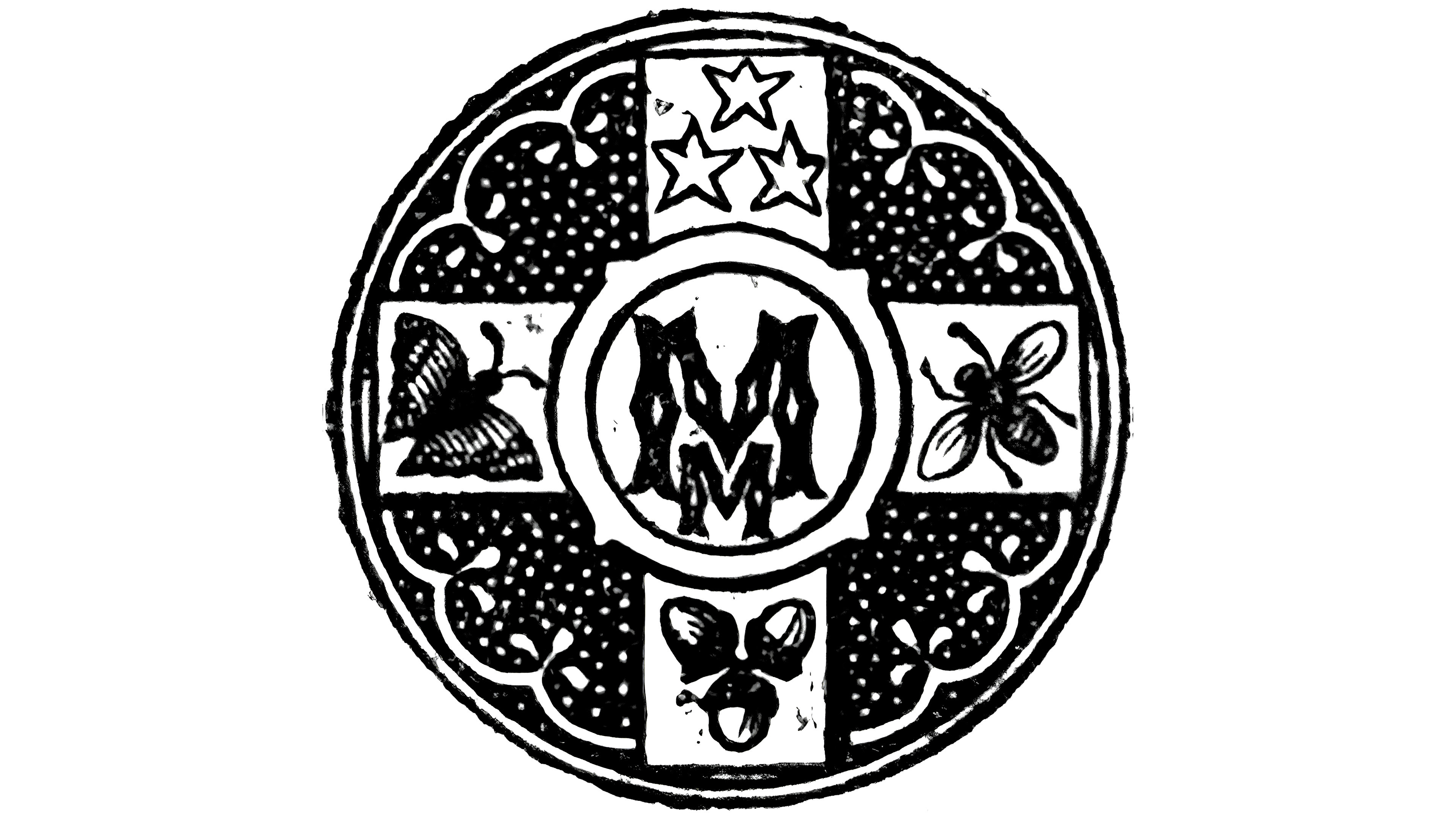
The first officially confirmed version of the logo was presented in 1881. It was probably used before, as evidenced by the biographies of Alexander Pope and Leslie Stevens. This is a rather mysterious emblem that resembles a seal. It is shaped like a circle with many elements. In the central part is another circle with two “M”s inside. This is an abbreviation for the company name. A fly is depicted on the right, a butterfly on the left, stars on top, and acorns on the bottom.
The inscription itself is in Gothic type. Moreover, one letter is much larger than the other.
1884 – 1886

The first redesign was introduced in 1884. He changed the specifics of the logo. Now it was a horizontal line with a rounded left edge and a thick black dot in the center. Above this line, two “M”s were displayed. One of them was wide but short. The second, on the contrary, was high but at the same time narrow. To make the logo more mysterious, dots were placed between the letters, and decorative elements were added on the sides.
1886 – 1900
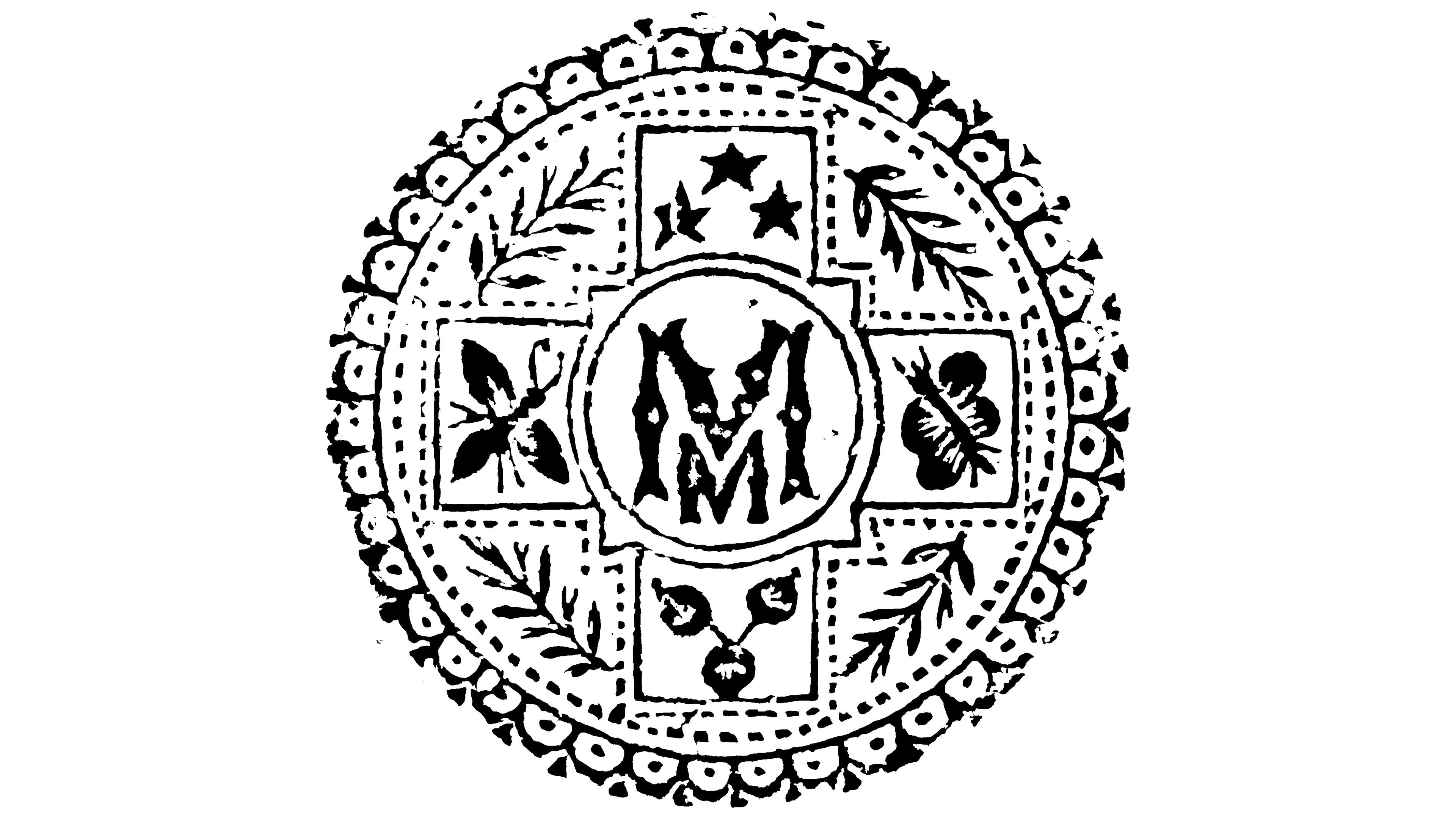
The previous version of the logo was used for a relatively short time, and the company later decided to return to the original. In general, the same elements were used: two letters “M” in the center and four additional images. At the same time, in the new version, preference was given to white, which made the logo more vivid and memorable.
1900 – 1913

Again, a round frame and a base identical to the original version are used. At the same time, the space between the images was filled with white dots on a black background. Also, the circle has a narrow white outline.
1913 – 1995

For much of the 20th century, an option very similar to the one used in 1884-1886 was used. However, now the logo looks more modern and confident. The rounding in the horizontal line has become more elegant, and the dot in the center has become white. The letters in the center have also been resized. In addition, the inscription “The” appeared to their left. The “h” had a significantly elongated tail that even hooked the outermost “M,” thereby replacing the previous “&” character.
1995 – 2019

At this stage, the company decided to adopt a more modern style. It was an elegant typeface with serifs and thin lines in the capital letters. To the left of the name is an emblem that can be associated with an open book or a flag. It is made in red with a white line in the middle. The emblem is no taller than the letters in the main name.
2019 – today
The logo is as similar as possible to the previous version. However, the capital letters in the title have been changed to lowercase, and the font has been somewhat simplified. Interestingly, this logo can be used in both two-dimensional and three-dimensional forms. Interestingly, in some cases, the name of the company division is additionally used.
Font and Colors

In the early versions of the logo, no wording was used except for the two letters “M” in the center. The name appeared only in 1995. The font was modern and sleek. Since the last redesign, a rounded sans-serif typeface has been introduced. It is not unique because it is as similar as possible to the classic “Arial,” but it is also readable on any surface without any problems. Moreover, the letters look harmonious against the emblem’s background.

The company prefers a laconic black-and-white color palette. However, in the last two versions, a red-and-white emblem appeared. Red should be associated with Macmillan’s potential customers who are passionate and eager to grow. The background color is usually white.