


 Malibu Logo PNG
“It only takes a couple of glasses of liquor to feel like relaxing on exotic beaches,” the Malibu logo says. The image reveals the beauty of the sunset and invites you on a pleasant journey.
The story of Malibu began in the late 1970s in South Africa within International Distillers & Vintners, part of Grand Metropolitan. In 1978, Peter Fleck, James Espey, and Tom Jago encountered a coconut rum liqueur, Coco Rico, produced by Gilbey’s.
Tom Jago, who developed Baileys Irish Cream in 1974, supported the concept. Due to South Africa’s political context, the product was repositioned with a Caribbean image, and production later moved to the Caribbean. The name “Malibu” was selected for its association with coastal lifestyle imagery.
In 1979, Malibu launched in the UK. Early batches used clear bottles painted white by hand. With an alcohol level of 21%, it was classified as a liqueur, allowing TV advertising that stronger spirits could not access under UK regulations. Campaigns built around tropical imagery helped establish brand recognition.
During the 1980s, Malibu gained popularity in bars, especially in cocktails such as the piña colada. In the 1990s, distribution expanded across Europe, and the company introduced new flavors, including mango, pineapple, and passion fruit.
In 1997, Grand Metropolitan merged with Guinness to form Diageo, placing Malibu alongside brands like Johnnie Walker, Smirnoff, and Captain Morgan. In 2002, Diageo sold Malibu to Allied Domecq for £560 million to comply with regulatory requirements.
In 2005, Pernod Ricard acquired Allied Domecq from Fortune Brands, integrating Malibu into The Absolut Company, which also manages Absolut vodka. In the 2010s, it added ready-to-drink products. By 2020, annual sales reached 4.4 million cases, second only to Baileys among liqueurs.
Meaning and History
This drink first appeared in 1893 on the island of Curaçao in the Caribbean. Since 1980, it has been produced in Barbados. The brand was resold several times before Pernod Ricard acquired it. This event is dated to 2005.
Today, Malibu is produced in Black Rock (West Indies) at the West Indian Rum Distillery. As many years ago, it is still blended with coconut extract according to legendary recipes. Moreover, it remains exotic and sophisticated. This is reflected in the corporate logo, imbued with the spirit of the Caribbean coast.
The brand wants to stay in line with modern events, keep up with life, and use trendy techniques to delight consumers with exquisite taste. Therefore, the latest redesign improved the logo by adapting it for e-commerce. As a result, the label and logo accurately reflect the mood of the low-alcohol drink: relaxation, calm, and freshness.
The branding gravitates towards identity. The vibrant Caribbean landscape enhances its authentic character. At the same time, the design evolves from simple to complex, adding increasingly attractive details. They convey legendary product value and relevance, regardless of season or year, beyond any single paradise.
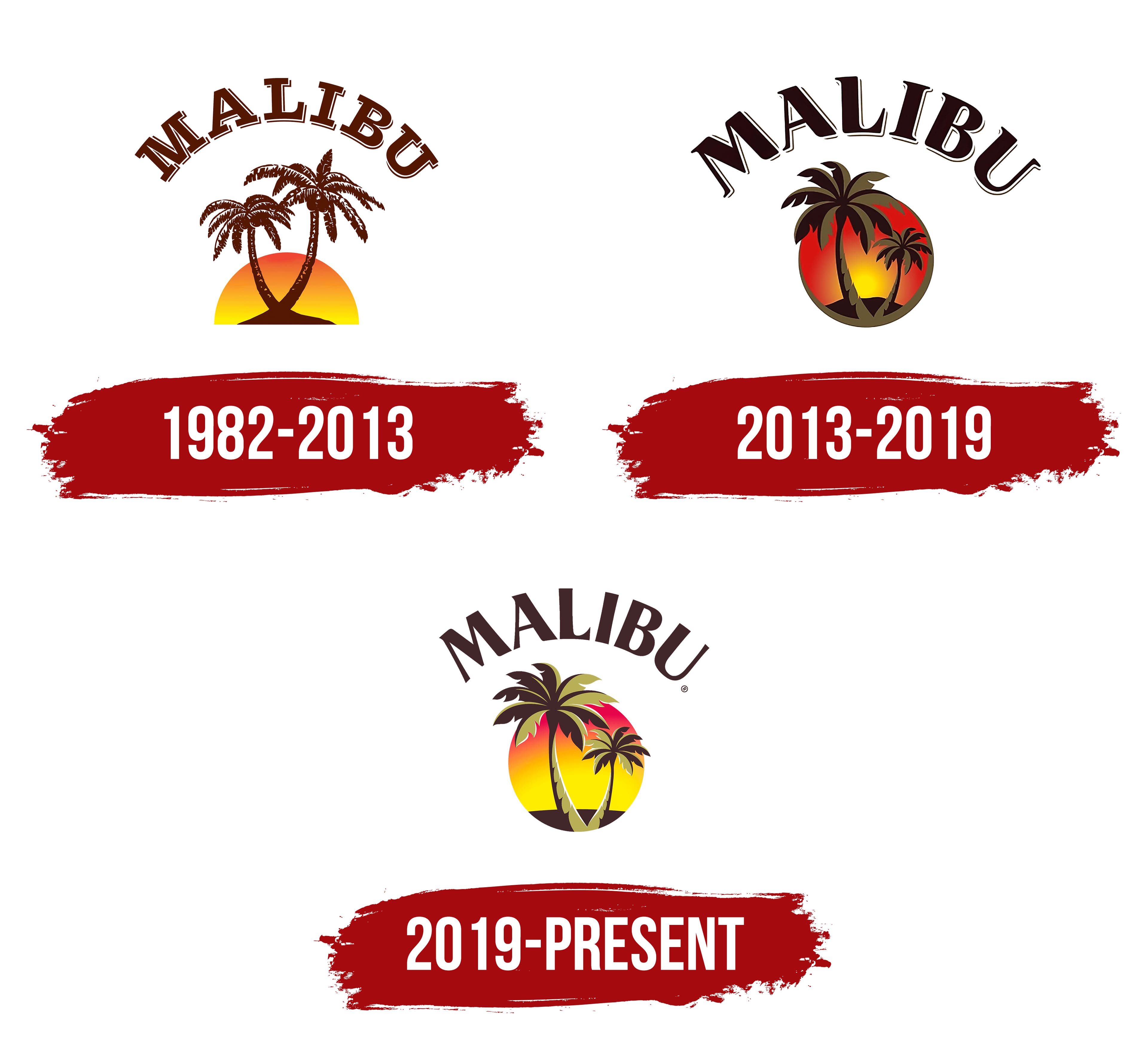
The famous brand’s emblem depicts two palm trees against a sunset background. At first, the logo was in black and white, but then it became colorful. The palms sit in the center: one is high, the other is low. A slight glare from the setting sun highlights the leaves. The opening variation also shows a piece of land. In the later version, it is not: the plants seem to look into the porthole, inviting viewers to enjoy life in carefree nature.
The original emblem depicted half of the sun’s disk; now it is complete. It obscures the sky, promising a bright mood and excellent weather. At the same time, the designers changed the red to an attractive yellow, with a slight darkening along the edges.
What is Malibu?
Malibu is an alcoholic beverage based on Caribbean rum, coconut extract, and distilled water. The brand was introduced in 1982 and is now owned by Pernod Ricard. The liqueur has a refreshing tropical flavor, making it popular at beaches and resort parties; it is served over ice or in cocktails such as Malibu Sunset and Piña Colada.
1982 – 2013

As already mentioned, the Malibu logo features an exotic landscape that reflects the spirit’s place of production. The brand’s birthplace is the island nation of Barbados, so its debut emblem depicted a small island with two palm trees. The choice of vegetation is because Malibu liqueur has contained natural coconut extract from the first day. The artist detailed the trunks, leaves, and fruits, but used a white-and-brown palette. The little piece of land below was also brown. The only bright spot was a red-yellow sun with a gradient. It rose on the horizon, so it looked less like a disk and more like a semicircle. It likely represented dawn, and the palm trees darkened at dusk. The brand name was at the top, forming an arch. It used a bold font with rectangular serifs.
2013 – 2019
In 2013, the letters became more elegant, acquiring short, triangular serifs with rounded ends. At the same time, the inscription was enlarged, and a contrasting font was used. The palm trees switched places: the big one moved to the left, and the small one to the right. In this version, they no longer grew from a piece of land (it moved to the background) but from a dark gold ring that forms a frame. The palms themselves were part dark gold, part brown. The base was a red circle with a yellow gradient spot inside. Obviously, this is how the artists depicted the sun.
2019 – today
After another redesign, the lower half of the sky turned yellow, and the upper half dark pink, with the two colors smoothly transitioning into one another. The letters have lost the decorative contours that made them voluminous. The serifs have become much smaller and shorter. But this is offset by extensions at the ends of the glyphs. The horizon line no longer looks like a hill; the artists have leveled it, although not perfectly. Instead of dark brown, they now use light brown, and beige with a green tint has replaced dark gold.
Font and Colors
The text part contains only the brand name. The word “Malibu” is placed at the top of the logo. It hangs in a semicircle over the palm trees, resembling an arch. It uses a custom font based on the classic Bengali Serre, echoing Fire Ladder (shadow lines) and Dragon Serial Heavy (a strict serif style).
The color scheme is traditionally Caribbean, with white (coconut pulp and white sandy beaches), orange, gold, yellow (sunny shades), and brown (coconut skin).