


 Marshmello Logo PNG
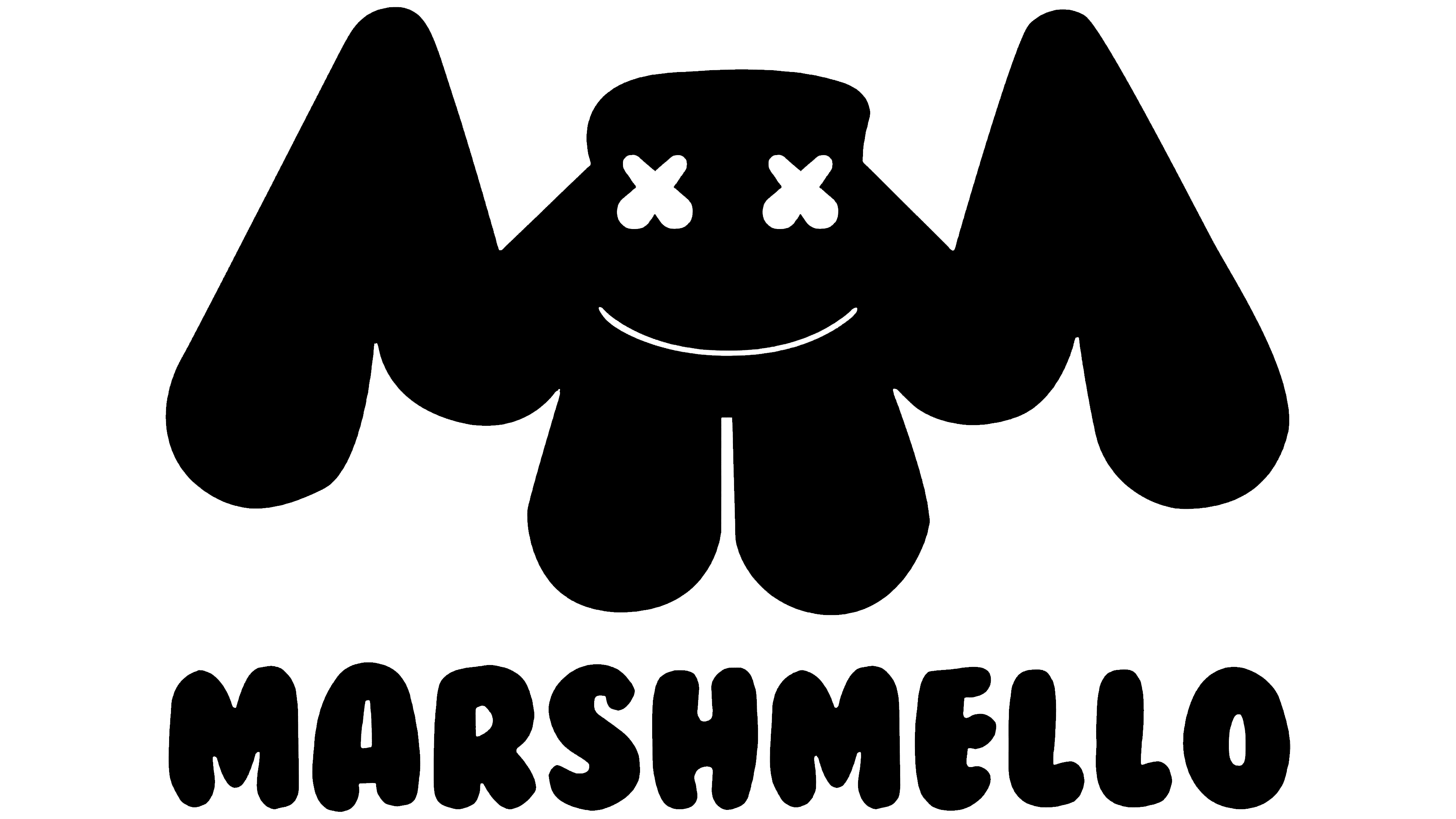
The Marshmello logo reflects the musician’s pseudonym. It features two “M” letters folded together, resembling a marshmallow with long arms and legs. The same face appears at the center of the emblem, on the musician’s helmet: two X-shaped eyes and a smiling arc. A separate symbol also features eyes and a mouth.
Christopher Comstock was born on May 19, 1992, in Philadelphia, Pennsylvania. He began his music career in 2010 under the alias Dotcom, using SoundCloud as an early platform. The Marshmello project appeared later under a new name, with a masked image and a different public identity.
On March 3, 2015, Comstock uploaded “WaVeZ,” his first original track as Marshmello. He then released remixes of Zedd’s “Beautiful Now” and Jack Ü’s “Where Are U Now.” The tracks spread online, and Skrillex reposted “FinD Me,” giving the project early visibility inside the EDM scene. Live sets followed, including Pier 94 in New York, HARD Day of the Dead in Pomona, and Miami Music Week.
The visual identity relied on anonymity. Comstock appeared in a marshmallow-shaped helmet, a format linked to earlier masked acts such as Deadmau5 and Daft Punk. In 2016, Marshmello released Joytime, a collection of previously issued material. The album reached No. 5 on Billboard’s Dance/Electronic Albums chart. In November 2017, Forbes reported that Marshmello was Chris Comstock, citing an old interview, royalty records, and shared management. However, his team never formally confirmed it.
By 2018, Marshmello had moved into cross-genre collaborations. He released “Wolves” with Selena Gomez, “Silence” with Khalid, “Happier” with Bastille, and “Friends” with Anne-Marie. That year, he earned $23 million and ranked fifth among the world’s highest-paid DJs. He later founded Joytime Collective, released Joytime II and Joytime III, staged a 2019 Fortnite concert for over 10 million players, earned a Grammy nomination for Shockwave in 2021, and worked with Kane Brown, SVDDEN DEATH, Ellie Goulding, Avaion, and Jelly Roll through 2025.
Meaning and History

Marshmello neither denies nor confirms his connection with Christopher Comstock. He said he doesn’t need fame and that his main goal is to create a positive, trustworthy image people like. From the artist’s words, it’s clear he separates himself from the character and lets it live a separate life. As manager Moe Shalizi explains, Marshmello can become anyone because the mask is universal. Because of this concept, brand developers have made it appealing to fans of all genders, ages, and professions.
Nevertheless, the anonymous artist has earned substantial income from private performances and tours and has even made it onto the list of the highest-paid DJs. He became famous for his gigantic, cartoonish marshmallow-inspired mask and his simple, cheerful dance music with trap arrangements. But we shouldn’t forget the logo, which played a significant role in Marshmello’s rise to fame.
What is Marshmello?
Marshmello is the creative pseudonym of DJ and producer Christopher Comstock. He maintains partial anonymity by not officially disclosing his identity, but everyone knows his real name (or thinks they do). The helmet, with drawn crosses for eyes and a big smile, lets him remain incognito. The artist never takes off the mask, as it is part of his stage image.

The emblem reflects the brand’s facelessness, offering no hint of the artist’s true identity. It contains the DJ’s main marketing tool – the mask needed to maintain pseudo-anonymity. This element is formed by two large black letters, “M,” tilted in opposite directions and connected in the middle. At the center is a face: two white crosses for eyes and a thin, smiling mouth. The side fragments of the “M” look like long arms, and the lower protrusions resemble legs. Underneath the logo, the word “MARSHMELLO” is written in a bubble font.
The logo also includes a symbol featuring only the improvised face. The black, bold crosses and smile on a blank white background match the drawing on the artist’s helmet. This graphic sign is recognizable even without a signature.
The Marshmello logo reflects the musician’s desire to perform behind a mask. The smiling character evokes sympathy because it is a demonstrative attempt to appear happy: behind the smile, he tries to hide the pain visible in his eyes. However, he has to maintain the image of a fun-loving person, no matter what.
Font and Colors

The bubble font, without serifs, evokes plump, soft marshmallows, so the letters in the inscription are bold, uneven, and angle-free. To further enhance recognition, the logo uses the same colors as the DJ’s mask: black and white. The high contrast makes them highly visible, creates a balanced image, and symbolizes adherence to etiquette.