


 McLaren Automotive Logo PNG
The McLaren logo reflects the brand’s ties to motorsports and the racetrack. Its contours evoke the speed of cars developed with input from racing drivers to win.
McLaren (full name: McLaren Automotive) is a British car manufacturer that specializes in high-speed racing cars. Its arsenal consists mainly of supercars produced at its sites. Australian racing driver Bruce McLaren and English businessman Ron Dennis founded the brand. It was founded in 1985. The head office is located at the Technology Center in Woking. The McLaren Group has owned the brand since 2017.
The company was originally called McLaren Cars, but it changed its name to McLaren Automotive in 2010. Bruce McLaren, the founder of the original structure that formed the basis of the modern company, is from New Zealand. He came to the UK under the Driver to Europe program to help Australian and New Zealand athletes compete in Formula One. Bruce was very promising from childhood, and he loved cars because his parents ran a service station in Oakland. By age 15, he had won his first serious race.
His racing career was brilliant in the new place: he became the youngest athlete to win the US Grand Prix. He was then 22 years old. At first, McLaren raced against other car brands. But then he opened Bruce McLaren Motor Racing (in 1963) and built his first sports car, the M1A. The M1B followed this (it won 43 Can-Am championship victories), and the M2B (debuted in the Monaco Grand Prix). Moreover, the racer designed and tested the cars, focusing on the super-light M6GT. However, the athlete died in an accident in 1970 without completing the project.
In 1985, McLaren Cars appeared but changed its name to McLaren Automotive (in 2010) because it was mostly inactive. The relaunch helped him revive it and secure investment for a new venture. Initially, it was separated from other structures of the same name, but in 2017, Ron Dennis contributed to their merger by selling his shares to the McLaren Technology Group.
Meaning and History
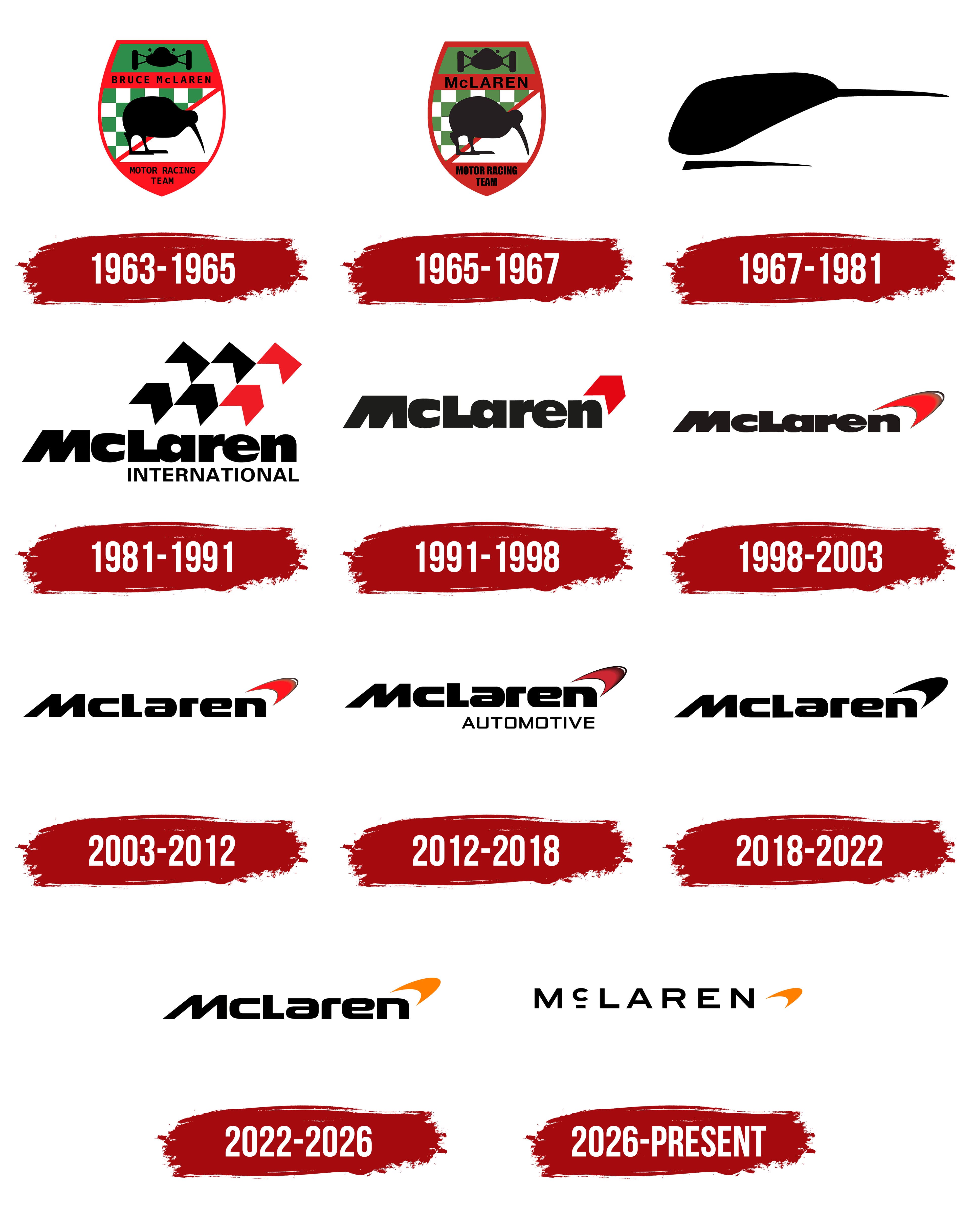
The brand’s first emblem appeared at its founding. Designer Michael Turner created it in 1963. He created a recognizable image of the kiwi bird, which lives in the birthplace of the Bruce McLaren racer. This tribute honors the company’s founder and his label.
What is McLaren Automotive?
This is one of the most renowned British supercar manufacturers, producing high-performance vehicles at its technology center in Woking, Surrey. The company creates models ranging from the Sports Series to hypercars like the P1, combining Formula 1 racing expertise with road-car production. At its state-of-the-art facility, the brand develops cars that prioritize advanced technology, lightweight design, and aerodynamic excellence. Each car has a carbon fiber chassis and complex operating systems, delivering unmatched performance and capability.
1963 – 1965
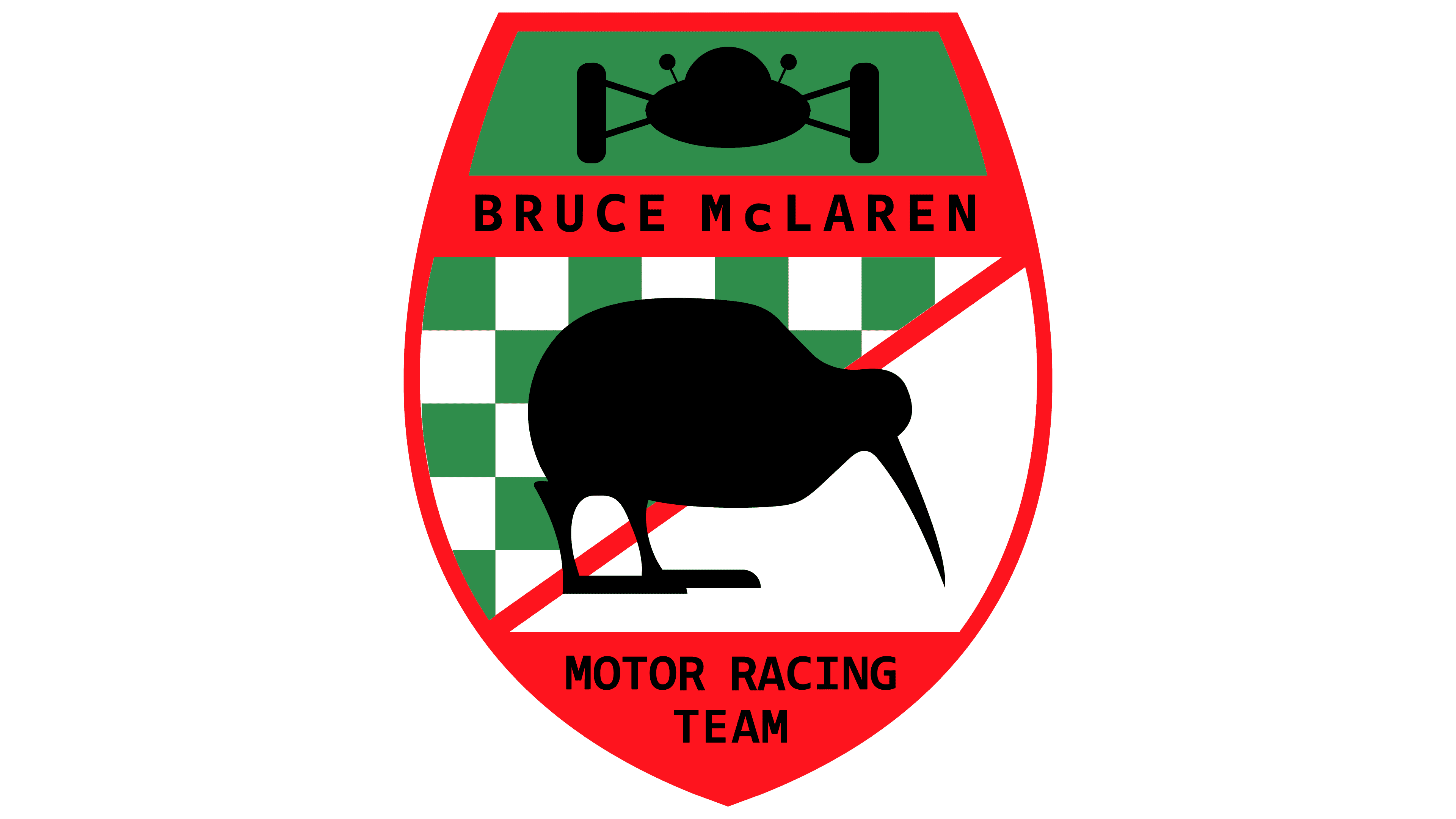
The kiwi on McLaren’s first emblem connected the British racing team to New Zealand, its founder’s homeland. Racing driver and constructor Bruce McLaren founded Bruce McLaren Motor Racing in 1963 and named the team after himself. The crest paired New Zealand’s national symbol with a race car and a checkered flag pattern.
McLaren commissioned artist Michael Turner to design the emblem in November 1963. The two were friends who shared a passion for motorsports, a frequent subject of Turner’s paintings. His design combined the founder’s origins and the team’s racing activities into a single crest. The finished emblem appeared in 1964.
The shield was divided into several sections. At the top, a race car silhouette and a checkered field represented competition. A green band bearing the name Bruce McLaren separated this racing scene from a large black kiwi with a long, downward-pointing bill. The bird occupied almost half the shield, giving the New Zealand connection prominence. For a team based in Britain, the kiwi reminded people of McLaren’s homeland.
The words Motor Racing Team ran along the bottom of the emblem. Together with the Bruce McLaren name, they identified the team and its involvement in motorsports. The lettering used simple shapes with minimal decoration. Red, green, and white areas divided the crest into sections, while black marked the bird, car, and text.
The McLaren name later extended from the racing team to road cars. On December 2, 1985, Ron Dennis established a separate automotive company and founded McLaren Cars. McLaren Automotive took its modern form in 2010. Based in Woking, England, the company produces sports cars and supercars. The word Automotive identifies its business, while the McLaren surname connects its road cars to the racing team’s founder.
1965 – 1967
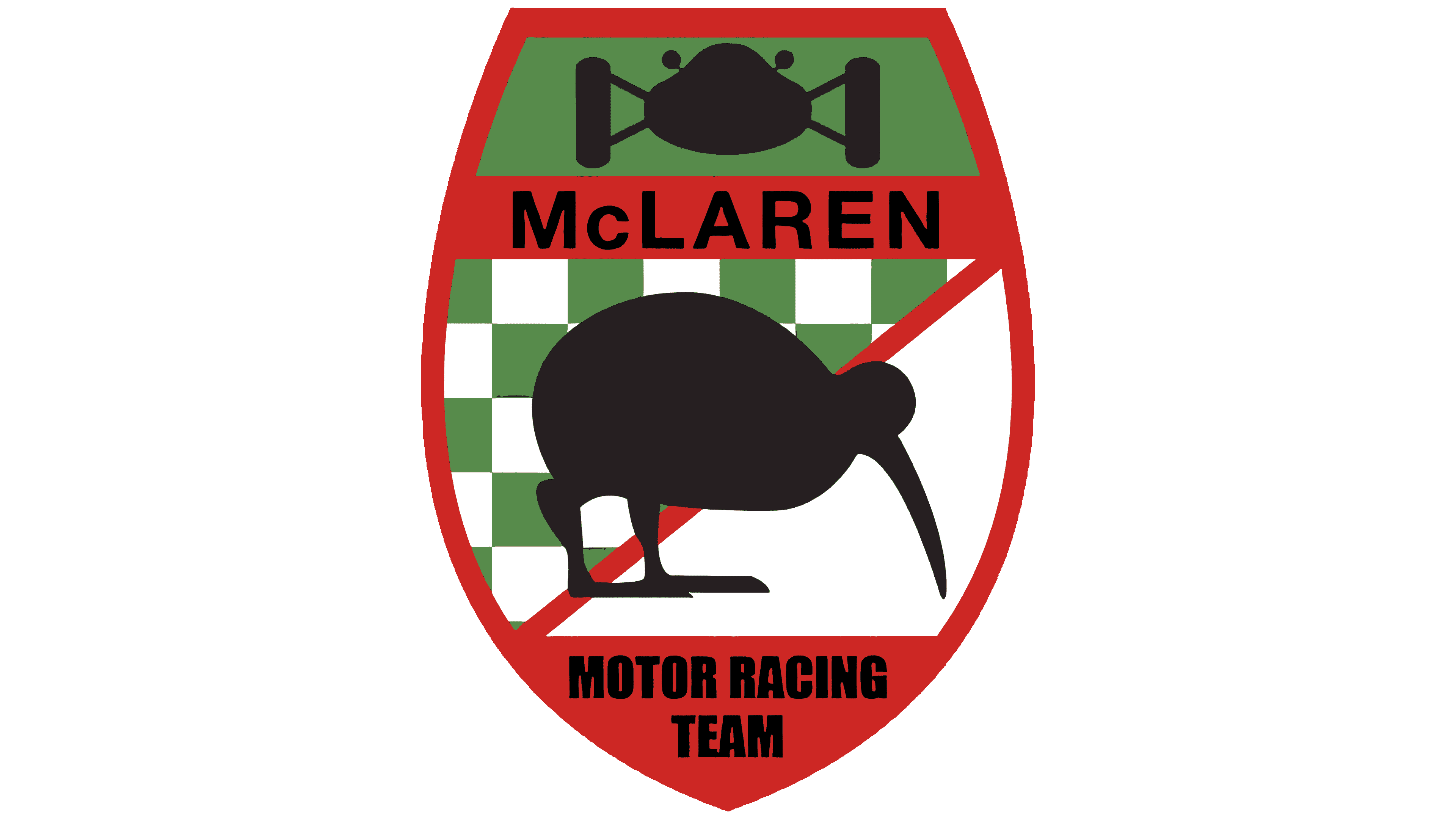
From 1965 to 1967, McLaren’s logo retained its crest format. The shield combined the founder’s surname, a race car, and a kiwi. The car represented the team’s motorsports involvement, while the kiwi recalled Bruce McLaren’s New Zealand roots.
The shield contained four sections of different widths. A car occupied the upper green field, with a red band bearing the McLaren name beneath it. The largest section held a black kiwi silhouette, its head lowered and long bill pointing down. The outlines of its body and legs conveyed the bird’s appearance with minimal detail. The words Motor Racing Team appeared in the narrow section at the bottom, identifying the organization’s purpose.
In 1967, the crest gave way to a standalone bird emblem called the Speedy Kiwi. Its silhouette became more elongated, with the bill pointing forward. A black outline curved around the rounded head and tapered to sharp tips. The kiwi replaced the shield, its colored fields, and its descriptive text. The bird maintained McLaren’s connection to New Zealand, while its shape and the Speedy Kiwi name suggested speed.
McLaren’s race cars also changed color in 1967. Bruce’s business partner, Teddy Mayer, proposed orange after seeing a similarly colored car at a race in Britain. Mayer appreciated how well it stood out on black-and-white television and in competitors’ mirrors.
Papaya debuted on the McLaren M6A on September 3, 1967, at the Can-Am race in Elkhart Lake. Orange then reached Formula 1 with the McLaren M7A’s debut on March 17, 1968. The color became known as McLaren Orange.
1967 – 1981

The increasing speed of McLaren’s cars was reflected in the Speedy Kiwi emblem designed by Doug Eyre in 1971. Its name matched the image of a bird running with an extended bill and a low head.
The rounded head flowed into a long, pointed bill. The lower edge of the black outline ended in a similar point. These two tapered ends stretched the silhouette horizontally, while the head’s curve preserved its resemblance to a kiwi.
Beside the bird, the McLaren name appeared in heavy, forward-slanting lettering. The letters leaned toward the bill, reinforcing the suggestion of speed. Their thick strokes balanced the outlined bird, giving the founder’s surname prominence.
1981 – 1991
McLaren received the logo created by industrial designer Raymond Loewy as a gift from its sponsor. Its introduction accompanied the 1981 merger with Ron Dennis’s Project Four and the adoption of the McLaren International name. An emblem of angular red and black shapes above the lettering replaced the bird.
Loewy arranged the shapes in three rows. The alternating colors recalled a checkered racing flag, while the stepped pattern resembled tire tracks. Gaps separated individual shapes. The red-and-black combination connected the racing imagery to Marlboro’s branding and reflected the sponsor’s involvement with the team.
The name beneath the emblem was split across two lines. Large McLaren lettering dominated, with International in smaller uppercase letters below. The scale difference kept the founder’s surname prominent while incorporating the team’s expanded name.
Getting the red to appear correctly on television required additional work. Marlboro’s standard paint looked darker on screen than intended, so the team tested several alternatives. The result was Rocket Red, a shade developed to produce the desired red in television broadcasts.
1991 – 1998
A single red chevron replaced three chevrons in McLaren’s 1991 logo update. The change accompanied the development of the McLaren F1 road car and the expansion of the automotive division. A shared brand covered both the racing team and road car production, with the name shortened to McLaren.
The red shape sat above the right side of the wordmark. It resembled a triangular arrow with a cutout underneath and a tip pointing diagonally upward. The emblem kept its angular geometry, reduced to one compact shape. The upward-pointing arrow suggested growth.
The wordmark was simplified to a single line. McLaren retained its existing typeface, with heavy black letters, smooth stroke endings, and tight spacing. The red emblem complemented the black lettering. The update simplified the logo’s structure and imagery, while the letterforms and colors maintained continuity with the previous version.
1998 – 2003

The end of McLaren’s partnership with Marlboro and the arrival of silver race cars coincided with a new emblem. In 1997, the angular symbol gave way to the curved red Speedmark. Its design drew on the vortices that form behind a car’s rear wing.
The Speedmark resembled an elongated arc or curved check mark. Its upper and lower edges followed different curves, creating a shape that varied in thickness along its length. The edges met at pointed tips, forming a solid red silhouette. The airflow reference connected the emblem to the speed and aerodynamics of a race car.
Similar shapes appeared on the upper surfaces of the cars’ sidepods. Their outlines recalled markings on predatory animals and insects. In the logo, the Speedmark sat above the right end of the McLaren name. The lettering changed from coal black to dark graphite, with the red arc standing out against it.
2003 – 2012
Race car aerodynamics inspired McLaren’s new lettering in 2003. The previous heavy letterforms were replaced with slanted characters featuring rounded contours and smooth transitions between strokes. The curves echoed the cars’ streamlined shapes.
The name retained its combination of uppercase “M” and “L” with lowercase letters. Tight spacing kept the wordmark compact, while a consistent slant unified the letters. Gentle curves softened the contours and complemented the angled lettering.
Another update accompanied the introduction of Vodafone McLaren Mercedes in 2007. The 2003 lettering and Speedmark remained, with silver versions adding a three-dimensional effect. The wordmark and emblem resembled metal components, matching the cars’ chrome liveries.
2012 – 2018

After the automotive division launched in 2010, McLaren used an expanded logo for its road car business, adding AUTOMOTIVE beneath the brand name. This additional line identified the division. Above it sat the familiar McLaren wordmark and Speedmark.
The two lines used different lettering styles. McLaren’s heavy, slanted letters kept the brand name dominant. AUTOMOTIVE appeared in thin, upright, uppercase sans-serif letters. The lower line supplemented the founder’s surname and clarified the division’s role.
In AUTOMOTIVE, rounded letters took on angular shapes with softened corners. The “O” had a closed outline resembling a rounded rectangle. The bottom of the “U” followed a similar shape, with the top left open. The automotive logo focused on this additional line, paired with the existing McLaren wordmark and Speedmark.
2018 – 2022

By 2017, McLaren had grown from Bruce McLaren’s small racing team into a group focused on advanced technology and supercar production, including the P1 and 720S. The group introduced an all-black logo across its three divisions. The wordmark and Speedmark shared the same color, bringing the different businesses together under the McLaren name.
The wordmark remained the logo’s dominant feature. The Speedmark sat above its right end, beside the “n.” Its curved silhouette and pointed tips resembled a wing or an arrow, evoking speed and McLaren’s racing heritage. Both parts retained their shapes and spacing, while black visually united the emblem and lettering. The racing division later received a separate logo version.
2022 – 2026
The slant of the “M” in McLaren inspired a design device called the M angle. Eight Inc. used the angle of the initial letter to develop the identities of McLaren Automotive and McLaren Special Operations. A shared approach to the wordmark and emblem connected both businesses to the McLaren brand.
The automotive identity centered on a lighter version of the McLaren logo. The Speedmark took on an additional role in treating vehicle names, while Velocity Orange became the primary color.
McLaren Racing introduced its update in 2021. The Speedmark turned orange, and the lettering was thinned for digital use. The logo continued to pair the McLaren name with the Speedmark.
2026 – today
At Les and Ruth McLaren’s auto repair shop in Remuera, an Auckland neighborhood, Bruce learned mechanics and prepared the car he drove to his first racing victory. Years later, the hand-painted family name on the shop’s sign became the basis for an updated McLaren logo.
The Automotive and Racing teams turned to the old lettering as they worked together on the brand identity. In their shared archive, they found a reference from the family workshop that predated both the racing team and McLaren’s road cars. The story of Bruce’s parents gave both divisions a common starting point for the new wordmark.
Thin, upright sans-serif lettering replaced the previous compact, rounded, slanted letters. Spacing increased, the strokes became even, and most of the name was set in uppercase. A smaller “c” was raised above the baseline, with a short horizontal line beneath it echoing a detail from the workshop sign. The McL 6GT was the first car to carry the updated lettering on its rear bodywork.
The identity retained the Speedmark and added the historic Heritage Shield and Speedy Kiwi to its emblem collection. Both represented early chapters in McLaren’s history. Alongside the new wordmark, they referenced the founder’s family background and the brand’s racing heritage.
Papaya orange was joined by colors drawn from McLaren’s early history. Ember referenced its early racing suits, while Midnight brought back a dark blue the brand used in the past.
Font and Colors
The distinctive McLaren Speedmark has multiple origins. One view says it recalls Speedy Kiwi’s debut logo, as the rounded, wide arc resembles a kiwi’s head. Under other assumptions, this is a modernized chevron that personifies Marlboro’s sponsorship. The third point of view is the inverted “checkmark,” a swirling vortex that usually appears at the tops of the car’s side supports.
The designers chose a vector version of Marcus Sterz’s Moki Lean typeface, first published by FaceType, for the logo. Its alternative is the A Space font. The inscription is also similar to the Serene MTC.
The corporate palette is restrained, consisting of classic colors: black, red, and white. The very first emblem also featured green.
FAQ
What is the symbol on a McLaren?
The first logo of this famous automobile and racing brand featured a kiwi, a nod to the New Zealand roots of its founder, Bruce McLaren. The kiwi represented the brand’s origins and was chosen for its speed and agility, which stand out among the more commonly used animals in car logos, such as horses and bulls.
As it evolved, the logo shifted from a Kiwi to a more abstract, stylized design. This shift helped the brand reach a wider audience and supported its growth into a leader in the automotive and Formula 1 racing industries.
Can I use the McLaren logo?
You may not use the logo without prior permission. It is a registered trademark, which means it is legally protected. If you want to use it for commercial purposes, promotions, or anything else, you must obtain written permission from the brand. Unauthorized use may result in legal consequences, as it violates trademark laws. The same rules apply to other names, logos, and designs on their website; they are protected, belong to their owners, and require permission to use.
What does the McLaren logo mean?
The McLaren logo has various interpretations. Some believe that the swoosh shape originated from the brand’s sponsorship by Marlboro, reflecting the style of that time. Others see it as a stylized kiwi bird, honoring the New Zealand roots of its founder, Bruce McLaren. Another idea is that the logo resembles smoke from a car’s exhaust pipe, symbolizing speed and power. Each interpretation highlights a different aspect of the brand’s story and its role in motorsports and the automotive industry.
Is McLaren a Kiwi?
This famous car brand originally used the Kiwi bird in its logos to honor its founder, Bruce McLaren, who was from New Zealand. The Kiwi represented his New Zealand heritage and gave the brand a unique background. Over time, the logo changed from a Kiwi to a more modern, stylized design featuring an inverted arch. This new logo gives the brand a fresher, more abstract look while maintaining its rich racing and automotive design history.
Why is the McLaren logo a Kiwi?
The brand’s original logo featured a kiwi to honor the New Zealand roots of its founder, Bruce McLaren. Born in New Zealand, Bruce wanted to use a symbol that reflected his heritage. The kiwi bird, the national symbol of his home country, was the perfect choice. His friend Michael Turner designed the logo, using the kiwi to highlight Bruce’s origins and give the brand a unique personality. This decision helped the brand stand out by connecting it to Bruce’s past.
Is McLaren a Ferrari?
These are separate brands in the automotive industry. McLaren operates independently within the McLaren Group, a privately owned company that produces high-performance vehicles, including supercars and Formula One cars. Ferrari is an iconic Italian brand known for its luxury sports cars and extensive motorsport history.