


 Meijer Logo PNG
The supermarket chain, known for its creativity, stands out with an original logo. The Meijer logo may seem simple at first glance, but its expressive contrast draws the eye in. It’s like a magnet for customers.
Meijer began in 1934 during the Great Depression, when Hendrik Meijer, a barber in Greenville, Michigan, opened a small grocery store. Economic pressure drove the change: barbering income had fallen, while food retail remained a steadier business. From the beginning, Meijer used the self-service format, shopping carts, and open access to goods, which was still new for many local grocery stores.
After World War II, Hendrik’s son Fred Meijer became deeply involved in the company. Father and son expanded the chain across Michigan and kept experimenting with store formats. The key moment came in 1962, when they opened Thrifty Acres in Grand Rapids. The store combined a full grocery supermarket with clothing, appliances, home goods, garden supplies, and pharmacy products under one roof.
This format later became known as the supercenter. At the time, Kroger was associated mainly with groceries, while Kmart focused on general merchandise. Meijer combined both in a single store, targeting middle-class shoppers who used cars and wanted to buy across many categories in one visit. Hendrik Meijer died in 1964, and Fred continued expanding the business into Ohio, Illinois, Indiana, Wisconsin, and Kentucky.
By the 1980s, Meijer already had two decades of experience with the supercenter model. Walmart opened its first supercenter in 1988 and later became a major Midwest rival. Fred Meijer died in 2011, when the chain had more than 200 stores and remained family-owned, making it one of the largest private retailers in the United States.
Meaning and History
The organization was originally named Meijer. A Dutch immigrant opened it in Greenville, Michigan. He wasn’t a businessman; he worked as a hairdresser. However, during the Great Depression, the entrepreneur began selling groceries. The letter “s” with an apostrophe indicated that the family wholly owned the business. And so it was: even the owner’s 14-year-old son worked there.
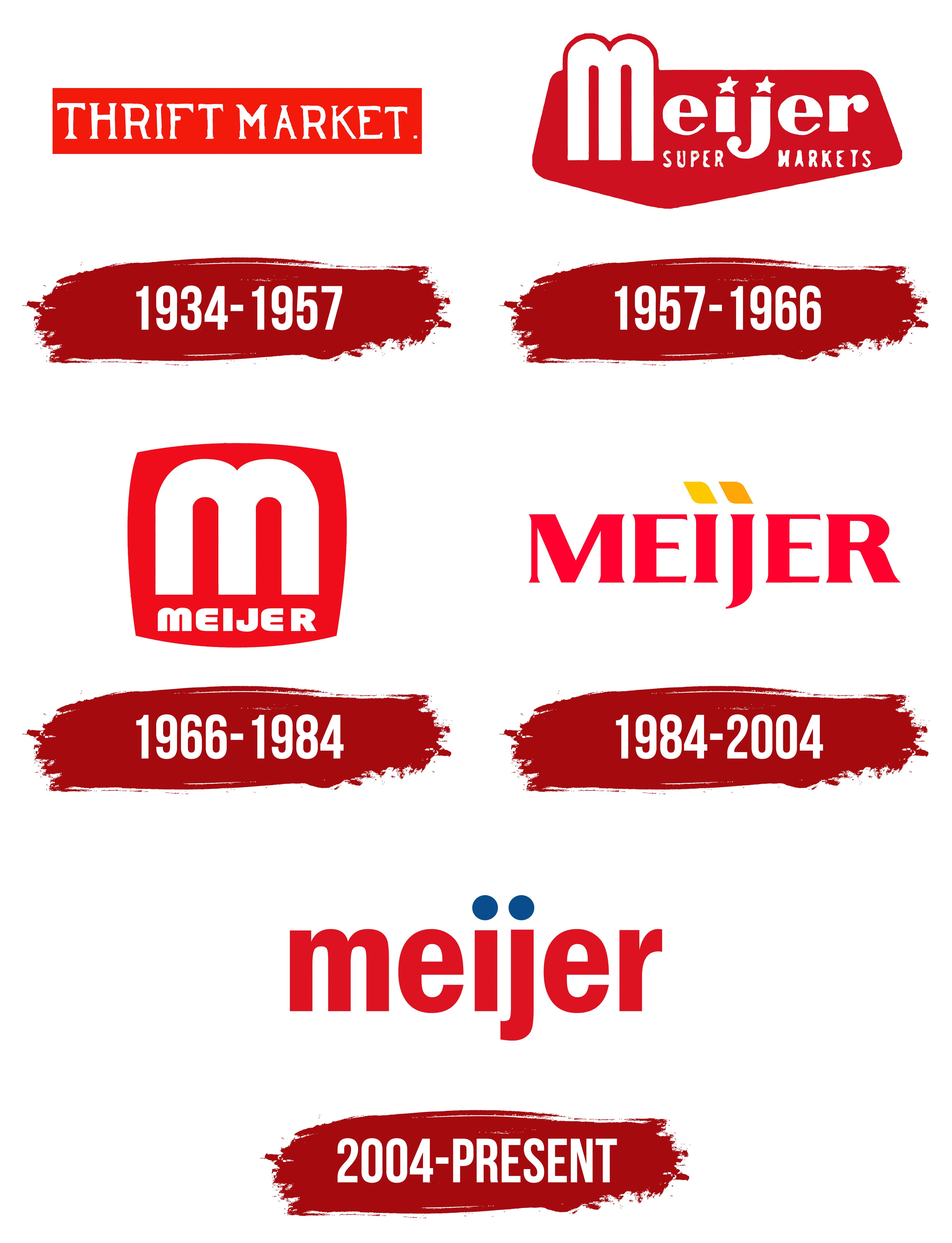
With each major expansion of points of sale, their owner changed outdoor signs, which also served as logos. The most fundamental redesign was introduced in 1984, the 50th anniversary of supermarkets. Then, for the first time, the company changed not only the emblem design but also the corporate font.
What is Meijer?
Meijer is a United States supermarket chain owned by a company of the same name. It was the first to combine several stores from different directions into a single building, thereby introducing the concept of hypermarkets. It now operates over 250 shopping malls. The head office is located in Walker, Michigan. The corporation was founded by Hendrik Meijer. Its appearance dates back to 1934.
1934 – 1957

An early logo featured the white words “THRIFT MARKET” inside a red rectangle and was used as a sign. The letters used an unusual font with triangular serifs, and the inscription ended with a small square dot.
1957 – 1966
Meijer’s visual identity began with the wrong pentagon. In any case, this is exactly what the geometric figure looks like, and it served as the background for the new store’s name. That is, it is a pentagon with edges of different lengths. It is colored red. It has three white inscriptions, grouped into two parts. The first row is occupied by the name of the trade and commercial complex. It is essentially in lowercase, but with a large “M” whose legs are stretched vertically as if it were a capital letter with a rounded top. At the bottom, the phrase “Super Markets” is separated by a hook “j.”
1966 – 1984

During this period, designers used the first letter of the hypermarket chain’s name as the basis. Therefore, all other characters are adapted to “m.” They have the same streamlined shapes, rounding, and lack of serifs. The inscription is in white. Of particular interest are “E” and “m”: the designers, noticing their near-identical similarity, depicted them as identical. The only difference is rotation: in “m,” the protruding elements (legs) point downward and are arranged vertically, whereas in “E,” they point right and are arranged horizontally. A single large “m” floats above the brand name. The background is a red square with convex, barrel-like sides.
1984 – 2004
The logo update marked a significant milestone: Meijer’s 50th anniversary. With that in mind, management decided to radically change the outdoor sign’s style. As a result, the designers removed the single “m,” which looked like a double gate. They used the name as a basis and set it in bold geometric letters with sharp angles and miniature serifs. Moreover, the lowercase “m” became “j,” with the “dot” above it shaped like a parallelogram. The “i” has the same figure. The developers removed the background entirely, leaving an empty white space that made the red inscription visible.
2004 – today
The modern logo is radically different. It contains only text, no graphics. The characters are rounded and streamlined, with smooth lines. The exceptions are “i” and “j.” They have a columnar shape with right angles. The dots above them are perfectly round and dark blue. All letters are in lowercase and traditionally colored red.
Font and Colors
Frequent alternation between uppercase and lowercase characters characterizes the text portion of the Meijer logo. Another interesting detail is the dots above the “i” and “j.” In the debut version, miniature stars were used instead. Then yellow parallelograms appeared. In the current emblem, they were replaced with large, solid blue disks. Moreover, the supermarket chain’s logo also served as an outdoor sign at all times.
For its visual identity, Meijer chose expressive typefaces that remain legible from a distance. Almost all are custom, with modified elements. The latest logo version uses a font that exactly matches Vacer Sans Bold by Aring Typeface AB.

The trading network’s corporate palette is bright and catchy, with designers opting for rich red. Yellow, orange, and blue complement it in different periods. In some emblems, the inscription is white.