


 Memphis Redbirds Logo PNG
The Memphis Redbirds logo reflects the club’s athletic and regional character. It visually emphasizes the team’s connection to Memphis, focusing on local traditions and the fan community.
Memphis Redbirds were founded in 1998, restoring Triple-A baseball to a city with a long professional tradition. The club joined the Pacific Coast League as an affiliate of the St. Louis Cardinals and first played at Tim McCarver Stadium. The Redbirds’ name reflected the connection with the parent organization and its cardinal symbol.
A major step came in 2000 with the opening of AutoZone Park in downtown Memphis. The stadium cost about $80.5 million, an unusually high figure for a Minor League venue at the time. The move brought immediate sporting success, as Memphis won the Pacific Coast League championship in its first season at the new park.
During the 2000s, the club became an important development stop for future major leaguers. Albert Pujols and Yadier Molina both passed through Memphis before long careers at the highest level. Pujols later won three National League MVP awards. The Redbirds won another league title in 2009, but financial and management problems emerged in 2010. Ownership later passed through Comcast-Spectacor, the parent club, Trinity Baseball Holdings, and Diamond Baseball Holdings.
The strongest period came under manager Stubby Clapp in 2017 and 2018. Memphis won consecutive Pacific Coast League championships and then captured the 2018 Triple-A National Championship by defeating the Durham Bulls. The result completed the franchise’s first back-to-back league title run. It became the club’s biggest national-level achievement.
Meaning and History

What is Memphis Redbirds?
It is a Triple-A baseball team based in Memphis, Tennessee, competing in the International League. Founded after a franchise was relocated from Louisville, it is owned by a nonprofit organization, a rare ownership model in professional baseball. The team is affiliated with the St. Louis Cardinals and has won multiple league championships. Home games are played at AutoZone Park in downtown Memphis.
1998 – 2014

After the team was founded, it officially joined the Triple-A Pacific Coast League, and that was when the world first saw the Memphis Redbirds logo. The visual design emphasized the connection with the parent team, the St. Louis Cardinals, through a shared color palette of navy blue, red, muted yellow, and gray. This combination reinforced the sporting continuity and clear association with the major league club.
The design featured a horizontal, navy-blue oval outlined with a thin red line. Inside the oval was the text “Memphis Redbirds Baseball,” divided into two levels and set in a serif typeface with strong contrast, characteristic of baseball clubs of that era. The capital letters had substantial serifs and consistent stroke weights, creating an impression of solidity, reliability, and classic baseball tradition.
In front of the oval, the silhouette of a baseball player was captured in the moment before a swing. The player was rendered realistically, in a natural athletic stance, emphasizing the dynamism and tension before the hit. This choice of pose was symbolic, with the baseball player serving as a universal emblem of club identity, embodying classic baseball values such as skill, strength, and concentration.
The player’s uniform was primarily gray, with darker tones for shading and contours, while the wooden bat stood out in a natural yellow. This approach added a sense of volume to the design and reinforced the game’s sporting tradition, rooted in American baseball history.
2015 – 2016

The Memphis Redbirds logo, introduced in February 2015 ahead of the Minor League Baseball season, was developed by the St. Louis Cardinals’ design department under the direct supervision of team president Bill DeWitt III. The new visual concept emphasized both continuity and the club’s independence.
The color palette was refreshed by adding a bold shade, Memphis Redbirds Yellow, which was previously absent from the official colors. The core set now consisted of classic red (Memphis Redbirds Red), navy blue (Midnight Navy), and contrasting yellow. The introduction of yellow symbolized freshness and energy, giving the brand a more active and vibrant feel.
The centerpiece of the composition was the traditional “birds on the bat” motif used by the St. Louis Cardinals, a bright yellow bat with two red cardinals perched at either end. While the Cardinals used a single bird, the Memphis logo intentionally featured two, highlighting a dual meaning: the bond with the parent club and the uniqueness of its own identity. The birds were drawn realistically, with detailed feathers and contours, navy accents, and yellow beaks, adding visual brightness and emotional depth to the logo.
Below the yellow bat was the word “Memphis,” written in cursive reminiscent of the Cardinals’ lettering style, with local stylistic distinctions. The glyphs had smooth, rounded forms, a slight rightward slant, even stroke thickness, and clean terminals. The red lettering was enhanced by a bold navy blue outline, which added visual depth and reinforced brand recognition.
2017 – today

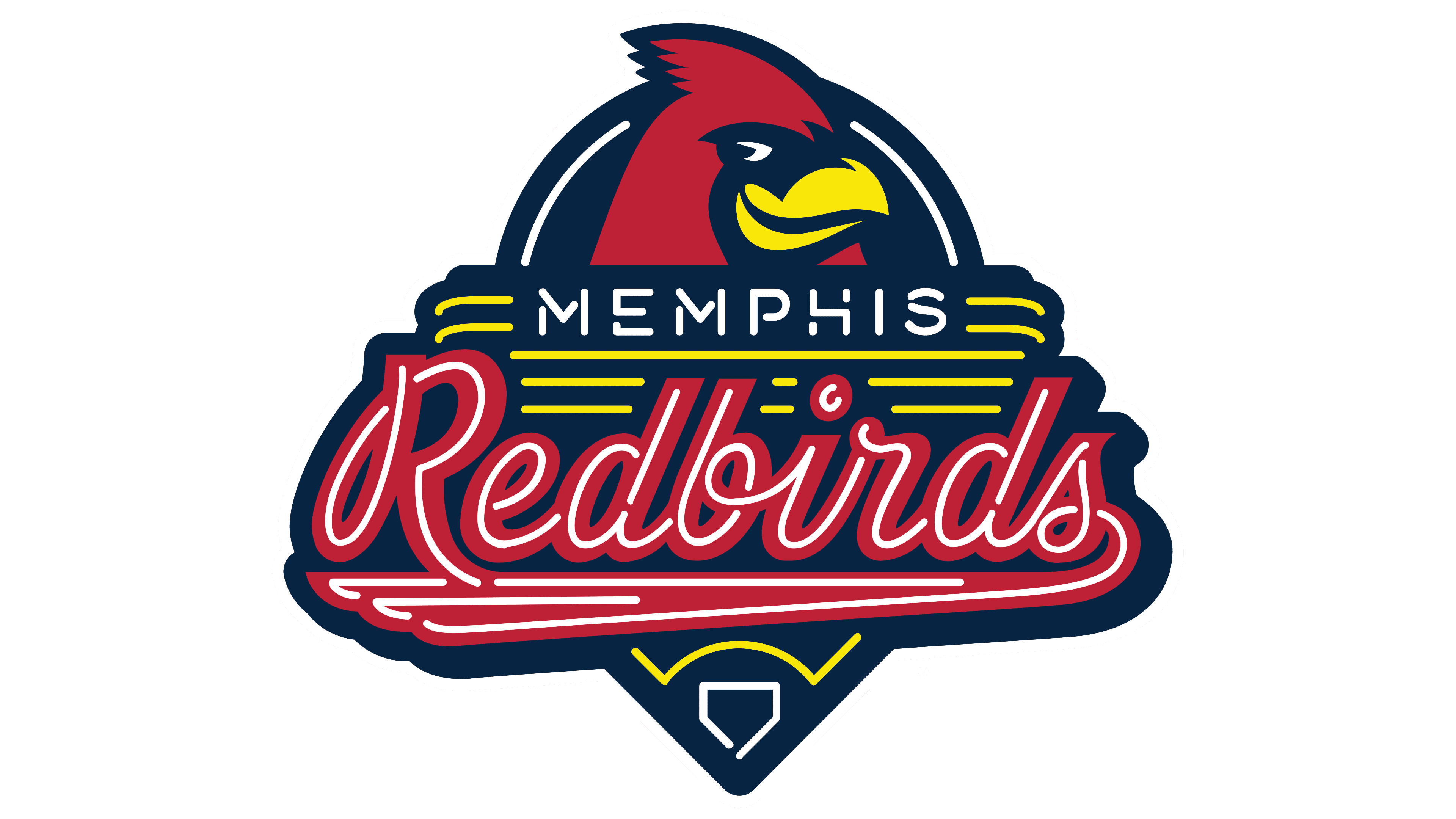
In 2017, the Memphis Redbirds introduced a refreshed look designed by the American firm Studio Simon under the direction of Dan Simon. The new visual concept, unveiled to the public on January 18, reflects the baseball club’s connection to Memphis’s musical and cultural heritage, expressed through a style inspired by the city’s legendary Beale Street neon signs.
The logo’s palette remains true to the club’s traditional colors: red, navy blue, and bright yellow. However, its application has undergone significant changes. Yellow plays a central role, symbolizing the city’s characteristic neon glow. Thin yellow lines run horizontally along the sides of the lettering and beneath the baseball home plate, enhancing the effect of an illuminated sign.
The key figure in the logo is the club’s recognizable symbol, a cardinal named Rocky, depicted in a large profile view of the bird’s head. The graphic style is minimalist, with bold, contrasting shapes that emphasize strength and confidence. The bird is rendered in deep shades of red and blue, with a vivid yellow beak that highlights the brand’s energy and assertiveness.
The typographic portion of the logo consists of two stylistically distinct elements. The top word, “MEMPHIS,” is set in a strict geometric typeface that resembles segmented neon tubing. The clean white letters are complemented by an “M” shaped like a musical note, referencing the historic logo of the Memphis Blues baseball team that played in the city during the 1970s. This detail underscores continuity with Memphis’s sports and music traditions.
The lower word, “Redbirds,” is in a script typeface with smooth lines and elegant curves, also styled to resemble neon tubing. The red letters are accented with outlines and light highlights to enhance a three-dimensional, glowing effect. Placed diagonally, the script adds dynamism and expressive movement to the overall composition.
At the bottom of the emblem is a depiction of a baseball home plate, reinforcing the direct connection to the sport and neatly completing the design’s base. The plate is outlined in simple white on a navy blue background, with a yellow accent to tie it into the rest of the palette.
