 Mumbai Indians Logo PNG
The Mumbai Indians logo unites athletes and fans in a shared pursuit of triumph. Every line of the emblem reflects the team’s continuous movement toward new heights, while the central image symbolizes an unwavering drive to achieve set goals.
Mumbai Indians began in 2008, when the BCCI launched the Indian Premier League (IPL). The Mumbai franchise became the most expensive team in the new tournament, bought for $111.9 million by Reliance Industries, led by Mukesh Ambani. The name connected the club with Mumbai, while blue and gold became its official colors.
The first seasons were uneven. In 2008, Mumbai finished fifth, with Sachin Tendulkar serving as captain and the squad’s main figure. In 2009, the team missed the playoffs again, yet used the season to develop local players and build a stronger youth base. A breakthrough came in 2010, when Mumbai won its group and reached the final, where it lost to Chennai Super Kings.
In 2011, the club won its first major trophy by defeating Royal Challengers Bangalore in the Champions League Twenty20 final. In 2013, Rohit Sharma took over as captain and led Mumbai to its first league title. The franchise added further championships in 2015, 2017, 2019, and 2020, including a one-run final win over Rising Pune Supergiant in 2017 and a five-wicket victory over Delhi Capitals in 2020.
Beyond match results, Mumbai built long-term club structures. In 2010, it launched Education for All to support children from low-income families in Mumbai. In 2015, it created a cricket academy for young players. After missing the playoffs in 2021 and finishing last in 2022, the team rebuilt in 2023 with new signings, including Cameron Green, reached fourth place, and exited after losing to Lucknow Super Giants.
Meaning and History
What is Mumbai Indians?
It is a professional cricket team based in Mumbai, India, and plays in the Indian Premier League (IPL). The team is one of the most successful franchises in the IPL, having won several championships. Owned by Reliance Industries through its subsidiary, IndiaWin Sports, the team is recognized for its strong roster of both domestic and international players. The team plays its home matches at the Wankhede Stadium in Mumbai. It is known for its performances, leadership, and loyal fan base, making it one of the most popular and dominant teams in the IPL.
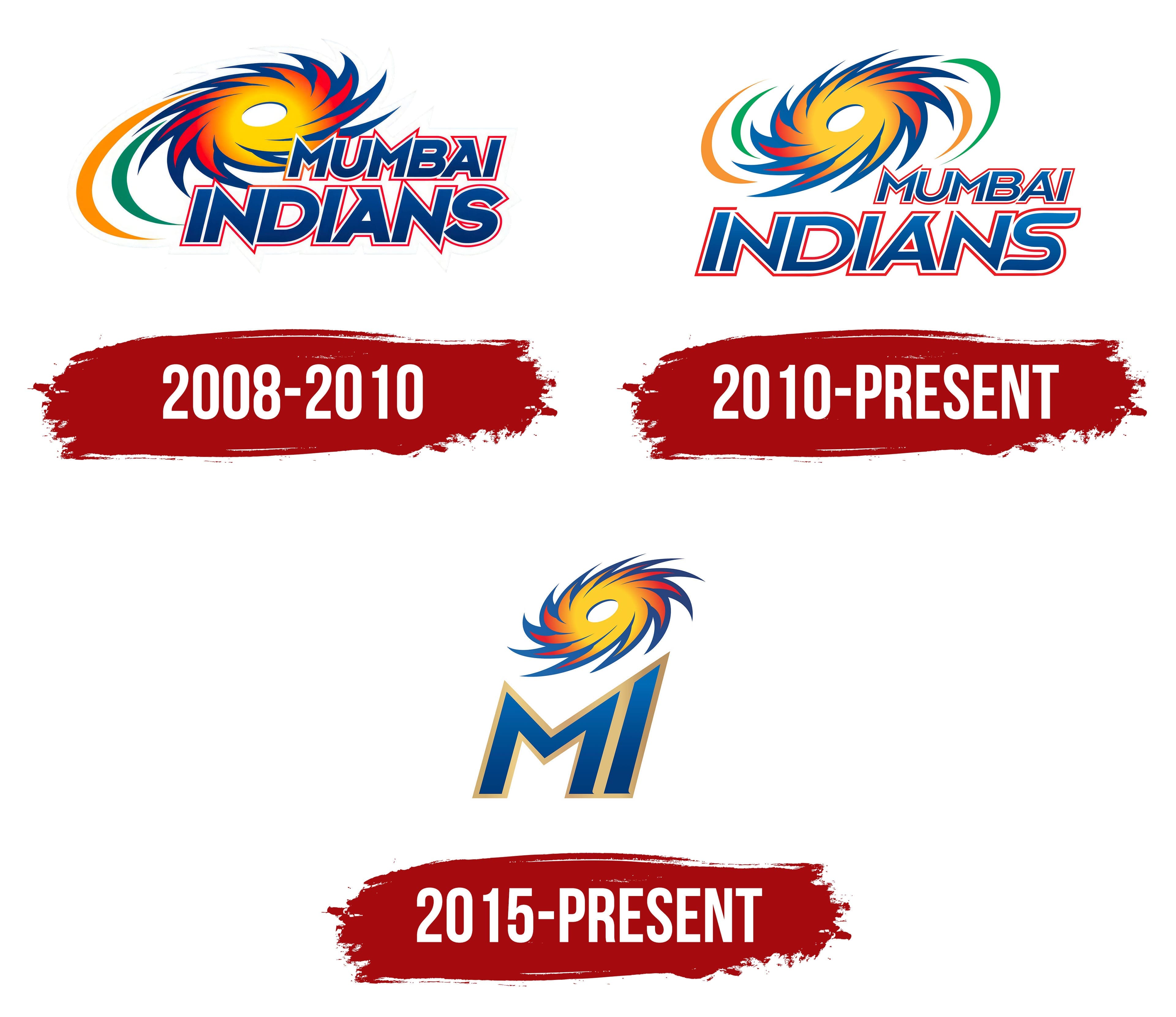
2008 – 2010
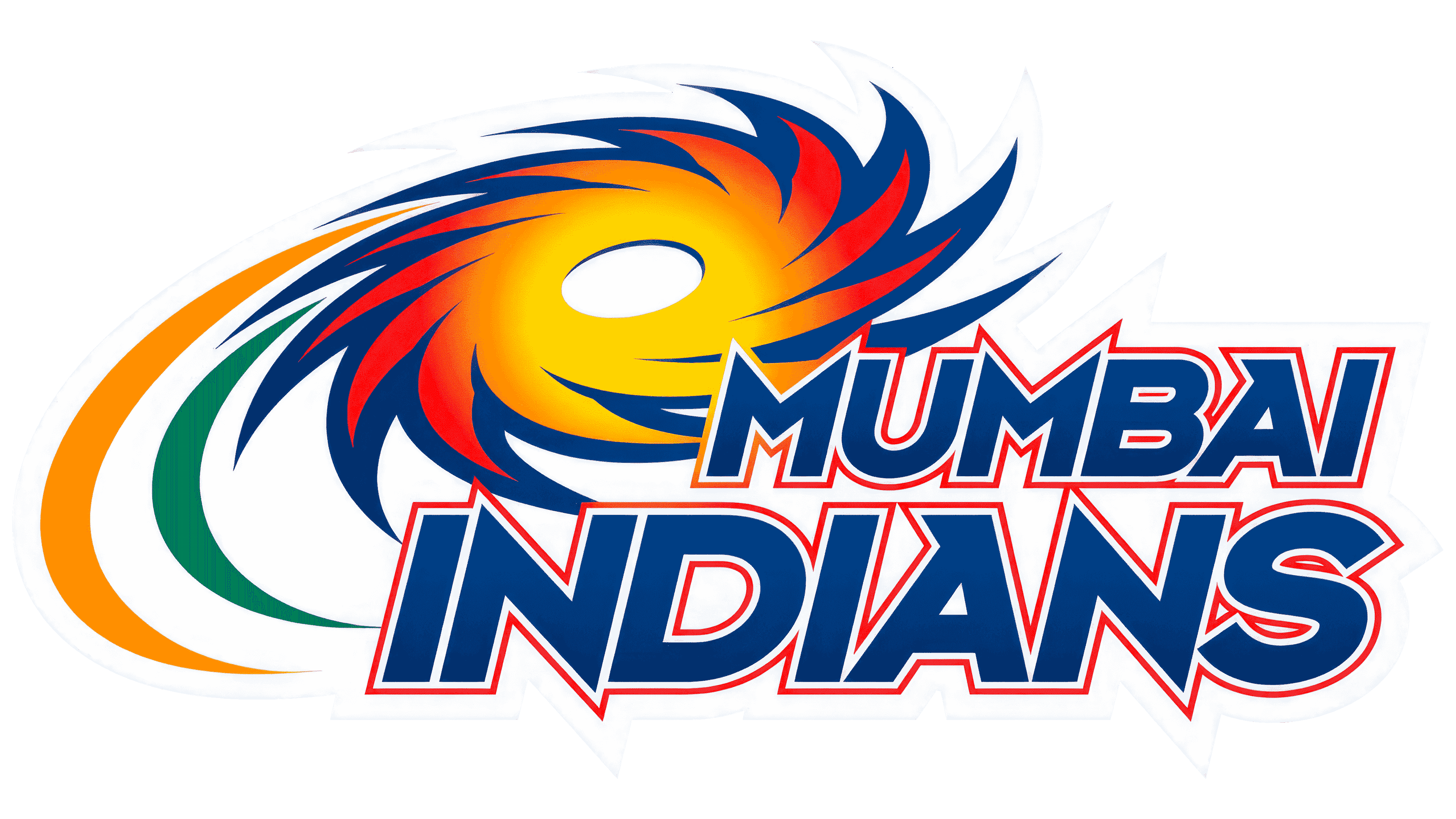
In 2008, the Mumbai Indians unveiled their debut logo, symbolizing their ambitions for the first season of the Indian Premier League (IPL). This emblem was meant to represent the athletes and their unique spirit, energy, and connection to Mumbai’s culture, India’s largest metropolis.
The cricket club’s name is at the bottom of the logo, split into two lines and aligned to the right. The large, bold, and dynamic font conveys strength and confidence, reflecting the players’ determination to win every tournament despite the challenges they faced in the early seasons. The bold letters symbolize resilience, while their slanted shape makes the text visually dynamic. The two lines differ slightly:
– The word “MUMBAI” appears compressed, emphasizing its seriousness and importance.
– “INDIANS” is much larger and takes up more space, signifying the team’s great potential.
The blue text represents the club’s essence, modern spirit, and drive to achieve its goals. A thin red outline around the letters adds contrast and emphasis, while a small white gap between the letters and the vibrant outline gives a sense of lightness. This visually embodies the ease with which the athletes throw and bat the ball to score points.
Some glyphs feature sharp, well-defined angles, adding more energy to the text. They resemble spikes that extend beyond the lettering, most noticeably in the “M” and “N,” whose sharp edges stretch upward and downward, like blades ready to slice through space.
Another intriguing detail is the triangular serifs on both “A” s. They resemble sharpened arrowheads, adding an aggressive accent to the logo. These elements may seem minor, but they symbolize the team’s determination to stay ahead of its opponents.
In the upper-left corner, a swirl appears, fiery-looking because of its yellow, red, and orange gradient. Two arcs, one orange and one green, trail behind it. These are speed lines that create the illusion of movement. The sharp lines and bright colors convey the athletes’ energy, as cricket demands strength, speed, and agility. A dark blue outline tempers the intense emotions, keeping them controlled, as both stamina and precise strategy are crucial in the game.
The swirl has a hollow oval center and eleven pointed tips that curve counterclockwise. Its shape resembles a shuriken, the traditional Japanese weapon. However, the emblem’s meaning runs deeper, rooted in India’s cultural context.
What may appear to be a flying shuriken is a Sudarshana Chakra. This term refers to the fiery disc used by the Hindu god Vishnu to fight evil. The blazing Sudarshana flies, striking down all demons in its path. Similarly, the Mumbai Indians move swiftly forward, consistently defeating their opponents.
2010 – today
The overall appearance of the logo remained the same, but the designers made a few adjustments to give it a cleaner, more modern look. These changes affected both the text and the graphic element.
- The triangular serifs on the two “A”s now point to the right instead of the left. This better aligns with the slant of the letters, making them appear to fly forward. Continuous movement best captures the essence of cricket and other sports.
- The tall, sharp points remain only on the first “M” in “MUMBAI,” while they’ve been trimmed from the other “N” s and “M” s. This doesn’t affect the visual dynamism, as the glyphs have become thinner and more refined.
- The letter “S” underwent the most significant change: it now features distinct horizontal lines connected by curves. This shape conveys sharp turns and hints at the team’s agility, which persists even during intense play.
- The thin red outline along the edge of the text is now broken in several places. This serves as a reminder that not everything is perfect sometimes; effort is required to achieve the desired outcome.
- The text’s blue color now has a gradient, with the top slightly lighter than the bottom. This smooth transition of shades reflects the Mumbai Indians’ progressive nature as the athletes continually refine their skills.
The most significant change, however, is in the graphic symbol resembling a flying shuriken, a stylized Sudarshana Chakra. The designers removed the symbol from the cricket club’s name, creating more open space in the logo. The pointed tips now face right instead of left, making it appear that the disc is spinning clockwise. The four-speed green and orange lines, arranged in pairs on either side of the Sudarshana, also enhance the sense of motion.
2015 – today
In 2015, a logo featuring the Mumbai Indians’ shortened name was created. Unlike the 2010 version, this one is easier to integrate across various branding elements, including merchandise, tickets, and promotional materials. The simplified emblem looks sleek and modern, symbolizing a new era in the cricket team’s history and reflecting its ambitious goals and drive to become one of the top teams in the IPL.
As before, the logo embodies strength, energy, and passion, but these qualities are now expressed through entirely different artistic elements. The abstract image of a spinning vortex is placed at the top. Designers had to scale it down to achieve balanced proportions.
The Sudarshana Chakra still resembles a shuriken with an oval hole in the center and eleven sharp blades. The flame smoothly transitions from bright yellow to red, representing the players’ fire and passion, while blue symbolizes calmness and stability, qualities essential to champions.
The vortex hovers above the large letters “MI,” like a guiding star leading the team to victory. Using the abbreviation “Mumbai Indians” instead of the full name highlights the brand’s strength, signaling that the cricket club is so well known that its initials are enough to identify it.
The “I” blends naturally with the “M” because its top is cut at the right angle. The letters are tightly spaced, separated only by a golden outline. The gold border appears shiny due to a soft, gradient effect. Its texture evokes associations with leadership, prestige, grandeur, and valuable prizes. It reflects the pride in a successful team that has won numerous IPL titles. The blue color of the letters provides a pleasing contrast, giving the inscription a refined and polished look. A gradient is also used here to showcase the cricket club’s modernity.
The logo’s smooth font and clean lines add simplicity and elegance. Although the abbreviation is tilted to the right, it still exudes strength and stability, perfectly capturing the grandeur of the Mumbai Indians. The combination of bright colors and dynamic shapes symbolizes athletic prowess and the pursuit of triumph, as the club is among the most successful in IPL history. Even the Sudarshana Chakra resembles a victorious vortex, which the team carries onto the field as they defeat their opponents.