 Minnesota Valkyrie Logo PNG
The Minnesota Valkyrie logo united players and fans, reflecting the team’s strength and determination. Each game was a test of skill and teamwork, transforming the arena into a stage for thrilling battles, where everything, from the uniforms to the symbolism, emphasized a fighting spirit.
Minnesota Valkyrie was announced by the Lingerie Football League on March 23, 2011, as one of five expansion teams for the 2011-2012 season. Cleveland Crush, Green Bay Chill, Las Vegas Sin, and Toronto Triumph joined in the same wave. On April 4, the name was selected after 28,451 public submissions and refers to Minnesota’s Scandinavian heritage. The fan who proposed it received lifetime season tickets and the right to conduct the opening-day draw. An open tryout followed on April 9 at Vadnais Sports Center, where 35 players advanced to minicamp.
The team played at Target Center, home of the NBA’s Minnesota Timberwolves, with MTV2 carrying the games. Tony Nguyen served as head coach. Minnesota opened on August 26, 2011, by defeating Green Bay Chill 28:25. Losses to Los Angeles Temptation, Chicago Bliss, and Seattle Mist followed, leaving the club at 1-3.
The league suspended all US teams before the 2012-2013 season, citing financial difficulties and player discipline. Competition resumed in spring 2013 under the Legends Football League name, and Minnesota returned with Benson Manento as head coach. The rebrand shifted attention from the former lingerie image toward professional athletic competition.
The comeback lasted less than a year. Minnesota Valkyries folded in December 2013 without an explanation from the league or franchise. Green Bay Chill closed in 2014, and Minnesota was never restored during later league changes, including the 2019 rebrand as X League.
Meaning and History
What is Minnesota Valkyrie?
This women’s football team from the United States competed in the Women’s Football Alliance (WFA). It was founded in Minneapolis and was named after the warrior women from Scandinavian legends. Dressed in purple-and-white uniforms, the athletes took to the field to win and promote women’s football. They organized master classes and training camps and helped young players develop their skills. Their confident playing style and strong team spirit made them a favorite among local fans, while matches at Sea Foam Stadium drew a lively, emotional crowd.
2013 – 2019
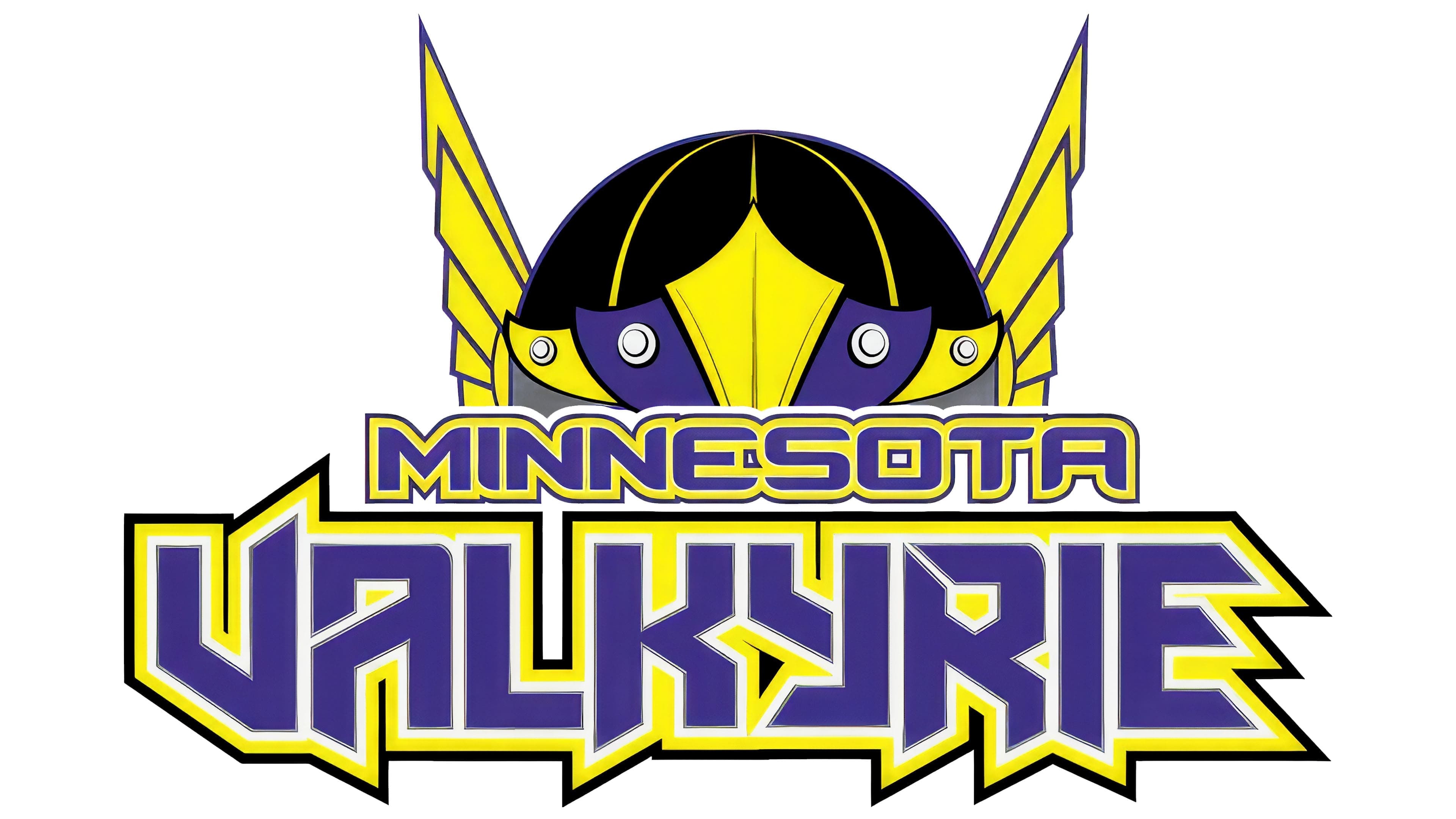
The Minnesota Valkyrie logo combines elements of Norse mythology with late 20th-century American sports design traditions. The designers drew inspiration from the culture of Scandinavian warriors, borrowing the image of a Valkyrie helmet, complemented by side wings and details reminiscent of ancient Viking armor. The helmet is rendered with an emphasis on sharp lines and pointed geometry, reinforced by a protruding upper part resembling a bird’s beak or a sharp crest, lending the emblem a combative expressiveness. The use of metal rivets and silver-purple inserts supports the reference to historical images of Scandinavian warrior women.
Minnesota’s regional identity dictated the logo’s color scheme. The combination of bright yellow and deep purple echoes the colors of the professional football team, the Minnesota Vikings, an NFL member. Yellow highlights the contours of details and provides contrast; purple dominates the typography, reflecting energy, strength, and competitiveness. An additional black hue is used in the outlines of the letters and helmet elements, enhancing the overall emotional tone and adding visual richness to the composition.
The typographic design is divided into two levels. The upper part contains the inscription “MINNESOTA,” executed in a compact geometric font with square-shaped glyphs and moderate angular cuts. A two-color outline of the letters, combining yellow and purple, reinforces the name’s expressiveness against the backdrop of decorative details.
The lower level is occupied by the large and dominant inscription “VALKYRIE.” It uses a massive sans-serif font that is aggressive due to its sharp edges, asymmetrical lines, and pointed ends. The overall look of the font is reminiscent of a futuristic aesthetic commonly found in video games, wrestling, and comic books. An additional depth effect is achieved by a frame created through a sequence of contours. First comes the inner white, then a more pronounced yellow outline, and finally a black outer contour.
The emblem was created to convey the energy and fighting spirit of athletic competition. Despite referencing masculine techniques of sports design from the past century, the design takes into account the specific needs of women’s contact sports. Through emotionally vibrant colors, sharp geometry, and an assertive font, the mark reinforces the team’s image as a formidable opponent, aligning with the mythological meaning of its name.