


 National Lottery Logo PNG
“Fingers crossed for good luck,” the National Lottery logo says. The emblem shows the honesty and transparency of the drawings, as well as concern for players’ well-being and their lives if they win the jackpot.
Meaning and History

The first lottery was tried in 1988 but was canceled before the mass draw. It was closed for legal reasons. A few years later, another one was approved – the French one- under the state license of the government headed by John Major. This event is dated 1993. In 1994, a national lottery was created under a franchise provided to a private operator. The Camelot Group received permission that year in May.
The debut drawing was held on 19.12.1994 as part of a TV show hosted by Noel Edmonds. There were seven winners. Gradually, many prize tiers emerged, offering smaller amounts in additional winnings.
In 2000, the National Lottery undertook a massive rebranding as ticket sales plummeted. The base game was renamed Lotto, and some additional games were removed due to low demand. At the same time, it changed the hand-with-fingers-crossed-for-good-luck emblem. As a result, the owners raised the game’s prestige and made it the most popular gambling event in the UK. Today, it has six logo types.
What is the National Lottery?
The National Lottery is a British brand that encompasses several gambling games, including “UK Millionaire Maker,” “Online Instant Wins,” “EuroMillions,” “Set For Life,” “Thunderball,” “Lotto,” and others. Each game has its own rules and prize amounts. A portion of the funds collected is allocated to charitable projects. The first lottery draw was held in 1994. The Gambling Commission, established in 2007, regulates the games.
1994 – 2002
Saatchi & Saatchi created the first version. The emblem looks like a left palm with two fingers crossed: the middle and forefinger. This sign of good luck is easy for everyone to understand. The nameless and little fingers are bent. They form peculiar eyes beneath a wide smile. Below is the inscription: “The National Lottery.” It appears in two lines of red capital letters, while the palm is blue.
2002 – 2009
After the great reboot, the lottery received enhanced features and an updated logo. The Landor Associates studio created it. The designers retained the previous form in full because it is successful and detail-focused. They added a white touch to the bent fingers, forming not only the outlines of the nails but also stylized eyes with a perky look.
Complemented by a joyful smile, this option looks very attractive. The emblem seems to invite you to the game in a confidential manner, evoking positive emotions in those around you. This is exactly what the lottery organizers were trying to achieve as it began to lose popularity. And the developers slightly stretched the smile, bringing the sharp angle almost to the thumb. They placed the inscription “The National Lottery” in a semicircle to resemble a wide smile. The authors have replaced the strict angular font with a smooth, rounded one.
2009 – 2014

All elements remain the same in this version; only their position has changed. The designers moved the text behind the icon and positioned it on the right. In addition, they returned the hand to its original color, which was in the opening variation. In contrast, they reduced the intensity of the red shade, bringing it closer to pastel.
2014 – 2015
Corrections to the emblem mainly affected the inscription’s arrangement. Now, it occupies not one but three lines at once, each with one word from “The National Lottery.” The letters are enlarged but not changed in style; they remain rounded and smooth, with a soft effect. The developers have intensified the red color to scarlet.
2015 – 2019
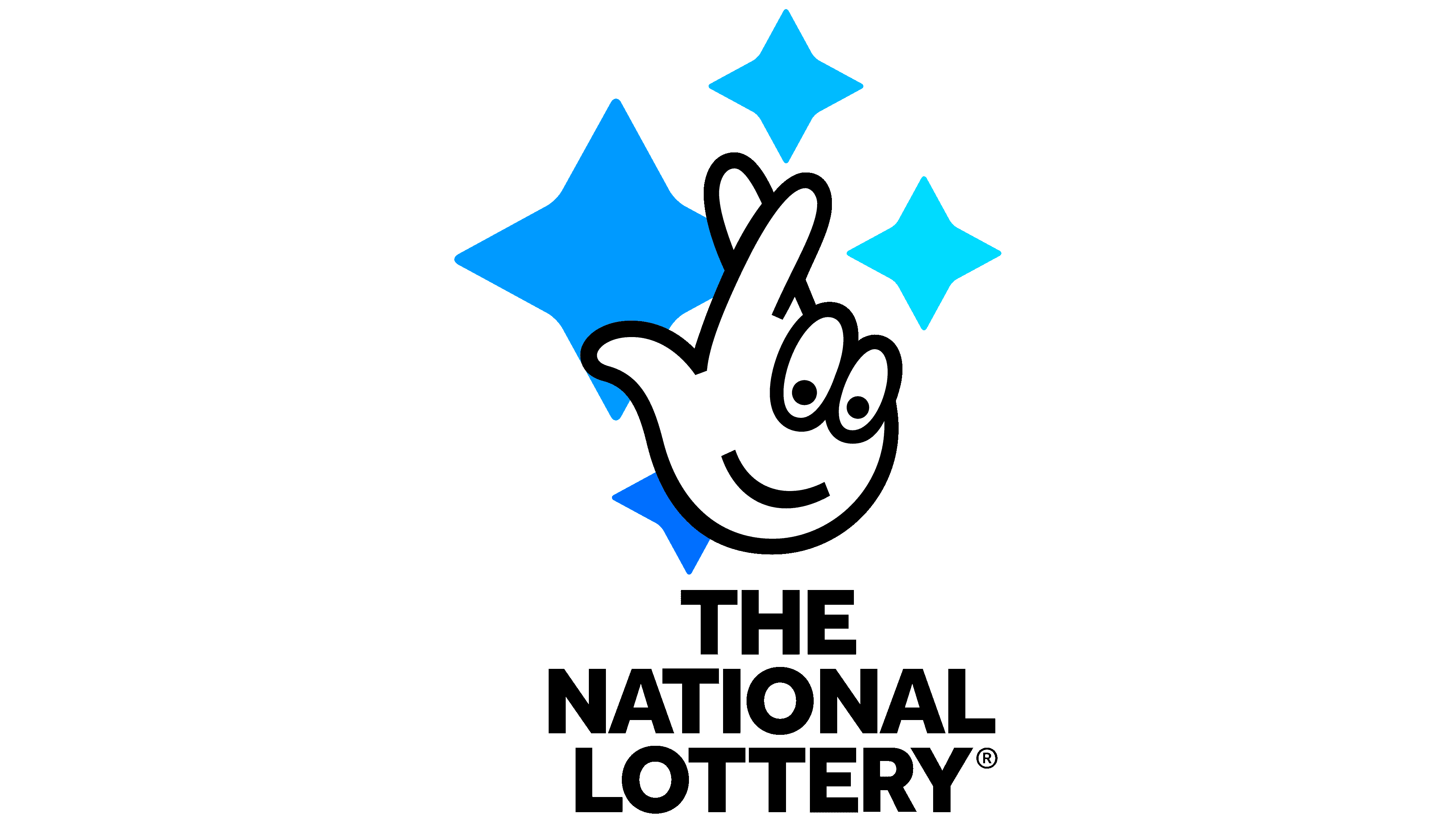
Another reboot came in 2015, when the company adopted a radically different emblem. Its author is Wolff Olins. He removed the solid fill color and left only the outlines, drawn with a medium-thick black line. The designer also replaced the looped lines on the little and middle fingers with large dots. They represent nails and eyes at the same time. Moreover, the crossed fingers have slightly changed in proportion: they are now shorter and more proportionate.
The smile, a thickened arc, is replaced by a slightly bent black line that looks pretty and friendly. Outwardly, it resembles an inverted parenthesis. This version is also interesting because it has a four-star background, with one larger than the others. The stars are multi-colored and dyed blue, mint, and ultramarine. The logo developers shifted the text, writing it in clear block letters of the same size.
2019 – today
Designer Jones Knowles Ritchie made minimal changes to the logo. He replaced the black with dark blue (a cobalt hue), removed the starry background, and rearranged the lettering. Now, it occupies not three but two lines: the top one is “The National,” and the bottom is “Lottery.”
Font and Colors
In general, the logo’s evolution has been systematic. There were no abrupt transitions or radical changes: a palm with crossed fingers perfectly conveys both the emotional mood and the service’s main concept. She says, “Everything depends on your luck; you may be lucky.” The only major change concerns color. In earlier versions, the whole hand was painted; in later versions, only its outline was painted.
One early font closely resembles Kareemah Black. The typeface is minimally adapted and closely matches the one used in the 2009-2015 logos. Another version later appeared, reminiscent of Effra Heavy. Designers Fabio Luiz Haag and Jonas Schudel created this font, and Dalton Maag published it. The closest free analog of this humanistic sans serif typeface is the TABARRA BLACK Font.
The corporate palette mainly consists of red and blue tones. Depending on the year, these colors were scarlet, burgundy, blue, ultramarine, and cobalt. Moreover, the emblem’s designers avoided using multiple shades within a single logo, so it is monochrome. The exception is the 2015-2019 version, which features several blue variations simultaneously. But black balances them well.