


 Nelvana Logo PNG
Designers have created a “Nordic” emblem with cartoon-style elements for the Canadian animation studio. Despite the external cold, the Nelvana logo radiates hope, dreaminess, confidence, resilience, and faith in a brighter future.
Michael Hirsh, Patrick Loubert, and animator Clive Smith founded Nelvana in Toronto in 1971. The studio took its name from Nelvana of the Northern Lights, a Canadian comic-book heroine Adrian Dingle created in the 1940s. Hirsh and Loubert met at York University, while Smith had worked on The Beatles animated series and Yellow Submarine in 1968.
They started in a worn apartment in downtown Toronto, with handmade equipment and almost no money. Early work included low-budget shorts for the Canadian Broadcasting Corporation. A Cosmic Christmas, made for CBC in 1977, became the first major break. After seeing five minutes of it, George Lucas hired Nelvana to create an animated segment for The Star Wars Holiday Special in 1978.
In 1983, Nelvana released Rock & Rule, a feature-length animated film with music by Cheap Trick, Debbie Harry, Iggy Pop, Lou Reed, and Earth, Wind & Fire. The film failed at the box office, and the studio survived by moving into children’s literary adaptations. Babar aired on HBO and became its first international co-production, followed by the acquisition of rights to The Adventures of Tintin, Little Bear, The Magic School Bus, and Rupert. Unlike Hanna-Barbera, Nelvana built much of its reputation through book-based animation. In 1989, Tim Burton directed Beetlejuice, which premiered on ABC.
Nelvana went public in 1994, bought Windlight Studios in 1997, and acquired Kids Can Press in 1998. In September 2000, Corus Entertainment bought the studio for $540 million. Later projects included The Backyardigans, Braceface, Hotel Transylvania, and Max & Ruby. Its production mark, a white polar bear looking at the North Star, has appeared since the mid-1980s.
Meaning and History
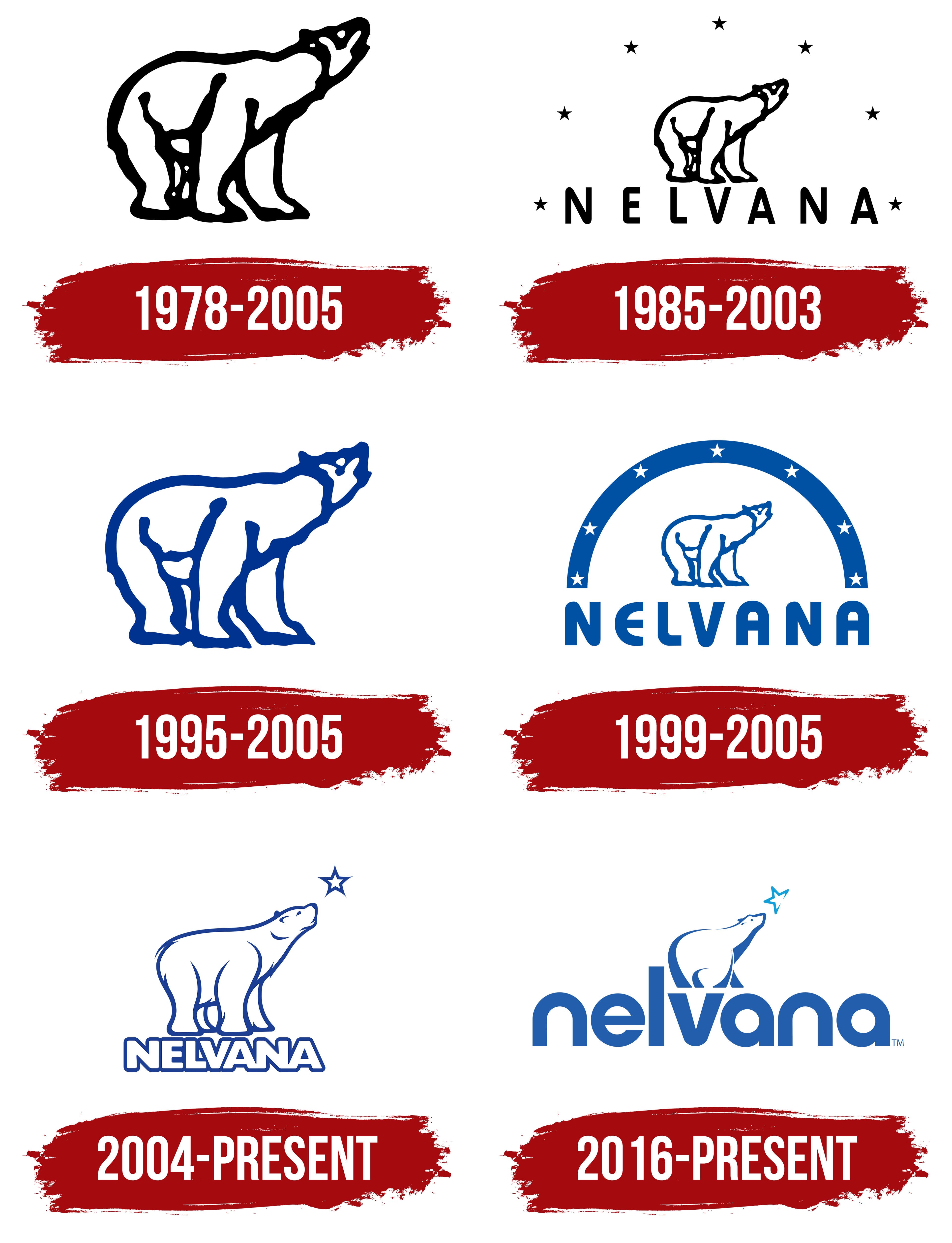
The company redesigned its logo six times during its development. However, the main element, the polar bear looking at the North Star, remained unchanged.
What is Nelvana?
It is one of the largest Canadian animation studios, with over 40 years of experience. In addition to producing animated films, it is also known for distributing animated series, including on cable channels such as Nickelodeon.
1978 – 2005
The first version of the Nelvana logo appeared in 1978. It consisted of a single element, the studio emblem. It showed a bear facing right, its muzzle raised. The image was black-and-white, but the bear looked quite confident and modern.
1985 – 2003
The bear image remained unchanged. At the same time, it was inside an arc consisting of seven black stars. A verbal inscription also appeared for the first time: the word “animal.” A classic sans-serif font was chosen for the name Nelvana. It consisted of large capital letters with thin lines. At the same time, the generous spacing between the symbols makes the logo feel lighter and more open.
1995 – 2005
Another redesign of the logo made only minimal changes to the original. The black outline of the polar bear drawing was replaced with a light blue one.
At the same time, the second version of the updated logo was presented. The bear image also has a blue-and-white color scheme. The emblem is inside a blue arc with seven white stars. The studio name uses the same classic sans-serif font. However, the color has also been changed to blue.
1999 – 2005
The new Nelvana redesign made only small changes to the previous version. Significantly changed the style of writing verbal inscriptions. The studio name became more voluminous and immediately catches the eye. The letterforms are also more rounded. All symbols are closer to the arc and the main image, highlighting how the elements interact. The arch uses a blue gradient to make the Nelvana logo look more modern and confident.
2004 – today
For the first time, the bear’s image was changed. Now, he looks more natural, thanks to attention to detail, such as the wool’s appearance and the high-quality rendering of the muzzle. Of the seven stars, only one remained, and the arch was removed entirely. As a result, the picture looked more realistic and modern. The verbal inscription became more voluminous, with white letters, blue outlines, and a barely noticeable shadow. There was virtually no spacing between characters.
2016 – today
The most recent redesign has significantly changed the logo. Now, the key element is the name “Nelvana,” which is twice as large as the animal image. It seems the bear was kept as a nod to tradition. Moreover, the star has also been simplified. Now it is no longer five-pointed but four-pointed. As for the name, the updates focus on the wordmark’s size and font. It looks more modern and confident, and the rounded corners immediately catch the eye. In addition, lowercase characters are used for the first time rather than uppercase.
Font and Colors
Nelvana used different fonts at different stages of its development, ranging from classic sans-serif to a modern style with three-dimensional letters and rounded corners.
The black-and-white color scheme, which the company used for the first time after the studio’s launch, was replaced with blue and white. The latter seems better suited to Nelvana’s child-focused project profile. A polar bear with blue outlines looks fresh and interesting, and it seems to genuinely appeal to potential customers.