


 New Jersey Devils Logo PNG
Devilish ingenuity, strength, and resilience shape hockey players’ character, and the New Jersey Devils’ emblem conveys devilishly skilled players. The team’s name also played a significant role. As a result, the athletes chose an emblem featuring a devil. Designers put considerable creative effort into stylizing the image of Satan and creatively used the letter “J.”
It’s a rather interesting question why the National Hockey League established a team in Kansas City in 1974. Unfortunately, no one will answer this question, as the NHL’s motives are difficult to understand. Despite its name, Kansas City is located in Missouri on the right bank of the Missouri River. Nevertheless, the city’s western suburbs are in Kansas, whose third-largest city also bears the same name: Kansas City (Kansas). In Kansas, hockey was almost unheard of, while in Missouri, all the “love for the puck” shifted east to St. Louis, home of the hockey team, the “St. Louis Blues.” However, in 1974, the NHL was enticed by the modern “Kemper Arena,” built to host professional basketball and hockey teams in the city. Thus, in 1974, an expansion team called the “Kansas City Scouts” entered the league.
Originally, the new team was called “Kansas City Mohawks.” It meant “Iroquois,” an Indian tribe that inspired James Fenimore Cooper’s fictional “Mohicans.” The Iroquois are the easternmost tribe of the Iroquois Confederation and mostly reside in New York. However, the name was chosen with a specific purpose. The first two letters (MO) are the official abbreviation for the state of Missouri, and the last word (Hawks) evokes the Jayhawkers. These Kansas partisans served in the Union Army during the Civil War. Thus, the name of the Indian tribe was supposed to symbolize the connection between the two states. Unfortunately, they abandoned the idea because the Chicago Black Hawks (at the time, its name was spelled separately) did not want any connection to the name or anyone usurping the Indian theme. After lengthy discussions, the Kansas City team was forced to abandon the “Iroquois” but was allowed to choose another “Indian” name. The owners then held a contest to name the new team. This time, the choice fell on scouts – in honor of the Sioux Indian, whose monument is erected in Penn Valley Park. Indians who served the federal government were indispensable scouts and trackers in the 19th-century American army. The team’s emblem featured an iconic statue of an Indian on horseback.
The Scouts’ colors were blue, red, and yellow, but most city residents didn’t know this, since almost no one attended the team’s games.
The economic downturn in the Midwest significantly affected the “Kansas City Scouts.” Two seasons later, the team found itself mired in 1 million dollars in debt. The club could no longer stay in Kansas City. Because the “Kansas City Scouts” did not want to repeat the fate of their native “Chingachgook” tribe, they moved to Denver. In 1976, the NHL planned another expansion – in Seattle and Denver- but, assessing the economic situation, league officials did not rush the expansion. Nonetheless, in 1976, the “Scouts” moved to the mountains of Colorado.
In Denver, the team adopted a new name: the Colorado Rockies. The club took its name from the Rocky Mountains. The Rockies didn’t even have to change their color scheme, since blue, yellow, and red are the colors of Colorado’s official flag. Moreover, Colorado’s state flag, drawn in the shape of a mountain, became the Colorado Rockies’ new logo.
The team’s situation in Denver did not significantly improve. Their six seasons here are notable for two things. First, the Rockies became the last NHL club to have two sets of pants. Second, the flamboyant Don Cherry was appointed head coach. Fans liked the team and attended home games (although the team made the Stanley Cup playoffs only in the 1977-1978 season). But that didn’t save the Rockies from being sold and moving to New Jersey. Denver was a provincial city at the time, and the club’s finances were terrible. The decision was obvious.
In 1982, John J. McMullen bought the “Colorado Rockies” and announced the team’s relocation to New Jersey. By then, a new sports complex had already been built in East Rutherford, near New York. The club rushed there, once again changing its jersey and name. The team was now called the “Devils.”
The team got its name not in honor of Satan but in honor of the legend of the Jersey Devil – an unknown creature that supposedly lives in the forests of the southern part of the state. The club’s owners held a contest to name the team. Several names were up for a vote, including Coastals, Meadowlarks, Blades, Jaguars, etc., but the choice eventually fell to Devils.
The legend of the Jersey Devil dates back more than 250 years. In 1735, Mrs. Leeds, a farmer’s wife from southern New Jersey, learned she was pregnant for the thirteenth time. This angered her, as she already had twelve children. In her distress, Mrs. Leeds cursed her husband and future child, screaming that the child would be a devil.
The poor woman’s wish came true: she gave birth to a disgusting monster, which immediately ate the entire family and galloped into the forest. The legend of the devil is part of the local folklore. For many years, the southern part of the state was shaken by fantastic rumors about hellish offspring lurking nearby. Settlers, gripped by panic, sat at home in the evenings; children did not go to school. Thousands of people supposedly saw this creature, but no one managed to catch it. The Philadelphia Zoo offered a $1,000,000 reward for catching the monster. A few days later, someone brought in a strange creature that turned out to be a kangaroo with glued-on wings.
Fascinated by this legend, the former “Scouts” and “Rockies” called themselves the “New Jersey Devils.” The team played in North Jersey (near New York), while the Devil lived in South Jersey (near Philadelphia) and did not interfere with the hockey players. Regardless, the club represents the entire state.
The team’s emblem is the letters “N” and “J” (denoting the state’s name), depicted with devil horns at the top of the “J” and a pointed tail at the bottom.
The team’s colors are red and green. The “Devils” began the 1983-1984 season in red-and-green jerseys. The team did not achieve great success.
The “New Jersey Devils” have a curious, humiliating, and offensive nickname: “Mickey Mouse.” Although it’s uncommon, fans, stunned by their favorites’ defeat, can call them Mickey Mouse. This nickname appeared in 1983. In a post-match interview after a 13:4 defeat by the “Edmonton Oilers,” legendary Oilers forward Wayne Gretzky criticized the “Devils.” They said they were “putting on a Mickey Mouse operation on the ice.”
The “New Jersey Devils” became one of the most successful NHL teams under the leadership of Lou Lamoriello, who took over the team in the late 1980s. In 1988, the team reached the Stanley Cup Finals but lost to the Boston Bruins.
Meaning and History
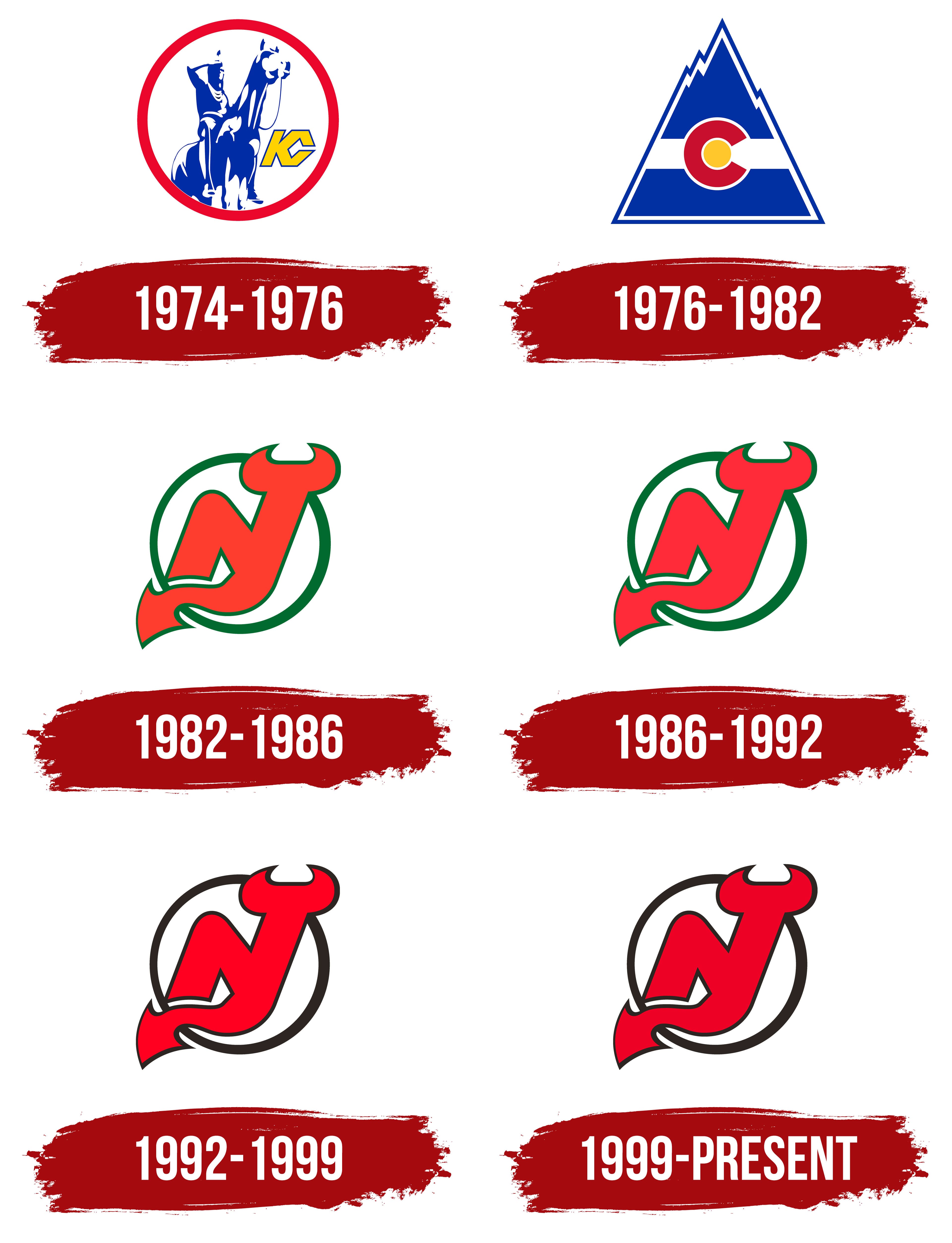
The club’s history is diverse: it started as the Kansas City Scouts, went through a Colorado Rockies stage, and eventually became the New Jersey Devils. Each stage included a rebranding effort, including changes to the logo design. The first two versions are related to previous names, so they symbolize the Scouts from Penn Valley Park and the “Rockies.” The prototype for the modern version appeared much later, before the team moved from Colorado to New Jersey.
What are the New Jersey Devils?
The New Jersey Devils are an American NHL hockey team. They represent the Metropolitan Division and are in the Eastern Conference. They are based in Newark, New Jersey. The franchise was founded in 1974 in Missouri and was initially called the “Kansas City Scouts.” It was then moved to Denver, where it was called the “Colorado Rockies.” The club received its current name in 1982 after relocating to East Rutherford. Its home stadium is Prudential Center.
1974 – 1976
Kansas City became home to a professional hockey team called the Kansas City Scouts. Their first logo was a graphic representation of the scout monument. It was a Sioux Indian sitting on a horse. The logo contained the yellow letters “K.C.” with blue edging and a red circle around the statue.
1976 – 1982
The move from Kansas to Colorado changed the name to Colorado Rockies and the logo. It featured the Colorado state flag, stretched like a mountain. It also featured a red semicircle, reminiscent of the letter “C,” and a yellow dot, reminiscent of a puck inside the letter, in the center.
1982 – 1986
As mentioned earlier, in 1982, the club was bought by a new owner whose wife designed a new logo. Since the new team name was “Devils,” the logo needed to match. She combined the letter “N” with a devil’s tail at the bottom and “J” with the devil’s horns at the top. The monogram was red with a green outline.
1986 – 1992
Subsequent changes to the logo were minor. The graphic quality and colors improved each time, but the drawing remained unchanged from 1983 to 1986.
1992 – 1999

No other changes were made, except changing the outline color to black to make the logo elements look more expressive. The team used this logo for six years.
1999 – today
Her husband, John McMullen, proposed the idea and sketch for the new emblem, which a professional graphic design and advertising studio then refined. The current version is a monogram containing two symbols from the word “New Jersey.” They represent the rest of the team, named “Devils,” as they resemble a devil with horns and a tail. The horns come from the upper serif of the letter “J,” and the pointed tail comes from the extended right leg of “N.” The expressive red figure is set against a white background within an open black ring.
Font and Colors
The New Jersey Devils hockey team has six logo versions. The first two stand apart and are not related to the rest. They reflect the franchise’s then-names. The first one depicted a scout statue in Penn Valley Park, and the second the peaks of the Colorado Rockies. Then came the era of the red “imp,” created by intertwining capital letters: the right leg of the “N” connects to the “J.” Both letters are stylized to resemble the body, horns, and tail of a “devil.”
The logo no longer includes text. Earlier versions used single sans-serif symbols in a chopped font.
The franchise’s official palette has remained almost unchanged: white, red, and black, which in 1993 successfully replaced green. In the earliest versions of the logo, blue was also present.
FAQ
What does the “Devils” logo represent?
The Devil’s Club logo reflects the name directly. It represents a stylized devil, depicted as two combined letters, N and J, with elements that harmoniously convey Satan’s tail and horns against a ringed background. The circle’s center is white, the signs are red, and the contour is black.
Why are the “New Jersey Devils” called “Devils”?
The hockey team is named after the local legend of the Jersey Devil, a mythical creature said to live in the Pine Barrens in southern New Jersey. Over 10,000 people voted for this nickname, which was approved in the summer of 1982.
Who is the mascot of the “New Jersey Devils”?
The mascot of the New Jersey Devils hockey team is a demon nicknamed NJ Devil. This image is taken from the local legend of mysterious creatures that inhabit the state’s Pine Barrens. They have membranous hooves, a tail, a goat’s head, and wings. They walk on two legs, like kangaroos.
Are the “New Jersey Devils” moving?
No, the “Devils” will not be relocating anytime soon. Rumors have been circulating for a long time. The city where the club might move has even been named. It’s Kansas City – the place where the team’s history began. In addition, the Sprint Center has 18,972 seats.